Anna Neville was still a student in Pawel Misztal’s indoor air chemistry class when she began to wonder if her own hair might hold clues about the air she breathes.
Her grandmother had developed dementia after a lifetime in Gary, Indiana, once home to some of the nation’s dirtiest steel plants, and Neville wanted to know whether air pollution might have played a role. “I became really interested in this idea of measuring human exposure, trying to make that connection between being exposed to something and developing a health condition,” she said.
Out of curiosity, Neville snipped off a lock of her hair and fed it into a machine in the lab. Heating the strands released a cloud of molecules that the device — a mass spectrometer, which sorts chemicals by their molecular weights — could analyze in real time. “It is kind of scary doing these types of studies on yourself,” she said.
When Neville examined the results, one spike stood out. The data showed unusually high levels of certain chemicals called phthalates — endocrine-disrupting plasticizers linked to household materials and personal care products. Tracing the timeline back, she realized the surge coincided with a visit to her parents’ house, where renovations had filled the air with construction dust and fumes.
The finding convinced Neville and Misztal, her Ph.D. adviser, that hair could be more than a curiosity — it could be a powerful tool for tracking exposure over time. That small experiment became the seed for a full-scale study, led by Misztal and Neville, showing that hair can capture a chemical record of human exposure across days, weeks, even months. The team’s article was published in September in Chemical Research in Toxicology.
Chemical Roots
Most exposure studies rely on urine or blood, which fluctuate daily and capture only recent exposures. Hair, by contrast, grows slowly and steadily, incorporating compounds into its structure as it forms. Every half inch represents about a month of chemical history. It is also, of course, easier to collect.
Neville, now a fourth-year doctoral researcher, and Misztal, an associate professor in UT’s Maseeh Department of Civil, Architectural and Environmental Engineering, developed a method to tap into that record by pairing thermal desorption — heating samples so they release embedded compounds — with a proton transfer reaction time-of-flight mass spectrometer, a highly sensitive instrument known in Misztal’s lab as the “sniffer.”
Unlike conventional hair analysis, which requires grinding and chemical extraction, the sniffer can scan intact strands for thousands of compounds at once, coupling faster, less laborious sample preparation with highly sensitive detection. “Not many people realize that volatility depends not just on the compound; it also depends on temperature,” Misztal said. “Once you start heating something up, suddenly you see in the gas phase all those molecules that were hidden before.”
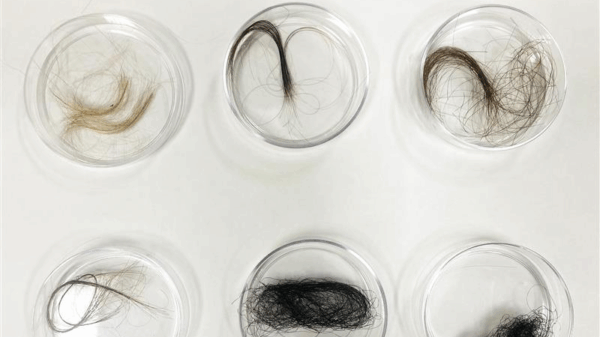
Analyzing small bundles of donated hair, the researchers detected more than 1,000 compounds, including the same phthalates Neville had seen in her first test, along with residues from cigarette smoke. “Phthalates are such a big deal for people studying exposure, so I had my fingers crossed,” Misztal said. “And we did find a lot of phthalates.”
‘Not All Doom and Gloom’
The project was partly jump-started by pilot funding from Whole Communities–Whole Health, a UT grand challenge research program that takes an interdisciplinary approach to how health care data are collected while engaging communities and participants in the research process. “Whole Communities–Whole Health was a great catalyst for some of these studies,” Misztal said, referring to multiple studies on air quality measurement that have resulted in published articles. “They are relatively small grants, but they are sufficient to jump-start some of these pilot studies.”
The broader message of the research is that exposure doesn’t just come from smokestacks or car exhaust. Americans spend about 90% of their time indoors, where pollutants from cooking, furniture cleaning products and even our own bodies often dominate. “When we think air pollution, we think a smelly part of town or a power plant,” Neville said. “But the emphasis our lab is trying to make is how important the indoor environment is.”
Yet even in a world saturated with unseen chemicals, Misztal and Neville stress practicality over panic. Simple habits like vacuuming more frequently and avoiding personal care products that contain phthalates can lower exposures. “Even knowing that before going to bed, just opening the windows for a few minutes and flushing the house with some fresh air, [your] exposure can really be much smaller,” Misztal said.
For her part, Neville acknowledges that given her line of work, it’s hard not to let thoughts of chemical exposure creep in, “but I’m not trying to drive myself into psychosis about it,” she said. “I find it more interesting than anything. And a big part of this field is designing engineering solutions to improve indoor air quality and finding ways to reduce your overall chemical exposure by spending more time breathing fresh air in the great outdoors. It’s not all doom and gloom.”