The two schools farthest apart on the UT campus are the Dell Medical School, at the southeast corner, and the School of Social Work, for the next few years at the northwest. But in terms that matter most, they’ve just become closer than ever.
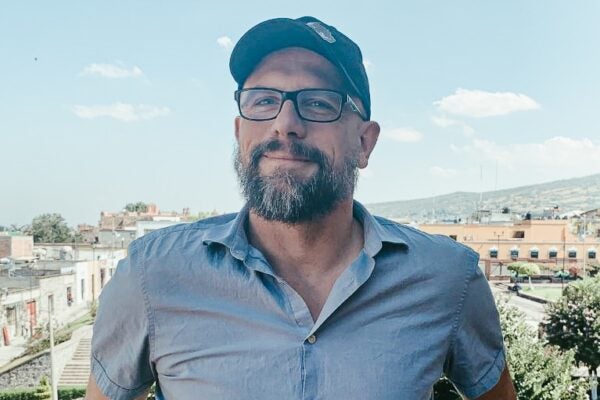
Allan Cole, dean of the School of Social Work, is helping Dell Med build a certificate program, its first, in medical humanities and ethics, which will help medical students both in honing their skills and in what he terms their “professional formation.”
In 2024, Dell Med’s dean, Claudia Lucchinetti, asked Cole to become her deputy for medical humanities and technology, creating an interdisciplinary approach to medical education informed by the arts and humanities. His work also includes a focus on ethical uses of technology, as AI and other new capabilities (of which he is a proponent) call for even greater awareness of their potential for being misappropriated or misused.
Studies have shown that patient outcomes are better when physicians are informed by the arts and humanities. Several years ago, a program at Yale Medical School had students and physicians look for differences in paintings and articulate those. Their diagnostic ability improved by at least 30%. “They learned how to observe differences more closely,” Cole says, “because sometimes a diagnosis is made with only faint differences among options: is it this or is it that? If we train students perceptually with fine arts — in this case paintings — an outcome is that they become better diagnosticians.”

Almost anything within the realm of the humanities is fair game in the program. “They remind us what is most deeply human in us as we’re engaging in really important scientific work that all of us need and/or will need at some point in our lives.”
One innovation that differentiates Dell Med is that it has designated the third year of medical school as the “growth” year, when there’s space to explore outside medicine, be it a dual degree in business, public health or biomedical engineering. The certificate program is for students who don’t want that intense a course of study but are deeply interested in an area that will enhance their preparation. The certificate program will be launched by next fall.
One of Cole’s partners in this work is Jim Korndorffer, Dell Med’s vice dean for education. “While many medical schools including Dell Med have electives or enrichment courses to augment the traditional medical school course,” he says, “few if any create a series of courses in an area of study that has sufficient rigor and content to warrant formal recognition on a transcript.” Being able to leverage the broader University’s strengths in ways that stand-alone medical schools can’t not only sets UT and Dell Med apart from other schools, “but the recognition of the certificate on the transcript sets our graduates apart from other graduates,” he says.
In a sort of warmup or proof-of-concept for the program, Cole and Dell Med’s assistant dean for well-being, Greg Wallingford, have been leading a writing group of more than a dozen Dell Med faculty and clinicians. “There are qualitative gains that we see when doctors write about and talk about their experiences with patients,” Cole says. Many experiences in medicine are hard. “We don’t win every case, if you will. Having outlets that are creative in nature for doctors to tell their stories, to have other people hear them, and to understand these stories more deeply and in a more nuanced way — that makes a material difference in their overall well-being and effectiveness.”
The crux of the matter, Cole says, is found in the difference between illness and disease: “Disease is what happens to us in our bodies physically or mechanistically — chemically or structurally — that leads to us not being well. Illness is akin to disease but different: illness is our subjective experience of having a disease. If I know you care about me as my doctor and that you really are in this work for the right reasons, deeply humanistic ones, I’m better set up for success medically than would otherwise be the case.”
Cole knows only too well the experience of the medical patient, having been diagnosed with young-onset Parkinson’s Disease nine years ago, at age 48. “My experience of Parkinson’s is mine, just like others’ experiences of illnesses are theirs. Physicians who treat illness as intentionally and aggressively as they treat disease — the objective experience as well as the technical case — and who do that in a way that demonstrates a real investment in the personhood of the patient have better outcomes.”
Cole says, “At Dell Med, we treat people before we treat diseases. If we can talk about that with the medical students from the moment we get them in the door to the time they graduate, and even beyond, I believe we will come even closer to our ideal of patient-centered care that is tied to enduring human values and needs and which is distinctive among other ways of doing medical education.”
Dell Med’s guiding concept has been patient-centered care, and Cole says medical humanities is a natural input of that.
A clear example of something the field of social work can offer specifically is how to better have difficult conversations. “How do you break bad news to patients? Trying to humanize medicine starts with trying to humanize medical education more, because that’s the way you change cultures of healing over time.”
The program will include a foundational seminar, a writing group experience, various electives and an integrative capstone. Other courses being planned include “Humanities: Heart and the Art of Medicine”; “Medicine: Close Reading, Expressive Writing”; “Medicinema” (bringing film to bear); “Healers’ Art: The Heart of Medicine”; “Medical Anthropology”; and “Short Fiction and Medicine.” Cole will teach “Persons, Pain and Resilience.”
Cole has also spearheaded a related research project with colleagues in Social Work and Dell Med to study the effects of playing music on Parkinson’s. Cole took up the electric bass nearly three years ago, and playing in a band is now a source of joy and a major part of his life. “I’m an n of 1,” he says in research-speak, referring to sample size, “but I will tell you, something happens in my brain when I play music that’s good. It’s good for me. It makes me feel better emotionally but also physically, and so I want to figure out what’s going on! I don’t think I’m the only one out here like this, so we’re doing a little study.”

Dell Med’s guiding concept has been patient-centered care, and Cole says medical humanities is a natural input of that. “How do we prepare ourselves to be patient-centered? Well, one way is by developing dispositions, ethical commitments, and postures and practices for care. With experience, these help in the development of phronesis, or practical wisdom, that distinguishes the best physicians we have. The deep-seated stuff of humanity, the relational pieces, such as authenticity, compassion, empathy, and care — all those things make for the best doctors and the best medical treatment because they make for the best experiences as human beings.”
Cole thinks of this work broadly as “professional formation” — how doctors carry themselves across their whole careers. “How do we take bright students who come in the door who are very motivated to heal people and to be part of the public good and help them direct those passions, sharpen those skills and develop the capacities not just for knowledge but for action, ways of thinking and doing. Many professions have some version of formation in them. What is at stake in medicine in terms of developing dispositions and ethical frameworks and ways of being in that work that matters?”
Formation ultimately is about values that, when internalized and prioritized as norms, inform habits of practice and ways of being a physician. These qualities engender clarity about the physician’s role as well as public trust. He identifies four parts to formation: 1) professional identity 2) ethical and humanistic commitments 3) interpersonal and communication competencies and 4) well-being and self-regulation practices.
Once up and running, integrating the humanities and professional formation will distinguish Dell Med. “There are other schools doing this work because it adds value to medical education as well as to health care. But we will do it our way, with distinct accents and colors.
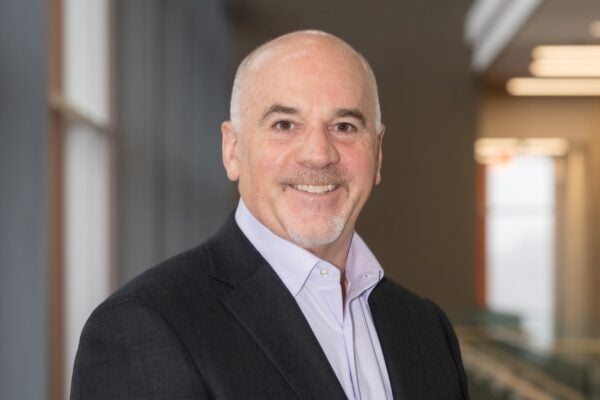
Korndorffer concurs. “The traditional medical education model prioritizes the acquisition of professional knowledge and clinical skills, while the importance of humanistic values and the cultivation of medical ethics is frequently overlooked,” he says. “This program represents a concrete answer to what many see as a challenge in medical education — demonstrating that humanities integration can be structural and comprehensive rather than superficial.” It positions UT and Dell Med as a leader in the movement toward a more holistic model of physician formation that balances technical mastery with human wisdom, he says.
Cole adds, “These are contributions that my school, Social Work, can make to interprofessional education that make a difference. That’s good for social work. It’s good for medicine. It’s good for patients. I spoke to a small group of students a few weeks ago about this work, and two of them got teary-eyed. They said, ‘This is what we need more of in medical school.’”