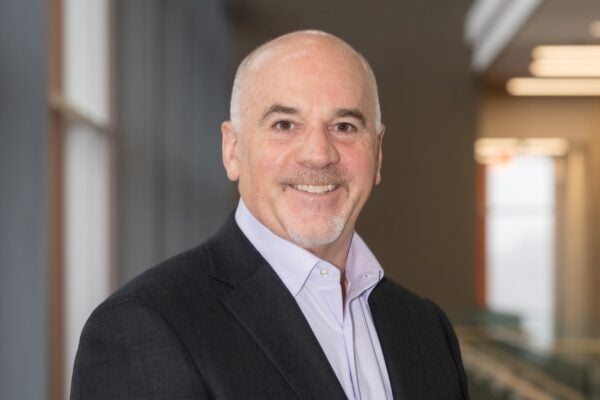
Nearly 500,000 Texans age 65 and over are living with Alzheimer’s disease, the most common cause of dementia in older adults. Texas ranks third in the U.S. for the number of people living with Alzheimer’s and second for the number of Alzheimer’s deaths.
Get to know five researchers at The University of Texas at Austin who are unlocking discoveries about Alzheimer’s and other forms of dementia such as Creutzfeldt-Jakob disease, Lewy body dementia and Parkinson’s disease.
Chandra Muller
Cowden Madden Centennial Professorship and Ashbel Smith Professorship
College of Liberal Arts, Department of Sociology
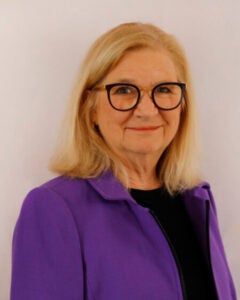
None of Chandra Muller’s close relatives has been diagnosed with dementia. But she has witnessed how tough it has been for several friends to navigate dementia.
“I am often struck by how many people know someone who has or has had dementia,” Muller said. “Dementia touches almost everyone’s lives. In contrast, I also appreciated how important cognitive functioning was to my grandparents as they aged. It was a precious gift.”
With her grandparents in the back of her mind, Muller co-leads two research projects investigating the long-term effects of education on later-in-life cognitive functioning. The projects tap into mounds of data that offer “a rich portrait of the social and biological pathways through which education ‘gets under the skin’ to shape brain health in later life,” she said.
Muller said she wanted to study the connection between education and cognitive functioning in conjunction with her broader interest in how and why education affects people.
“Typically, people think about how education impacts what degrees you earn, what jobs you get, or how much money you make. When I learned that education is the single most important malleable factor determining who develops dementia and when, I was hooked,” she said. “Brain health is fundamental to the quality of your life and the lives of your loved ones. I needed to know how and why education is so important.”
Brain health is fundamental to the quality of your life and the lives of your loved ones.
Jared Benge
Clinical neuropsychologist and associate professor
Dell Medical School, Department of Neurology
UT Health Austin, Comprehensive Memory Center within the Mulva Clinic for the Neurosciences
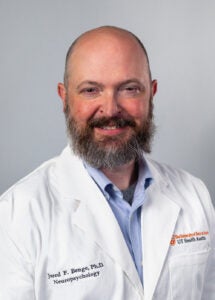
Jared Benge’s research sits at the intersection of technology, cognition and aging.
For instance, Benge co-authored a large-scale meta-analysis published in 2025 by the journal Nature Human Behaviour that examined data from more than 411,000 adults ages 50 and older. The study indicated that older adults who use digital devices — including computers and smartphones — appear to have better cognitive health and lower rates of dementia.
“I’m particularly interested in how we can leverage technologies to both identify cognitive problems but also help to treat real problems in the real world,” Benge said.
Ultimately, Benge aims to help develop technology, such as artificial intelligence, for people with Alzheimer’s and other dementia disorders so they can live as independently as possible. This could include technologies with real-world reminding and real-world monitoring capabilities, so people with dementia and their caregivers can stay connected and feel safe.
His message to both patients and caregivers: “There is hope, and there is hope through action.”
There is hope, and there is hope through action.
Audrey Duarte
Professor and Associate Chair for Academic Affairs
College of Liberal Arts, Department of Psychology

On any given day, you might find Audrey Duarte, a cognitive neuroscientist, and trainees in her Memory and Aging Lab using brain imaging, EEGs (electroencephalograms), wearable technology and sleep-monitoring devices to conduct research on study participants. Most of the lab’s research deals with factors — such as mood, depression and sleep quality — that predict cognitive outcomes, particularly declines in cognitive functions and memory, and the onset of Alzheimer’s.
Duarte said mood (including depression) and sleep quality are intertwined. “Mood symptoms can predict worse sleep. Worse sleep can predict worse mood symptoms. So, it’s a really vicious cycle,” she said.
Part of that vicious cycle is the potential accumulation of brain toxins — an accumulation that’s a “hallmark of Alzheimer’s disease,” Duarte said. Sleep helps flush built-up brain toxins.
Research into how aging affects cognition and brain activity became a passion for Duarte after she performed graduate research at the University of California, Berkeley related to brain-injured stroke patients, many of whom were 65 or older. Today, her lab at UT Austin sees study participants who fall into the 65-and-above age group.
“Everyone in my lab really loves working with the older population. The people who come in [are] really invested in the research. They want to help. They’re really motivated. And they tell interesting stories,” Duarte said. “I like interacting with people who are in this stage of life.”
Everyone in my lab really loves working with the older population. The people who come in [are] really invested in the research. They want to help.
Karen Fingerman
Wilson Regents Professor in Human Ecology, Department of Human Development and Family Sciences in the College of Natural Sciences
Director of Texas Aging and Longevity Consortium
Director of Research for the CAPS Program Development and Pilot Core

While Alzheimer’s disease rightfully captures much of the attention in dementia research, a different form of dementia intrigues Karen Fingerman.
At UT Austin, Fingerman directs an ongoing study of caregivers for older adults with Lewy body dementia, one of the most common causes of dementia. Fingerman’s study, funded by the National Institutes of Health, is the first of its kind to track caregivers for and family members of older people coping with Lewy body dementia throughout the day.
Fingerman said Lewy body dementia is more complicated and can be more demanding than Alzheimer’s, as it exhibits symptoms of Alzheimer’s and Parkinson’s disease, produces hallucinations and causes REM sleep disorders.
Work that Fingerman undertook while pursuing psychology degrees sparked her curiosity about research involving older adults. She entered graduate school to study adolescence. But when a professor whose research focused on aging recruited Fingerman to interview study participants from all age groups, she discovered talking with older adults was more captivating than talking with younger people.
“They were the most interesting people. They’d lived full lives, and their stories reflected that,” she said.
After that experience, Fingerman pivoted toward the field of “successful aging,” seeking to learn why some older people don’t experience declines.
“We are the first generations of human beings who’ve ever gotten to be on this planet expecting to live to old age. And it shapes every decision we make, every experience we have,” said Fingerman.
Explaining that the study of aging is a new “phenomenon,” she added: “What could be more interesting than that?”
We are the first generations of human beings who’ve ever gotten to be on this planet expecting to live to old age. And it shapes every decision we make, every experience we have.
Laura Colgin
Professor, College of Natural Sciences, Department of Neuroscience
Director, Center for Learning and Memory
Karl Folkers Chair in Interdisciplinary Biomedical Research
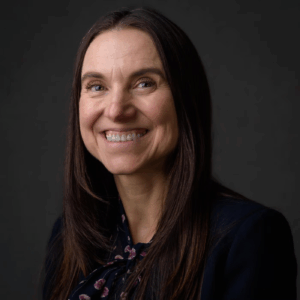
In Laura Colgin’s lab at The University of Texas at Austin, she and other researchers are relying on rats to help unlock mysteries of the brain.
Broadly, Colgin and her colleagues are trying to figure out how groups of the brain’s neurons store, retrieve and consolidate memories. About 86 billion neurons form 100 trillion connections to one another in the human brain. Neurons are nerve cells that send messages throughout the body, enabling us to carry out activities such as breathing, eating, talking, thinking and walking.
More narrowly, researchers at Colgin’s lab are using a rat model of a major genetic risk factor for late-onset Alzheimer’s disease to study neurobiological impairment that underlies the loss of memory function in people with Alzheimer’s. These genetically modified lab rats carry the human APOE4 gene. About one-fourth of people carry a copy of APOE4, although someone with this gene won’t necessarily develop Alzheimer’s.
“Thus far, we have preliminary data suggesting that [the lab’s] rats fail to remember environments that they have encountered many times previously and develop Alzheimer’s-related pathology as they age,” Colgin said.
How did Colgin wind up exploring the science behind learning and memory?
“I have always been fascinated by the idea that our own intentions and efforts can change the structure and function of our brain,” she said, “and can influence our patterns of future behavior.”
I have always been fascinated by the idea that our own intentions and efforts can change the structure and function of our brain and can influence our patterns of future behavior.