AUSTIN, Texas — The University of Texas at Austin is ranked No. 1 among U.S. universities for conducting the most research supported by the National Science Foundation (NSF). UT also ranked No. 5 in the nation in research financed by the Department of Defense (DOD) and No. 6 for Department of Energy (DOE) research.
The new rankings, which reflect UT Austin’s leadership position among the world’s most productive and impactful research universities, are based on the newly released Higher Education Research and Development (HERD) Survey for fiscal year 2024. UT conducted $176.4 million in research funded by the NSF in 2024.
NSF, DOD and DOE funding supports UT’s science and engineering discoveries that improve and save lives, strengthen national security, and fuel economic prosperity and competitiveness.
“It is a privilege to have the long-held trust of the federal government, built and sustained over several decades, and the opportunity to contribute to America’s dominance in energy, science and national security,” said UT President Jim Davis. “These rankings reflect the extraordinary work of our faculty and graduate students across AI, semiconductors and many other disciplines that are advancing society and changing lives for the better.”
The HERD survey, administered by the NSF’s National Center for Science and Engineering Statistics, is considered the gold standard benchmarking tool for comparing research expenditure activity among academic institutions nationwide.
UT has consistently maintained top 10 rankings for NSF, DOD and DOE funding during the past five years and last ranked No. 1 in NSF expenditures in FY20. More than 75% of externally funded research conducted at UT is financed by federal agencies.
Examples of how federal investment is driving breakthroughs and discoveries include:
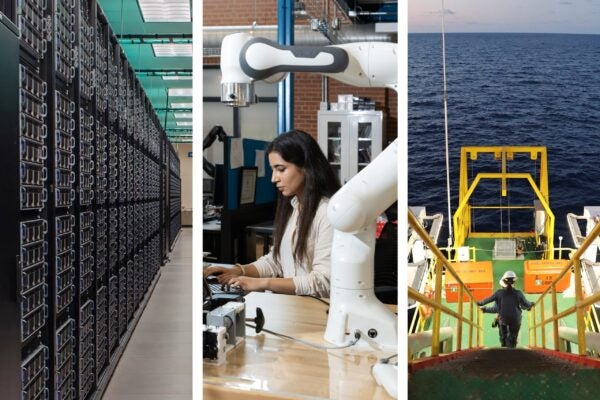
- Leadership in computing and artificial intelligence: Thanks to NSF funding, the Texas Advanced Computing Center is constructing a facility that will house Horizon, the largest and most powerful academic supercomputer in the nation. From AI to personalized health care to weather forecasts, Horizon will open the door to more society-changing discoveries that support America’s technological dominance.
- Advancing AI reliability: The AI Institute for Foundations of Machine Learning, funded by NSF and housed in the College of Natural Sciences, underpins the next generation of artificial intelligence and will improve the accuracy and reliability of AI models and lead to new drug development and improvements in clinical diagnoses.
- Materials innovation: With NSF funding, the Center for Dynamics and Control of Materials is accelerating materials science research to develop a new class of materials that will enable next-generation technologies in areas such as sustainable energy, quantum information processing, bioinspired systems, and semiconductors for telecommunications, computing and sensing.
- Defense and robotics: In collaboration with the U.S. Army and with funding from the Department of Defense, Texas Robotics researchers are developing new capabilities for autonomous navigation that could make search-and-rescue missions, mine-clearing operations and firefighting safer for humans. This partnership has created a new model for rapidly translating UT’s robotics and AI research into early-stage Army prototype software and vehicles.
- Energy exploration and storage: The Department of Energy funded research at the Jackson School of Geosciences to collect core samples of methane hydrate beneath the seafloor to help figure out whether it could one day be used as an energy source.
Beyond federal funding, UT’s overall research enterprise continues to grow. Other highlights from the HERD survey include:
- Total research expenditures for FY24 were an all-time high of $1.14 billion. UT’s total research expenditure increased to $1.37 billion in FY25.
- UT Austin had more federal research expenditures (nearly $700 million) than any other Texas institution.
- UT ranked No. 16 among all U.S. universities for research financed by industry partners. These companies invested $94 million in research conducted at UT.
To learn more about the many ways TEXAS Research is improving lives and communities across Texas and around the world, visit the Year of Impact website.