A half-dozen Longhorns have been inducted into the National Academy of Engineering, one of the highest honors in the field.
This group comprises four faculty members and alumni from the Cockrell School of Engineering and a pair from the College of Natural Sciences. UT faculty members John-Paul Clarke and Kenneth L. McMillan and alumni Farnam Jahanian, Nirmala “Nimmi” Ramanujam, Karen Thole and Mark Waggoner are UT’s representatives in the class of 2026.
They have made important contributions to a variety of fields, illustrating the depth of expertise at The University of Texas at Austin. They’ve transformed how we fly, ensured access to the internet, reinforced technological reliability, increased availability of health care options around the world, improved efficiency in our power systems, and delivered the venues where we watch our favorite athletes and artists.
“These scientists and engineers have made tremendous impacts in their field, and we’re so happy to see their work recognized with selection to the National Academy of Engineering,” said Fernanda Leite, UT’s interim vice president for research. “These Longhorns are emblematic of our mission to change the world and make lives better.”
This year, NAE elected a total of 130 new members and 28 international members. Election to the academy is among the highest professional distinctions bestowed upon an engineer. Membership honors those who have made outstanding contributions to engineering research and practice, including pioneering new and developing fields of technology and making significant advancements in the engineering field and profession.
Learn more about the newest Longhorn NAE members below and their contributions to their field.
John-Paul Clarke — Aviation pioneer
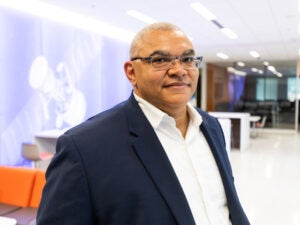
Every flight from the East Coast to Los Angeles in recent years, as well as many other destinations around the world, has been shaped by John-Paul Clarke.
The professor in the Cockrell School of Engineering’s Department of Aerospace Engineering and Engineering Mechanics is an internationally recognized expert in aerospace engineering, controls and optimization. He is known for developing commercial aircraft landing procedures first tested at LAX and now in use at 50 major airports worldwide.
Continuous descent arrival involves aircraft effectively “gliding” from cruise through descent and approach to landing, rather than the traditional “step-down” approach, which allows the engine to remain idle during descent. This has many advantages, including minimizing fuel use, reducing gaseous emissions and noise pollution, and saving the aircraft from additional wear and tear.
In addition to Clarke’s achievements in aviation, he competed as a hammer thrower and now is a track and field official, serving on the World Athletics International Technical Officials panel for North America, Central America and the Caribbean.
Farnam Jahanian — Internet stability leader
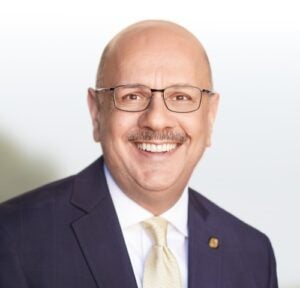
Unreliable and insecure internet can range from a minor annoyance to a catastrophic failure, depending on its use. The work of Farnam Jahanian (M.S. computer science 1987 and Ph.D. 1989) helped improve global internet stability and security.
Jahanian’s research in distributed computing, network security, and protocols significantly influenced how modern networks defend against cyberthreats, contributing foundational insights now adopted across academia and industry.
Jahanian is currently the president of Carnegie Mellon University. He has served in that post since 2018, and during that time Carnegie Mellon has expanded its research enterprise and interdisciplinary programs, securing record funding and strengthening global partnerships in technology and innovation.
Before his presidency at Carnegie Mellon, Jahanian led the National Science Foundation’s Directorate for Computer and Information Science and Engineering, guiding major U.S. research initiatives, and he co-founded Arbor Networks — a company that commercialized scalable network security technologies used worldwide.
Kenneth L. McMillan — Model verifier

No matter what you’re doing, it’s always a good idea to check your work. No one knows that better than Kenneth L. McMillan.
McMillan, professor in the College of Natural Sciences’ Department of Computer Science, is known for his work on symbolic model checking, which enabled automatic verification of hardware and software systems with extremely large state spaces. His innovations laid the foundation for tools such as the Symbolic Model Verifier (SMV), which have become essential for ensuring correctness in complex engineering systems.
McMillan’s research also advanced techniques such as Craig interpolation and constraint solving in verification, influencing modern verification tools across industries and research. McMillan’s foundational work now supports both hardware verification and emerging research in explainable artificial intelligence, connecting logic with machine learning.
Before joining the UT faculty in 2021, McMillan worked in a wide range of industry settings, including at AT&T Bell Labs, Cadence Research Labs, Microsoft Research and Amazon Web Services.
Nirmala “Nimmi” Ramanujam — Women’s health inventor
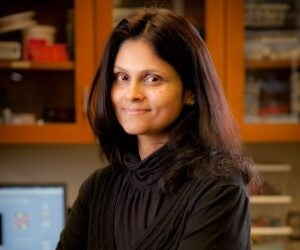
Women’s health wouldn’t be where it is today without Nirmala “Nimmi” Ramanujam (B.S. biomedical engineering 1989, M.S. 1992 and Ph.D. 1995) and her entrepreneurial research.
As a professor of biomedical engineering at Duke University, she’s developed several tools to advance cancer detection around the world, mainly the pocket colposcope — a low-cost, portable imaging device that improves access to cervical cancer screening. Cervical cancer is the fourth most common type of cancer in women around the world, and the device reduces the cost of testing for cervical cancer to one-tenth that of a traditional colposcope.
She founded a startup called Calla Health to commercialize the pocket colposcope. She also founded the Center for Global Women’s Health Technologies to further her research, which includes imaging and treatments for breast cancer and single-shot injections that target cancerous cells.
Growing up in Malaysia, Ramanujam was a talented veena player, performing in concerts and on the radio. Her early musical training has long influenced her approach to engineering.
Karen A. Thole — Turbine cooling expert
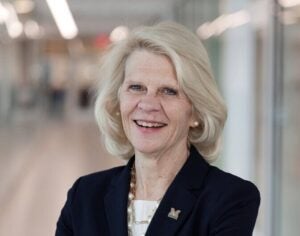
Karen Thole is pretty cool, and we’re not just talking about her research. Thole (Ph.D mechanical engineering 1992) has cooled off our power grid and aviation industry through her work in heat transfer and turbine component designs.
Thole’s work has been applied to the ground power turbines that produce 40% of the world’s electricity. She researched and created several key cooling technologies that have been patented and are flying today.
To evaluate these technologies, Thole built engine-relevant turbine test facilities, such as the Steady Thermal Aero Research Turbine (START) Lab at Penn State University, that have become national testing assets. In addition to building the facility, Thole led a joint team of four gas turbine manufacturers and the federal government to design, manufacture and test a national experimental turbine.
Thole is currently the dean of the University of Michigan’s College of Engineering, but she still occasionally wears burnt orange.
Mark C. Waggoner — Stadium designer

If you’ve been to a race, soccer game or big concert in Austin recently, you’ve enjoyed Mark C. Waggoner’s work. Waggoner (M.S. structural engineering 1997) is an expert in long-span roofs and lightweight systems for major facilities and sports stadiums around the world.
As a principal in the research and development group at Walter P Moore in Austin, Waggoner led the structural design of major local projects, including the Circuit of the Americas, Q2 Stadium and Moody Center. And he has contributed to the design of more than a dozen long-span roofs for professional sports facilities in the U.S. and around the world, including SoFi Stadium, State Farm Stadium and the Montreal Olympic Stadium roof replacement.
Since 2000, eight Super Bowls have been played in stadiums Waggoner designed. That number will rise to nine in 2027, when the big game is played at SoFi Stadium in California.