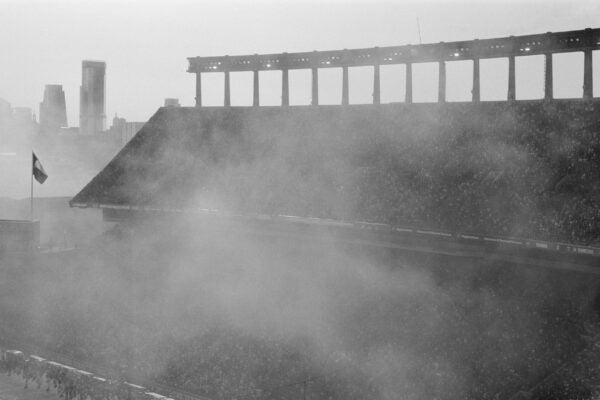
On any sunny day, Darrell K Royal-Texas Memorial Stadium (DKR) casts a large shadow over the buildings nearby — including that of the Visual Arts Center (VAC). Many who frequent football games might not know about the art building nearby. And many who stand inside the glass lookout of the contemporary art gallery may have never stepped foot inside the stadium. For artist Francesca Lally, the two worlds aren’t that different.
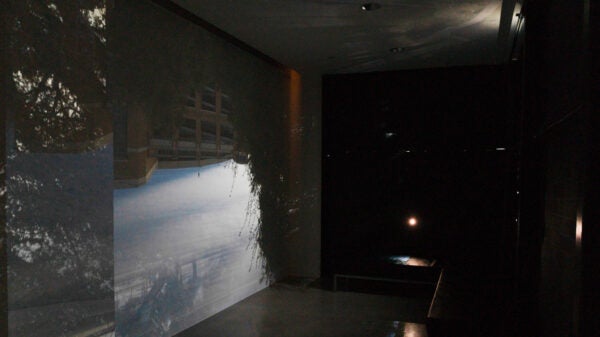
In her new exhibition, “Half Time,” on display Jan. 23 through March 21 at the VAC, the St. Elmo Artist Residency Fellow takes on the intersection of art and football through speculative histories, present-day stories, and the imagined futures of Texas’ landscapes and built environments. With work across mediums, the show features found photo and lenticular collages, videos and photos of football games at DKR, prints and paintings, and a large-scale camera obscura that projects the stadium (via a tiny pinhole) into the gallery.
Originally from New York, Lally received an MFA from the Tyler School of Art and Architecture, where during her studies, she spent her first year in residence overseas at Temple University Rome. Part of her commute to school in Rome was to bike around the Colosseum. When Lally moved to Texas in August to begin her St. Elmo Arts Residency, a program housed in the Department of Art and Art History, her commute felt strikingly similar.
Despite a 2,000-year difference in age between the Colosseum and DKR, what struck Lally was the idea that these two places, across time, serve a similar purpose –– a place for spectatorship.
“Even though modern cities have very little in common with ancient architecture and ancient flows of cities, this is a way in which the architecture has actually not changed that much because the function of the building is still fundamentally the same,” said Lally.
Other than the intended purpose, stadiums also tell stories about the people and places they represent. This is where Lally’s ideas of imagined futures come into play. If the Colosseum seemingly tells us about ancient Romans –– that they loved watching gladiators fight because they derived entertainment from violence –– what will the highly preserved football stadiums in the future tell people about our society of today?
One thing it undoubtedly says: In Texas, football is singular. Across the state, everyone has a connection to the game. Even if someone didn’t play football, they know someone else who did. Football and Texas are intrinsically connected in a multitude of ways and points of view. Lally remembers flying to Texas for the first time and looking out the airplane window to see a bird’s-eye view of stadium after stadium, some in towns that didn’t have much else to be seen from above.
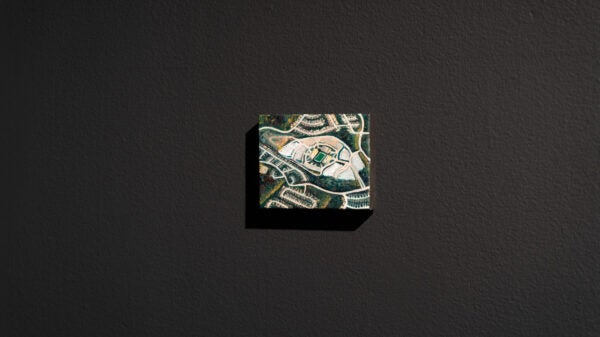
Her observations on football are spread across mediums throughout the exhibition, from small paintings of stadiums from above, to found photo collages that confuse the past and present, and video work capturing the atmosphere of a football game on Super 8. The largest work in the show is a projected video of Lally unraveling a ball of blue yarn as she walks around the stadium to see just how big it is.
DKR isn’t just big in the world of college football; it’s the seventh-largest stadium in the U.S. and the ninth-largest in the world, with a seating capacity of over 100,000. Throughout last fall, Lally found herself as one of the many, observing and documenting all the ways that people unite around the shared experiences of college football.
“Sports are not only something that connect people in the present, but literally something people have been doing in every society for all of human history,” said Lally.
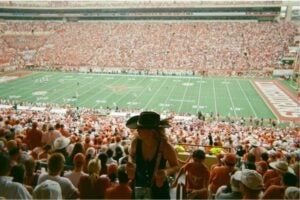
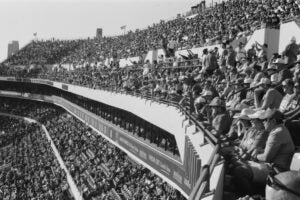
Although the show is about football, it’s also about spectatorship and the act of looking. In both art and football, people are active participants. Lally wanted this notion to translate to the work in the show as well, printing highly detailed images incredibly small, forcing the viewer to physically zoom in and out to see the photo’s content and installing a camera obscura that projects the stadium into the art gallery, only visible once viewers’ eyes adjust to the dark.
“I think that the show is really about ways of looking and points of view,” said Maysa Martins, the VAC’s 2024-26 Curatorial Fellow and the exhibition’s curator. “A lot of the works are about individual relationships with football and the community relationships, but there is also a larger scale of time and history. And I think all the works are doing that all the time. They’re zooming in and zooming out.”
Lally is particularly interested in exploring the similarities and differences between art and football across time and place. For her, both serve similar functions in society, providing participants spaces to experience extreme emotions, whether that be the joyous screams of a game win or the power of connecting with a work of art.
On Super Bowl Sunday, Lally hosted a “Big Game Watch Party” event at the VAC, where attendees gathered to create collages about what the future of Texas looks like while the game played on the big screen behind them. She also collected stories of participants’ relationship to football through an oral histories project.
If it seems a bit funny to host a Super Bowl watch party in an art museum, that’s the whole point. Lally uses humor throughout the exhibition, whether it’s in highlighting the proximity of the art building and DKR and their size difference, or collaging ancient Roman images with modern football player portraits. For her, that contrast sets viewers up to examine what art and football share and how the two can connect us across interests.
“Both football and art allow people to live out fantasies, have communal experiences, and tap into something that is super ancient and fundamental to humanity,” said Lally. “Similar to sports, I want to make work that brings people in and brings people together.”
Whether viewers feel they know more about football or art, “Half Time” meets them where they are, encouraging them to further examine their relationship to both. The exhibition is on view at the VAC until March 21. The VAC is open Tuesday through Saturday from noon to 5 p.m. and is always free.
Explore Latest Articles