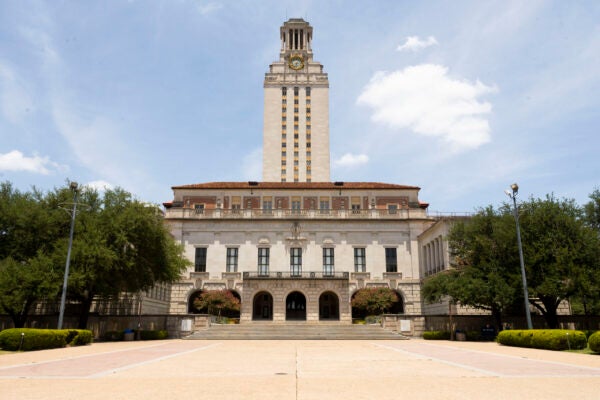
At the end of this month, the Tower will celebrate its 89th birthday amid a restoration project to revitalize the landmark for decades to come. But the materials that make up the Tower and Main Building — varieties of limestone and granite — have been part of Texas history for millions of years.
In the early 1950s, William Battle, a classics professor and chair of the Faculty Building Committee, wrote a detailed description of the Tower and Main Building, which he played a large part in creating. In it, he wrote about beginning the trek into the building from the outer steps:
“Herein will the thoughtful minded see a good illustration of how one age climbs upward over the life of another.”
To truly understand the history of the Tower’s materials, we must start at the beginning of their formation, which coincidentally begins as you take your first step upward.
Walking up the steps leading to the Tower, you might recognize the pink hue of the granite from the Capitol just behind you. This type is Oatman Creek granite, often called pearl gray granite. Geologists estimate this granite — the oldest stone on campus — was formed more than a billion years ago in what is modern-day Llano, Mason and Burnet counties.

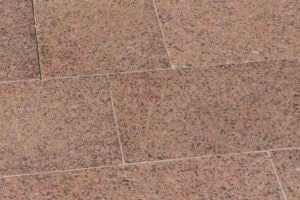
A product of the Precambrian Eon — the earliest period in Earth’s history, which saw the development of the first continents — the pearl gray granite that makes up the steps is fine-grained and composed of densely packed clear quartz and white/pink feldspar. Granite polishes well and is durable enough for everyday use, a big reason we see so much around Texas.
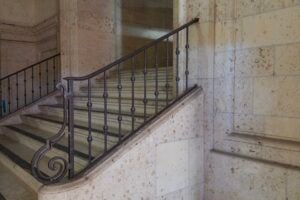
Once up the steps and into the outer corridor, if you look down at your feet, you’ll most likely be standing on a section of Cordova shell limestone, a textured limestone born of the Early Cretaceous Epoch between 100 million and 145 million years ago. Unlike some of the limestone around the outside steps, this stone isn’t smooth. It’s full of visible fossils, most of which are a type of clam called rudists, which were important reef-builders during the Cretaceous.
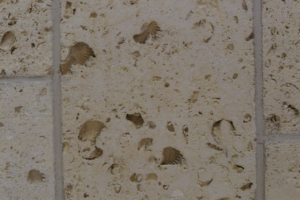
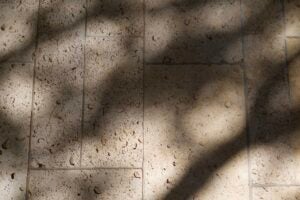
When rudists arrived during the Late Jurassic period (yes, like the dinosaurs), they looked like the clams we’re used to seeing today, relatively symmetrical on the top and bottom. By the end of the Late Cretaceous Epoch, the clam’s valves began taking on a variety of shapes. Around 66 million years ago, the clams evolved to an extreme –– some became the size of garbage cans –– and when the meteor that took out the dinosaurs hit, the rudists went with them. Scientists still don’t know exactly why.
And now they decorate the steps people walk on every day.
Despite existing so long ago, the Cordova limestones on the Tower’s front porch were always nearby, originating near Leander. At the time the limestone formed, almost all of Texas was an epicontinental sea, a shallow body of water atop a continent. Dinosaurs walked the Earth, flowering plants began to appear for the first time, and the sea levels were the highest they’ve ever been, with only about 18% of the Earth’s surface covered by land compared with 28% today.
In the shallow sea that’s now Texas, the limestone began to form in less than 10 feet of water. If the Edwards Aquifer and Edwards Plateau sound familiar, then you’re already acquainted with the limestone’s formation area. Although we mostly hear about Edwards around Austin, it extends west for hundreds of miles.
“From Austin west to Fort Stockton, that’s all basically Edwards limestone or its stratigraphic equivalent,” said Charles Kerans, professor emeritus at the Jackson School of Geosciences.
And although the Edwards Formation is specific to Texas, comparable conditions across the world during this period led to similar rock foundations forming in parts of Britain, North Africa and the Middle East.
As far as geologic timelines go, limestones grow up fast.
“That’s the cool thing about limestones in particular — they can turn into rock within 5,000 years,” said Kerans. “Geologically, there’s at least 5 million years of Earth history recorded in the Edwards [Formation], but those sediments turning into rocks, that’s happening in a few thousand years.”
Cordova shell isn’t the only limestone from Texas you’ll see around the Tower. There’s also its less-fossilized counterpart –– Cordova cream limestone. As the name suggests, this limestone is, well, creamier than the shell. It doesn’t feature any prominent rudists and instead is used as an accent to complement other stones on the steps and sides of the building.
Tons of other materials compose other parts of the Tower, most of which aren’t from Texas originally. There’s Bedford limestone from Indiana, Crab Orchard sandstone and dark cedar limestone from Tennessee, and slabs of pink Lepanto from New York in the Life Science Library.
One other part of the Tower is historically Texan, a section we can’t see but sits at the heart of the building. Before the Tower and the current Main Building, there was Old Main, which was completed in 1899 before being razed in 1934 to make way for the new one.
Old Main was built in the Victorian Gothic style entirely of light-colored bricks. Until 1912, almost all bricks used in Austin were made by Michael Butler, whose brickyard was set up along the Colorado River, with its primary clay field situated at present-day Butler Pitch & Putt. The bricks of Old Main were some of the 11 million a year produced by Butler, whose clay-testing technique to see whether it would create a good brick involved tasting samples of mud directly from the riverbank.
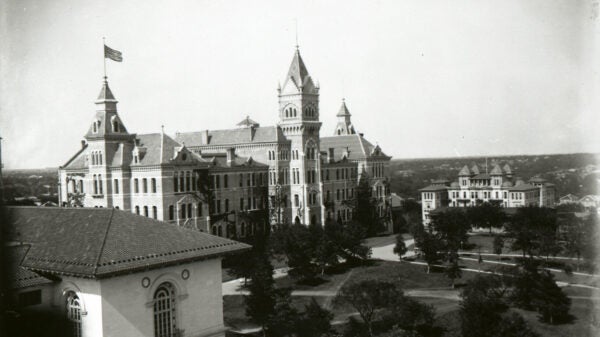
Although it was torn down in 1934 as construction began on the current Main Building, a stash of Butler bricks was kept safe and now make up the inner walls and air shafts of the Tower.
Across millions of years, sea and dry land, the materials that came together to make the Tower are part of Texas history. Whether during the time of the dinosaurs or less than 200 years ago on the banks of the Colorado River, the legacy of the Tower is intertwined with the natural and geological history all around it. Materials that have existed for millions of years are now in the process of being restored, ensuring their future for the (hopefully) next million.
Explore Latest Articles
Mar 31, 2026
UT Geodynamicist Thorsten Becker Elected to German Academy of Sciences

Mar 27, 2026
Charles Taylor Named Member of the Bavarian Academy of Sciences and Humanities