We’re about to mark a birthday on the campus of The University of Texas at Austin. But determining when the 89-year-old Main Building and Tower “opened” is not as straightforward as you might think. Parts of it, namely the lower floors of the north half, originally called the Library Annex, were occupied in 1934. At the other end of the range, the University did not accept ownership of every part of the building until at least late May 1937, when most newspapers nationwide began proclaiming that UT’s remarkable new $3 million “skyscraper” was finished.
And so, we take the date of the dedication ceremony, Feb. 27, 1937, as the official “birthday” of the Main Building and Tower. (This is not to be confused with the University’s birthday, Sept. 15, 1883.)
It was a mild Saturday (highs in the 70s), and the activities started at 9 a.m., when the Board of Regents inspected the contents of the lead record box that had been sealed up in the cornerstone of the original Main Building. The regents had peeked at it three years earlier when the box had been removed to prepare for the razing of Old Main.
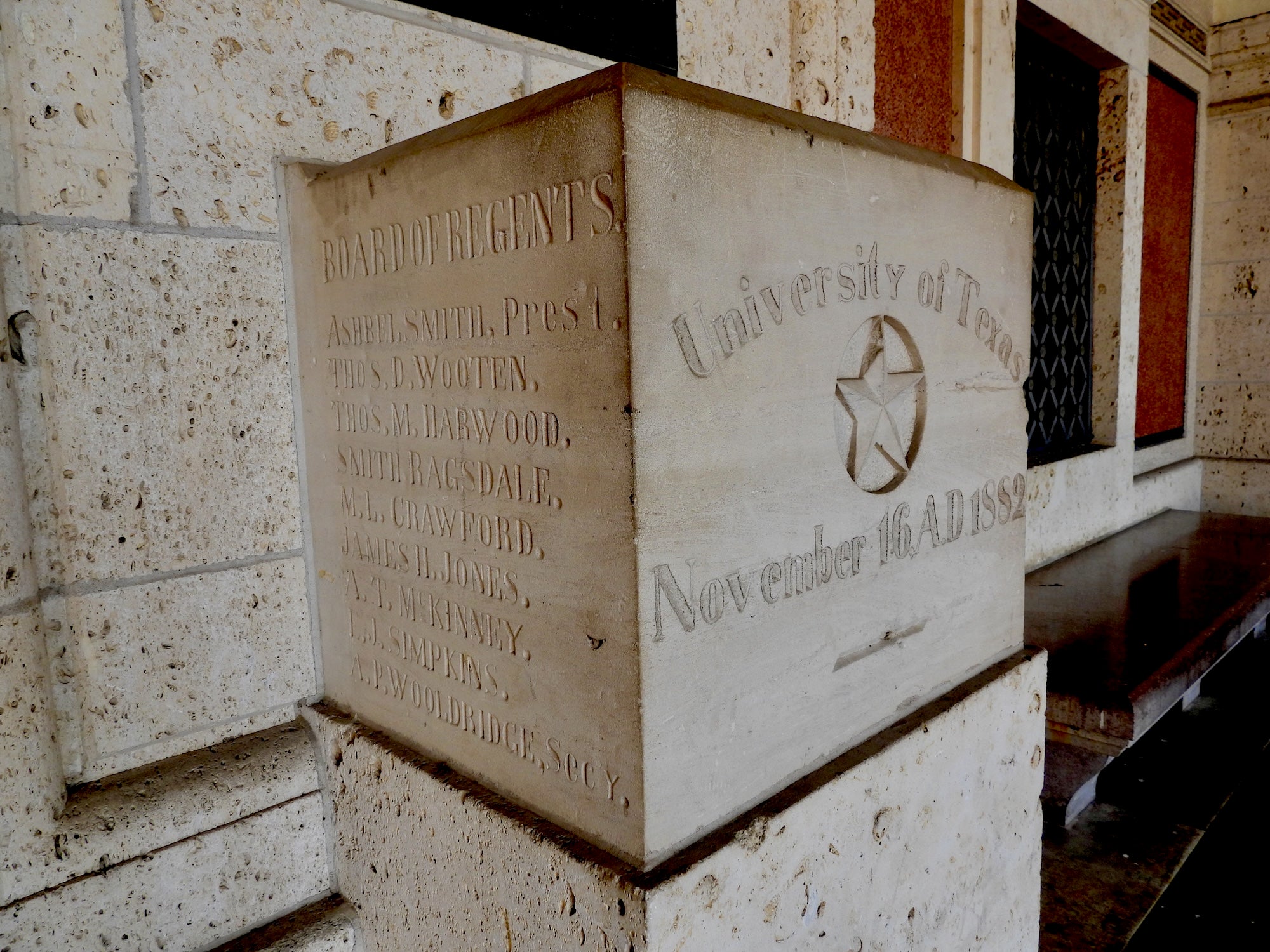
The record box was what we would call a time capsule, containing an assortment of items from the day, some germane to the building and many wonderfully random. The cornerstone-laying ceremony for Old Main was held Nov. 17, 1882, and UT’s Briscoe Center for American History preserves a two-page list of the contents. (The date carved on the stone was the planned date of the ceremony, but bad weather caused a one-day delay.) They include copies of the state laws regarding UT, Gov. O.M. Roberts’ message to the Legislature urging the formation of the University, and photos and signatures of the regents. There are 1882 newspapers from across the state, coins and bills (American, Mexican and Confederate), and three pecans.
There was a Bible submitted by the American Bible Society; a photo of the new Capitol; and membership and officer lists for various fraternal lodges, the Austin police and fire departments, and Terry’s Texas Rangers. There was a poem by “a Jewish maiden” and a picture of Queen Victoria “contributed by an unfortunate man in jail.” And, especially clever, a photograph of “the assemblage at the cornerstone laying,” which must have proved a great trick to take, develop, print and deliver before the box was sealed.
The miscellany also included a streetcar ticket, a charm against rheumatism that had been carried by Gov. Francis Lubbock for 40 years, and locks of hair from seven women including those in the Wooten family. [The full list can be read at historian Jim Nicar’s blog, “The UT History Corner.”]
In 1937, another box of items was added to the original, creating a sort of two-tier time capsule. The new items included the 1936-1937 UT course catalogs, a printed list of the Board of Regents members with their signatures, and newspapers from that day.
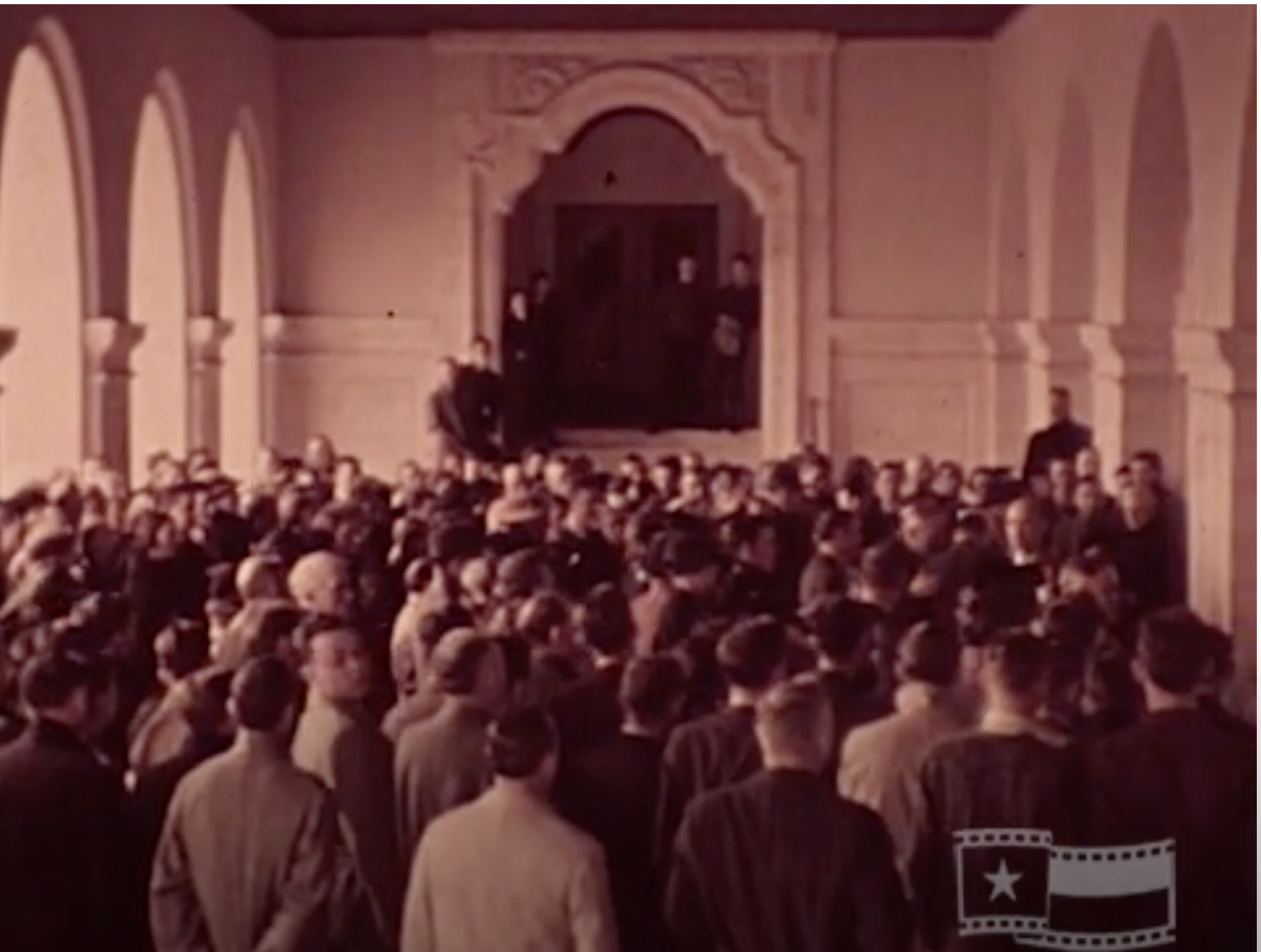
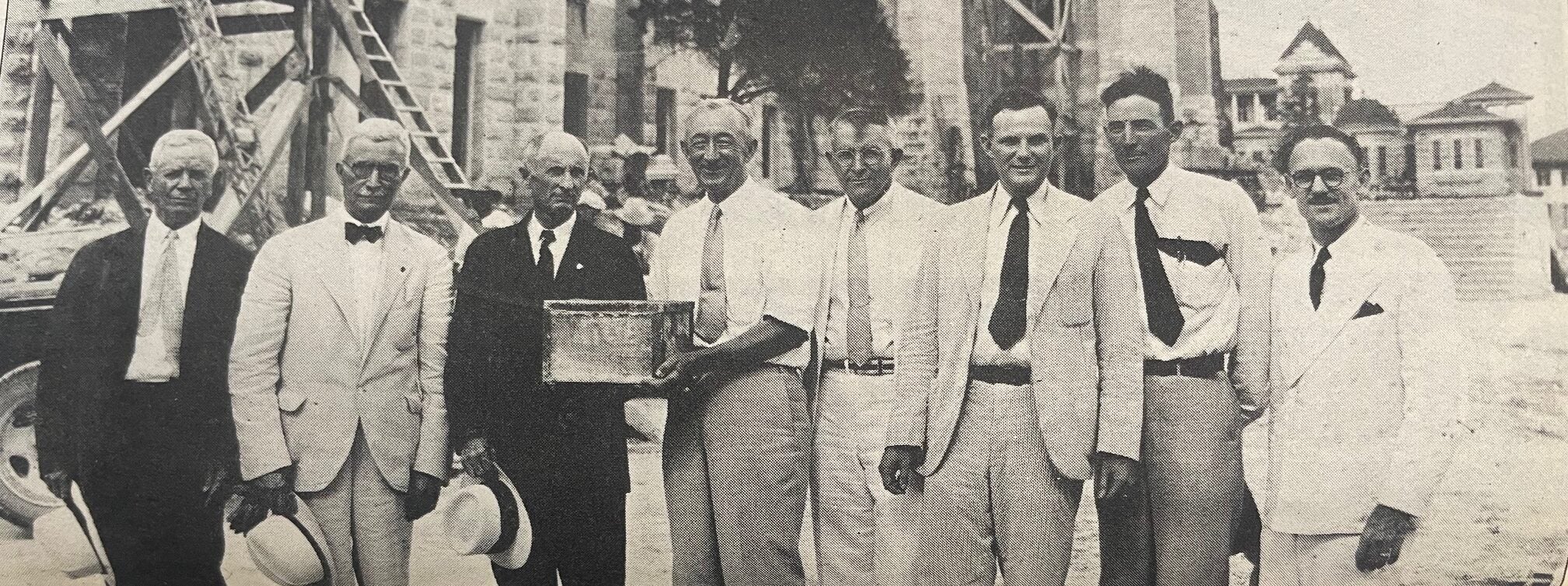
At 2 p.m. the regents gathered on the Main Building loggia, the grand, shaded overlook on the building’s south side, and were joined by the Faculty Building Committee; the architect, Paul Cret; the contractor, Hugh Yantis; the superintendent; and invited guests.
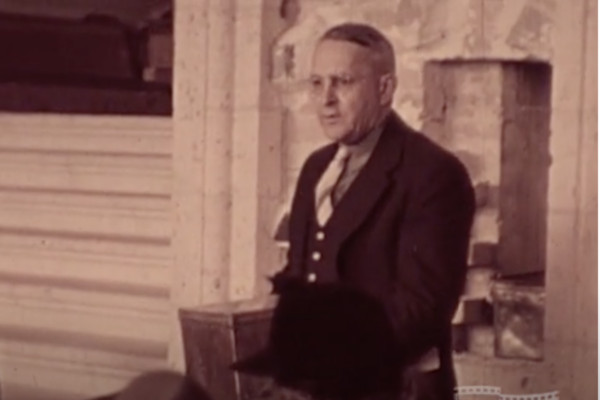
The dedication began with a look back. President H.Y. Benedict gave an “Account of the Laying of the Cornerstone of the West Wing of the Main Building, November 17, 1882.” This was followed by Col. Arthur A. Stiles giving a “Testimony of an Eyewitness.” Stiles was a former state reclamation engineer and was the only one to have witnessed both cornerstone ceremonies. Benedict then placed the old record box in its new place, a wall cavity just east end of the building’s main entrance from the loggia.
Beauford Jester, a former chairman of the Board of Regents who in a decade would become governor, gave an “Account of the Genesis and Erection of the New Building.” Then the chairman of the Board of Regents, H.J.L. Stark, placed the new record box on top of the old one inside the wall. The building tablet then was put in its place, on the east wall of the south entrance, by contractor Yantis and his assistants. And with that, the ceremony was over.
Nearly three months passed before headlines began proclaiming the building was opening. The Pampa News wrote:
“With only a few minor details yet to be attended to, the new unit of the Administration-Library Building of The University of Texas, located in the center of the main campus at Austin, is ready for occupancy. The cost of the two units comprising the imposing structure, including fixtures and furniture, total approximately three million dollars. Not a penny of this sum came from the taxpayers… The new unit of the building contains the offices of the president, registrar, auditor, comptroller, librarian and dean of the College of Arts and Sciences. Among the many attractive features are two rooms, exposed on three sides, and entirely glass enclosed, for pleasure reading. Students who attend the 1937 summer session will be the first to have the opportunity to use the building in its completed form.”
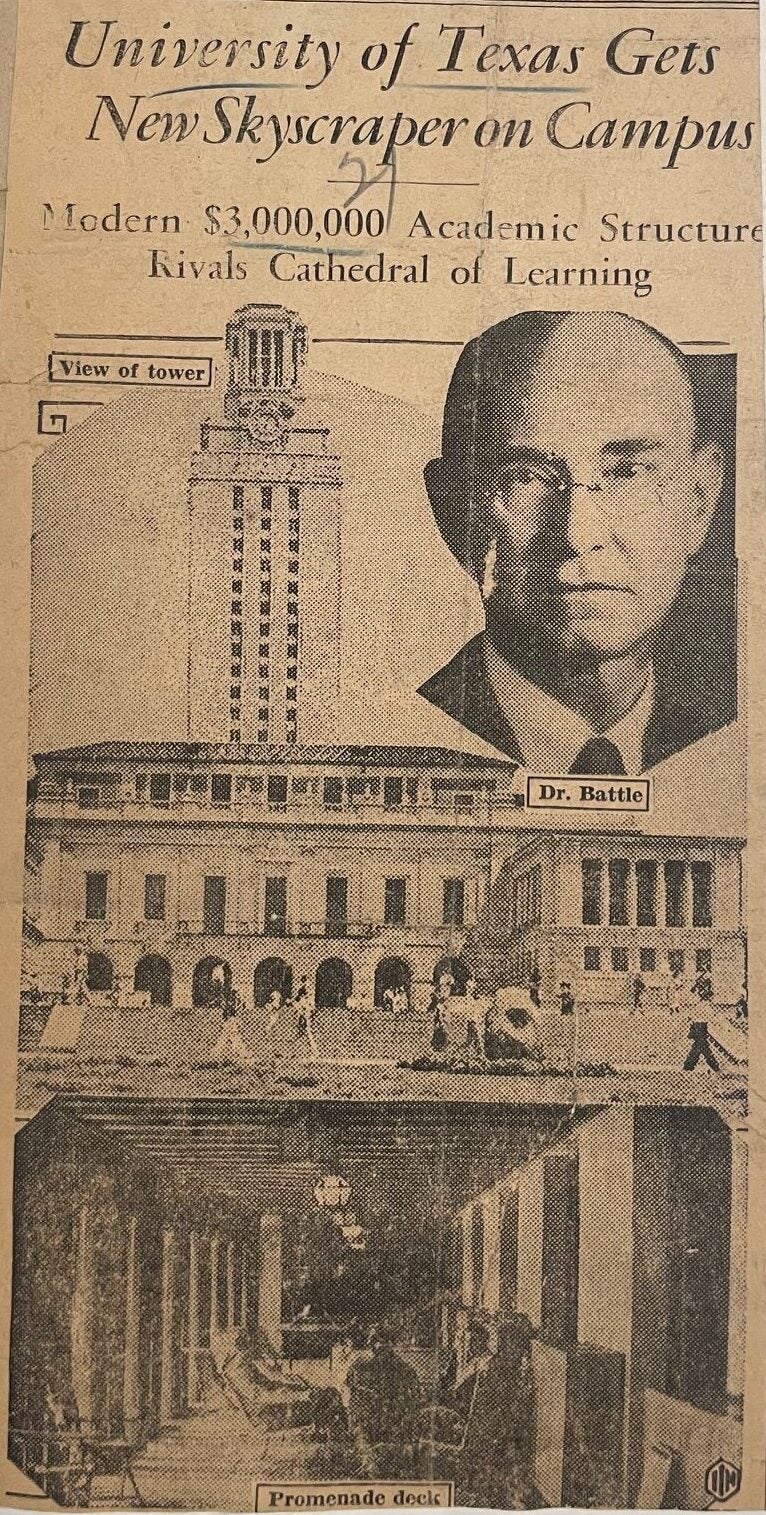
In June, the Monessen [Pennsylvania] Independent wrote: “University of Texas Gets New Skyscraper on Campus — Modern $3,000,000 Academic Structure Rivals Cathedral of Learning,” it said, in reference to the 42-storey colossus at the University of Pittsburgh.
A reporter for the International Illustrated News service wrote: “Its white native Texas stone makes it a conspicuous landmark in the capital city, and its height makes it visible for many miles before any other features of the Austin skyline can be seen by approaching travelers.”
But its full opening was muted by sadness. On May 10, 1937, Benedict was on his way from the president’s office, then still in its temporary home in Sutton Hall, to meet the car on Guadalupe Street that was to take him down to the Capitol. He leaned wearily against a tree in front of University Baptist Church, and when his car approached, he walked toward it. “His step broke at the running board,” the Austin Statesman reported, “and he slumped to the pavement.” Minutes later at St. David’s Hospital, he was pronounced dead.
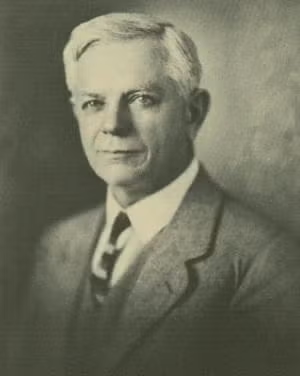
Like Moses passing away on the banks of the river Jordan, a cerebral hemorrhage had taken UT’s longest-serving president, who had shepherded the massive project to completion — only days before its full opening. The Austin Statesman wrote the following day that the hard-working president had died “in harness” and that “Only a few days ago, he officially inspected this handsome structure.”
On May 21, J.W. Calhoun, UT’s comptroller who now served as interim president, told the paper, “There are a few minor details to be cleared up, such as taking spots off stair railings, cleaning up here and there, making slight alterations in the decorations. When that is completed, Hugh Yantis, the contractor, and I will sign the necessary papers and the building will belong to The University of Texas.” That summer, Calhoun became the first president to occupy the new building, his office being in the southeast corner of the first floor.
The monumental building went by a variety of names in its earliest years, such as the Library Building and the Administration-Library Building. For a while, writes Nicar on the “UT History Corner,” the new building was informally dubbed the Mirabeau B. Lamar Library, “but the name wasn’t very popular. Students and faculty members preferred a remembrance to Old Main and simply called the library the new Main Building.”
1937 silent film produced by the Austin Chamber of Commerce showing dedication ceremony. Source: Texas Archive of the Moving Image, Austin History Center.