On the shelves behind my desk sit nearly 100 editions of UT’s alumni magazine, The Alcalde. These were the issues we published while I was editor during the 1990s and 2000s, and, as I’m still writing about UT, I like to keep them handy.
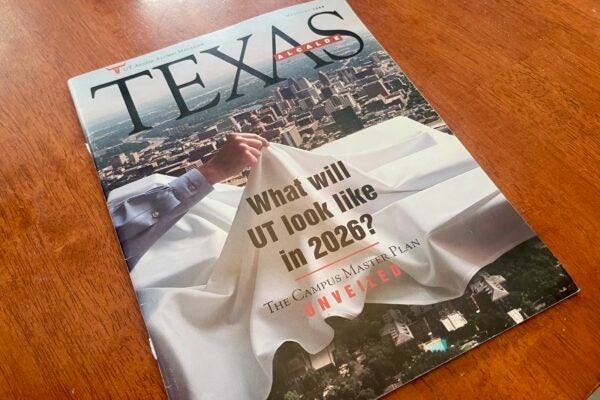
Recently I was passing the collection and noticed one that had made its way to the top of the stack. When I read the boldface question we had printed on the cover in 1996, I was dumbstruck: “What will UT look like in 2026?” When we published that issue, 2026 was unimaginably futuristic. Now, it was mere days away!
The image on the cover showed an aerial shot of Austin with downtown in the distance (and what a quaint downtown it was by comparison). In the foreground, superimposed over the Austin photo, a cloth was draped over the campus, and a hand held the highest point as if about to unveil a new University. We had DIYed all that on the conference table outside our office suite at the Alumni Center, using dictionaries, almanacs and tissue boxes to suggest campus buildings, borrowing a tablecloth from the caterer for the veil, and yours truly holding the cloth above the supposed Tower (no model-release form required).
The cover story was about the unveiling of the Cesar Pelli Campus Master Plan, which had been initiated under then-President Robert Berdahl to rein in the architectural styles and bring more order to the sometimes unruly Forty Acres. It was only the third master plan in the University’s history: The first had been the plans Cass Gilbert drafted between 1909 and 1920. The second and most formative was the Paul Cret Plan of 1933. In the 60 years between the Cret and Pelli plans, styles had run amok, and the campus enrollment had exploded, sending construction sprawling to the east.
The Pelli Plan had seven objectives, and I thought it would be interesting to look at those and see what had happened and what had not. I also wanted to get a hot take from my friend and UT’s university architect, Associate Vice President Brent Stringfellow. “A lot of progress was made on all of these,” he said of the plan’s initiatives, “but we’re continuing to wrestle with some of them.”
By sheer coincidence, UT is embarking on a new master plan this month. This time, the University has contracted Sasaki Associates, and Stringfellow expects the new plan within 18 months. That’s aggressive for a master plan, “but there’s so much going on right now,” he said, “that there’s a certain level of urgency.”
The Pelli Plan
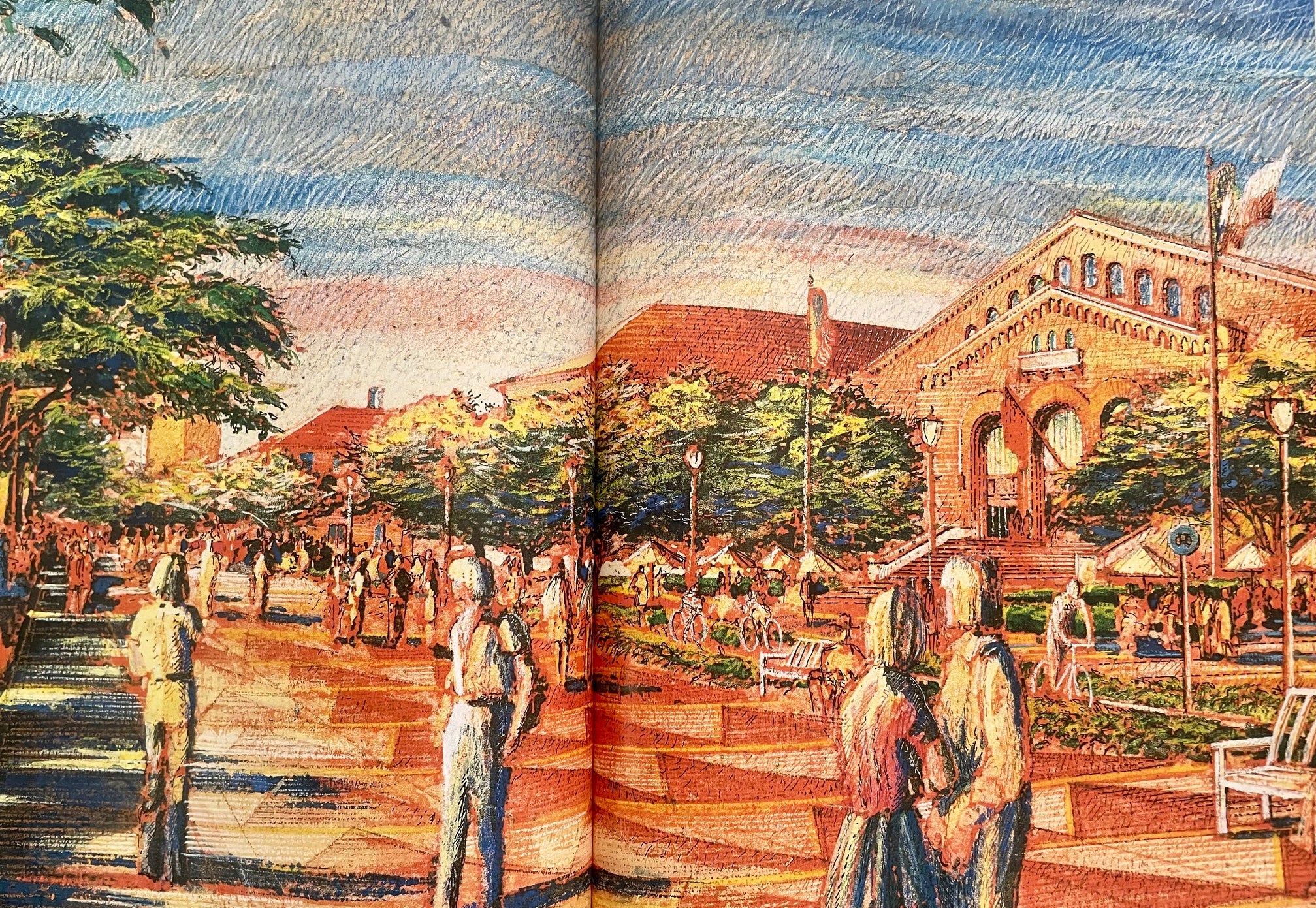
1. “Return the core campus to the pedestrian.” Of all the Pelli Plan’s goals, this one perhaps was the most successful. It called for the closing of Speedway and 24th Street to cars. Speedway was indeed eventually bricked over to become a pedestrian mall, and traffic on 24th was restricted from Whitis to east of Speedway. The Pelli Plan called for a “people mover” to run continuously between MLK Jr. Boulevard and Dean Keeton Street. It also called for Dean Keeton to be narrowed to two lanes and road humps installed to slow traffic, which did not happen and probably never will, as it is the main east-west thoroughfare between Guadalupe Street and I-35 north of campus.
The plan called for parking garages around the perimeter of campus, and the San Antonio, Brazos, Trinity and Speedway garages can all be traced to the Pelli Plan.
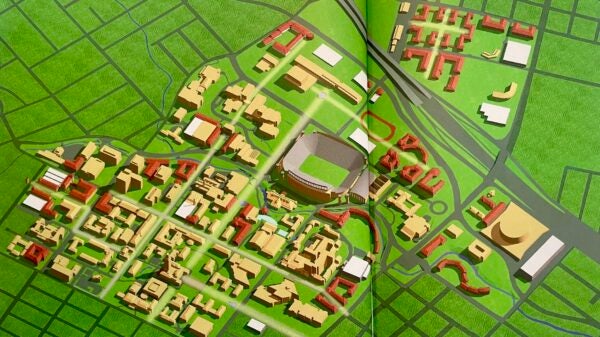
2. “Extend the Cass Gilbert and Paul Cret plans.” “The character of buildings on The University of Texas at Austin campus is eclectic,” the Pelli architects wrote diplomatically. “The individual structure should recess its identity into the greater whole of the campus fabric,” they said. In other words, make buildings look, if not matchy-matchy, at least like they belong. I asked Stringfellow what grade he gives us on getting back to a core architectural style.
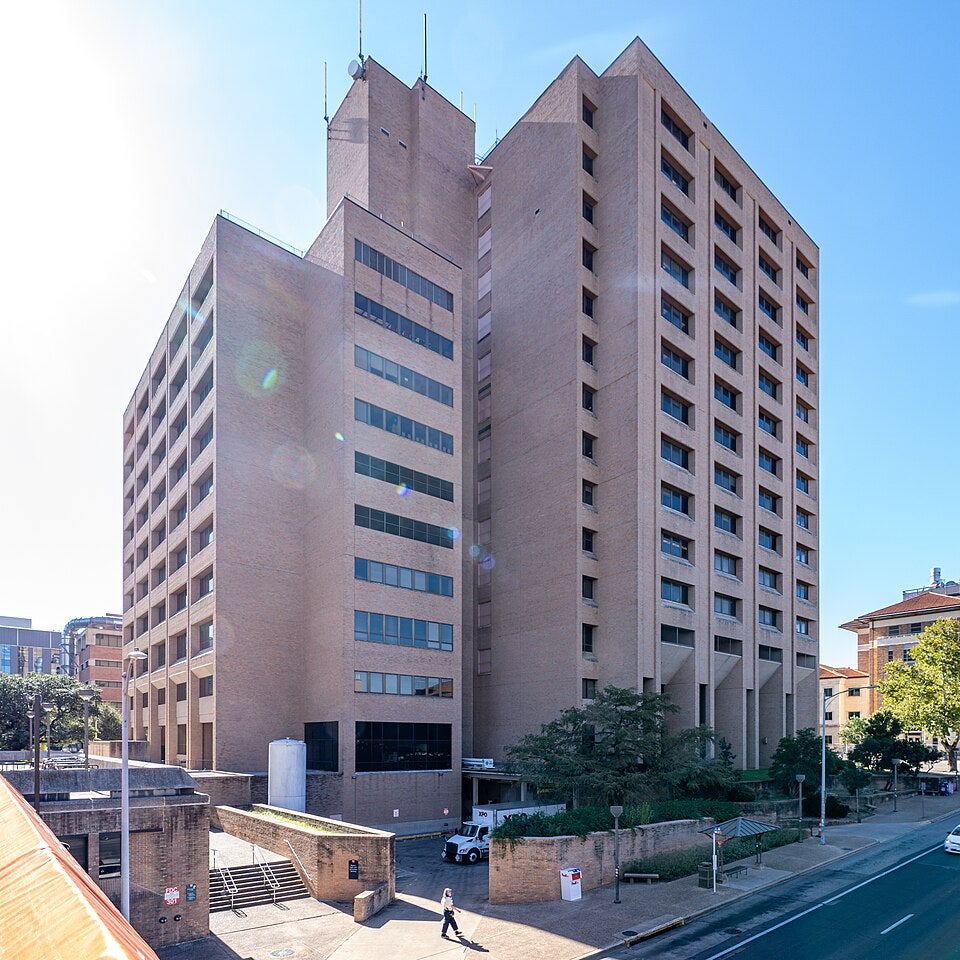
“We’re certainly doing better than we did with PMA (Physics, Math and Astronomy, née RLM) — and those other generic buildings from the ’70s and ’80s. What I would say is we’ve been very inconsistent. In general, there’s been a solid emphasis on the materials, and even when done in a contemporary style, they do help tie the campus together. It looks like a UT building. It has the cordova shell limestone, the Texas-blend brick.” Of Spanish-tile roofs, he said, “That can be problematic because of the scale of our buildings; it can look silly to have that. One thing we want out of the new master plan is a little more clarity about when these things should be applied.”
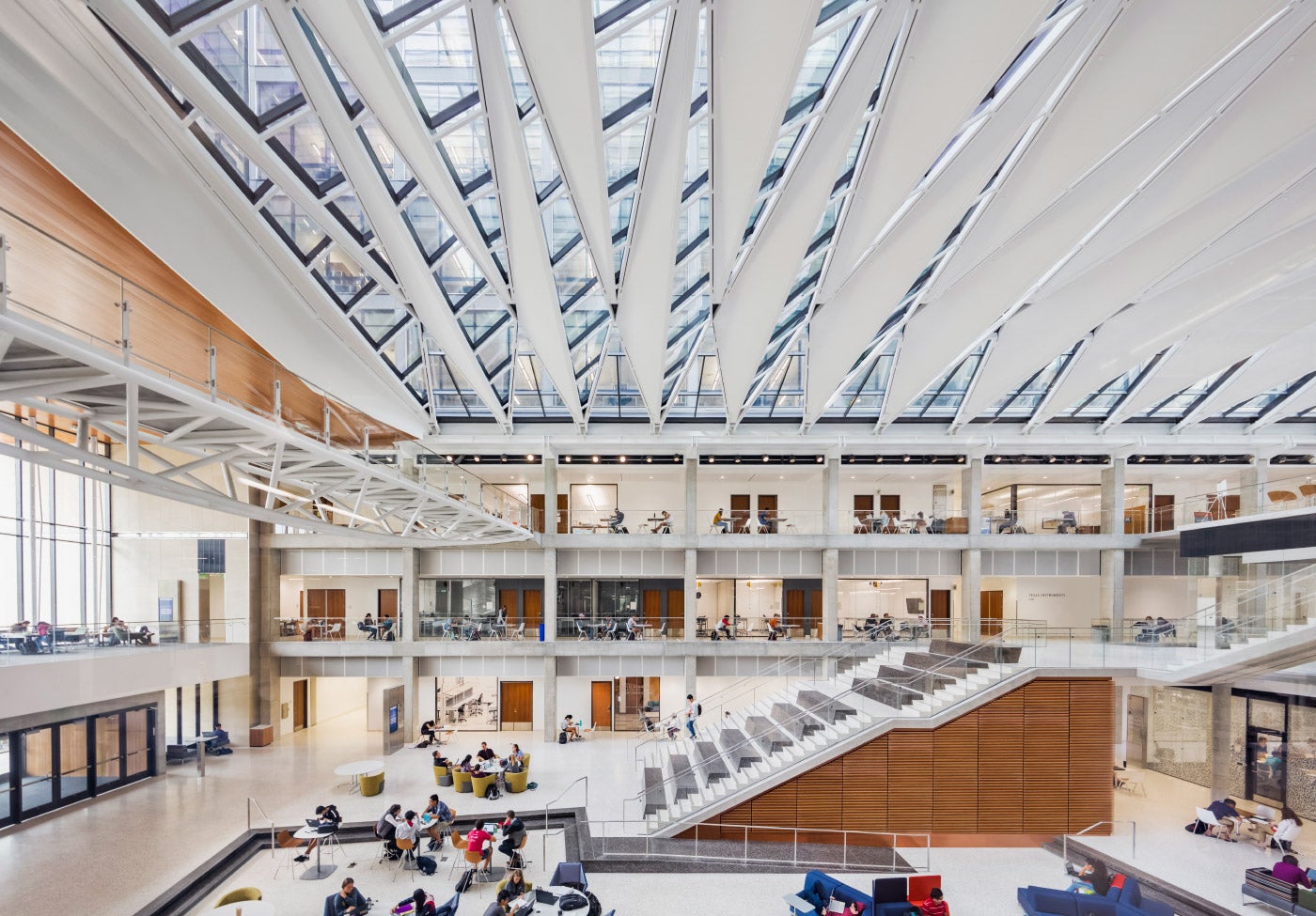
Stringfellow cited the atrium space in the massive Engineering Education and Research Center (2017) as “really stunning” and said it provides a great model. “If you think about the buildings that predated that, we didn’t have many big, open, academically driven spaces. I think that’s a real success. Stylistically, they were using the limestone and the patterning to tie to campus, and even that interior space might be considered a courtyard space, just evolved.”
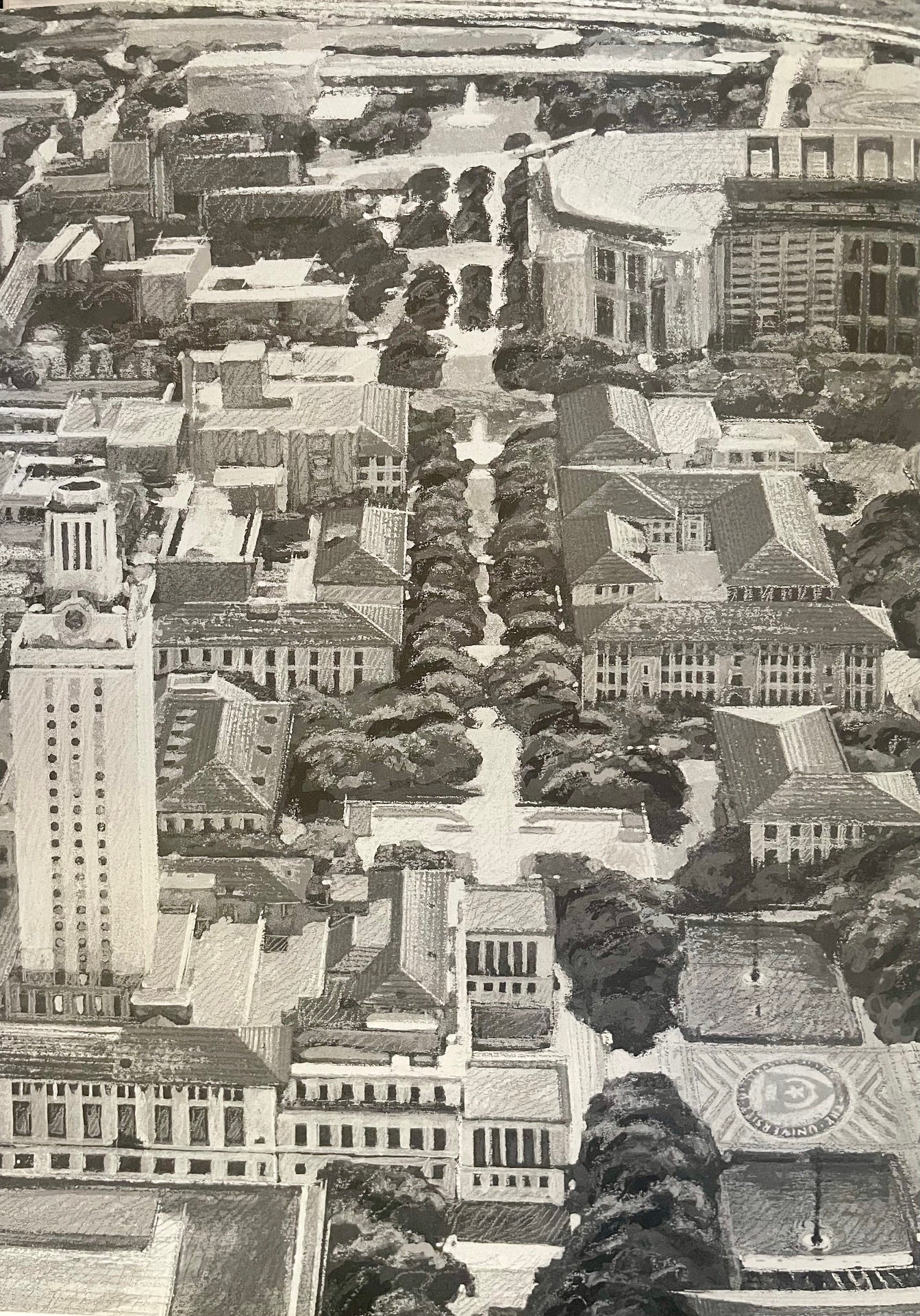
3. “Establish a community of landscaped open spaces.” Using new buildings to shape outdoor spaces was a major emphasis in the 1996 plan. On this front, there were some accomplishments and some “missed opportunities,” Stringfellow told me. Pelli and Associates recommended an ambitious North Mall, stretching from the north side of the Tower — where a new building would abut the Main Building — clear to the chapel of Austin Presbyterian Theological Seminary on 27th Street, “a handsome avenue lined with majestic trees and richly patterned pavement” creating “a ceremonial northern axis to complete the vision first conceived by Paul Cret.” (With our current mission of restoring the Tower to its original, 1937 state, seeing a proposed addition to the Main Building is a shocking novelty.)
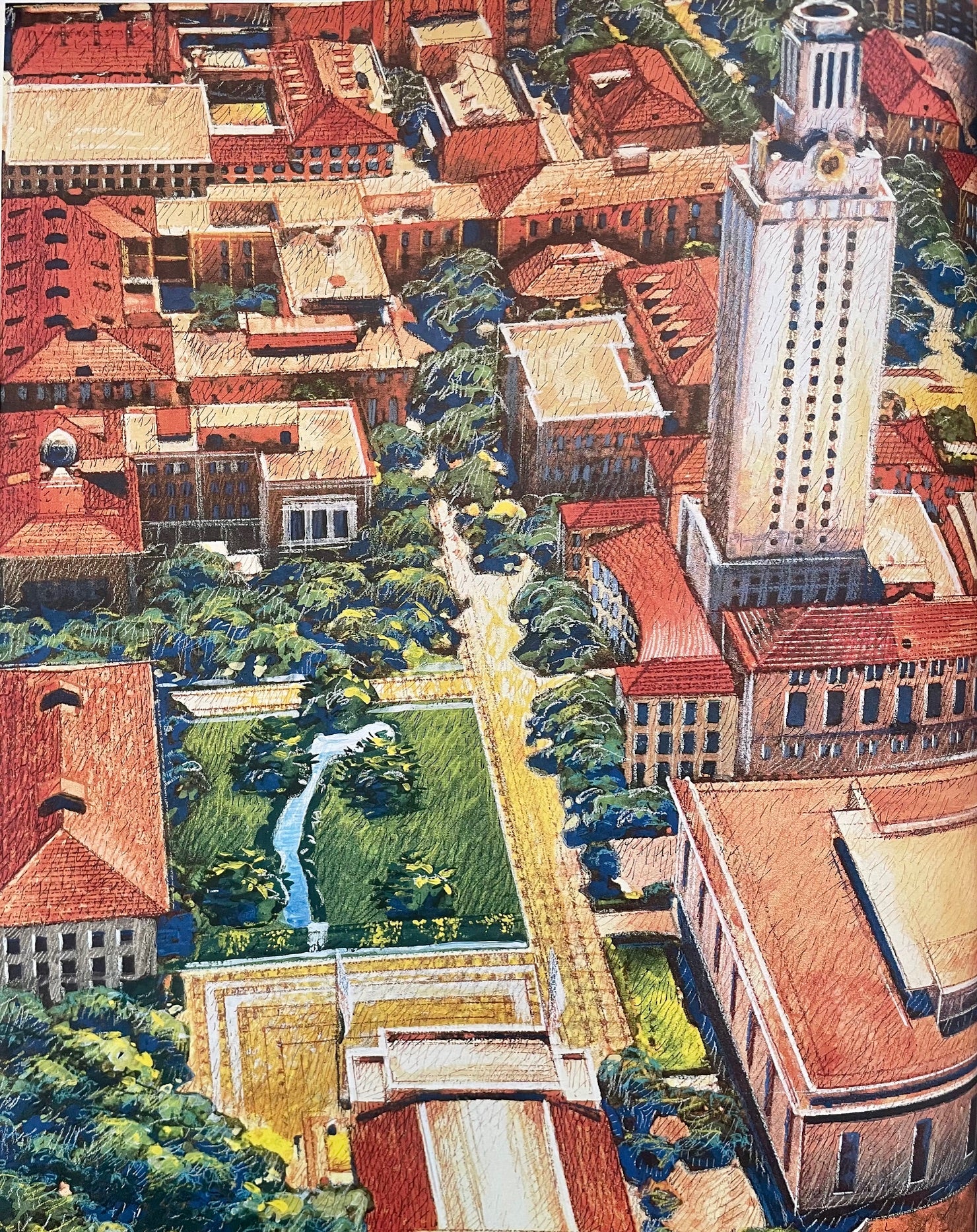
“[The North Mall] idea was probably considered crazy at the time,” Stringfellow said, “but had we done that, it would have brought significant advantages to the core of our campus. Now, in the current market world, it would probably be way too expensive to justify the cost. The North Mall and an underground parking garage (between the turtle pond and Hogg Memorial Auditorium) and would have been brilliant at the time. I have no appetite to propose it now.”
“A stone-and-brick-patterned plaza directly in front of Hogg Auditorium will serve as a colorful gathering place,” the Pelli architects prophesied, adding, “The plaza will restore the grandeur in front of the Auditorium, now diminished by angled parking and asphalt.”
4. “Increase student housing on campus.” The master plan proposed doubling the amount of campus housing so as to accommodate 80% of the freshman class. In 2000, San Jacinto Hall opened on the banks of Waller Creek, adding 900 beds; in 2007 Almetris Duren Hall added 588 beds. What the plan did not predict was a change in Austin building codes, the most noticeable occurring in 2019, when the so-called University Neighborhood Overlay program allowed high-rise apartments in the West Campus neighborhood of 300 feet (about as tall as the Tower).
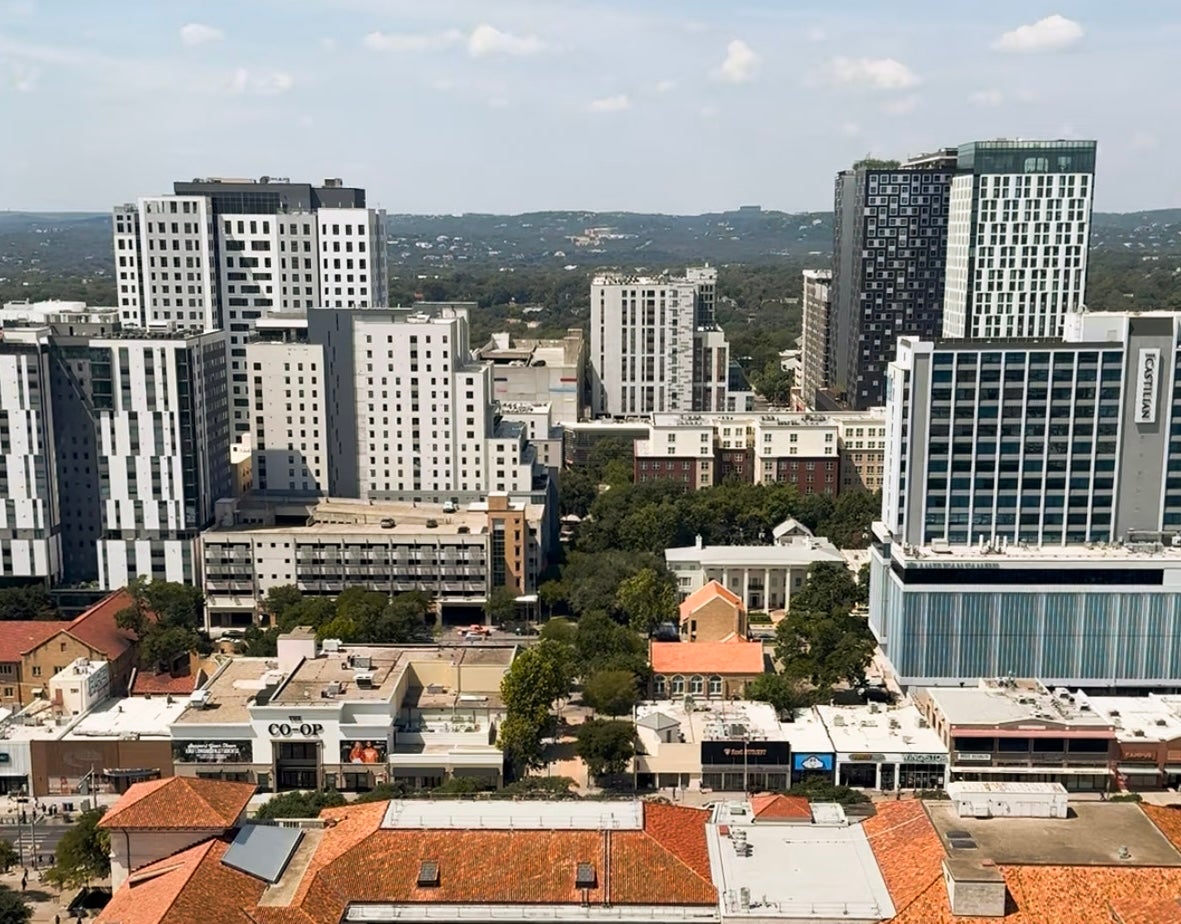
While this brought thousands of students closer to campus — obviating the need for them to ride shuttle buses to the student enclaves of Riverside Drive and Far West Boulevard, it did not bring them onto the campus proper. In 2021, UT purchased the 40-year-old, 27-floor private dormitory Dobie Center, now known as DobieTwenty21, adding 980 beds. The East Campus Graduate Apartments near UFCU Disch-Falk Field added 784 beds in 2024, and a new undergraduate dormitory on Whitis Avenue will add 1,000 beds in Fall 2027.
And where the Pelli Plan envisioned a chain of dorms hugging the curves of Waller Creek, there now sits a massive medical school, another thing few saw coming during the mid-1990s.
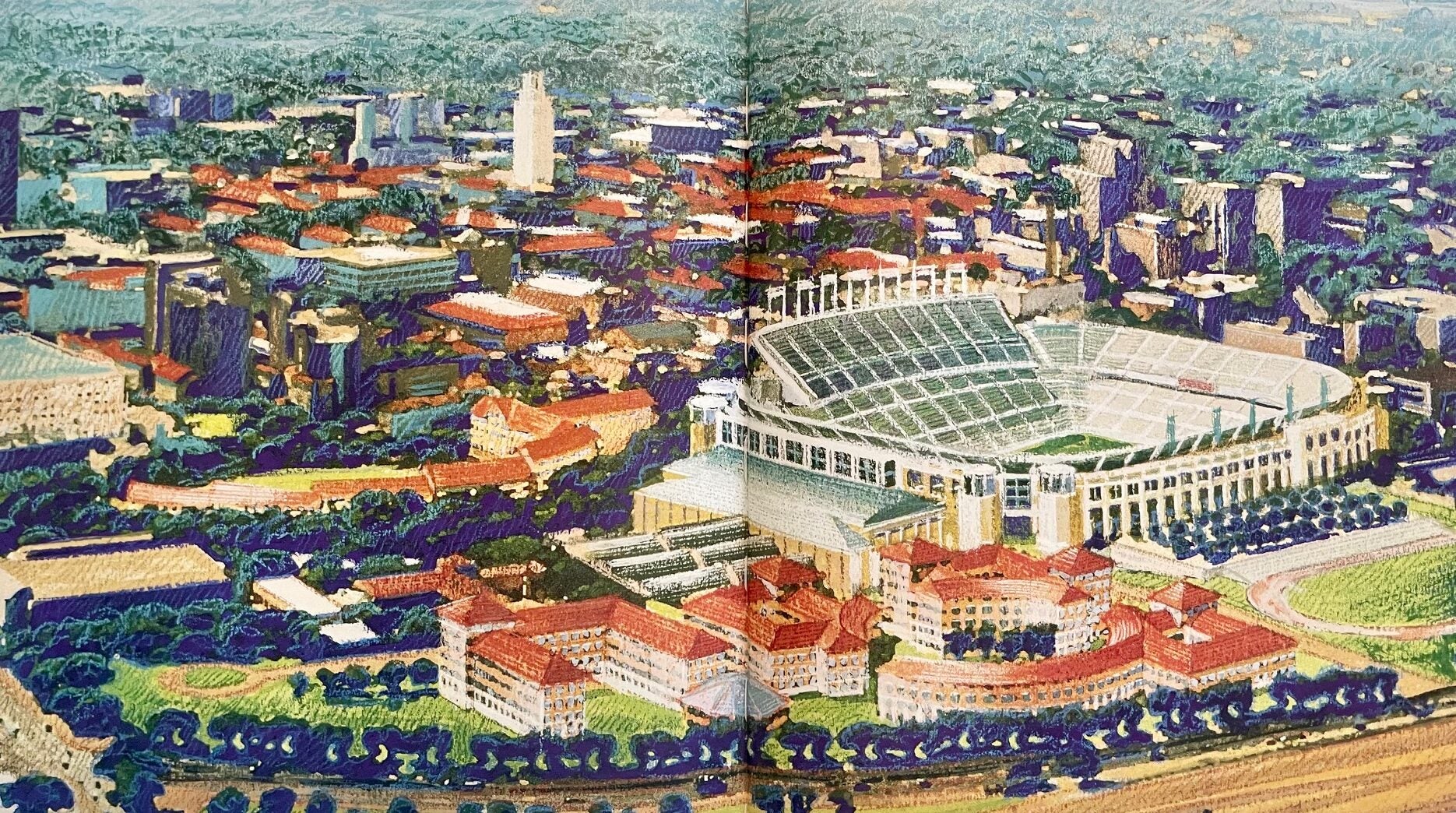
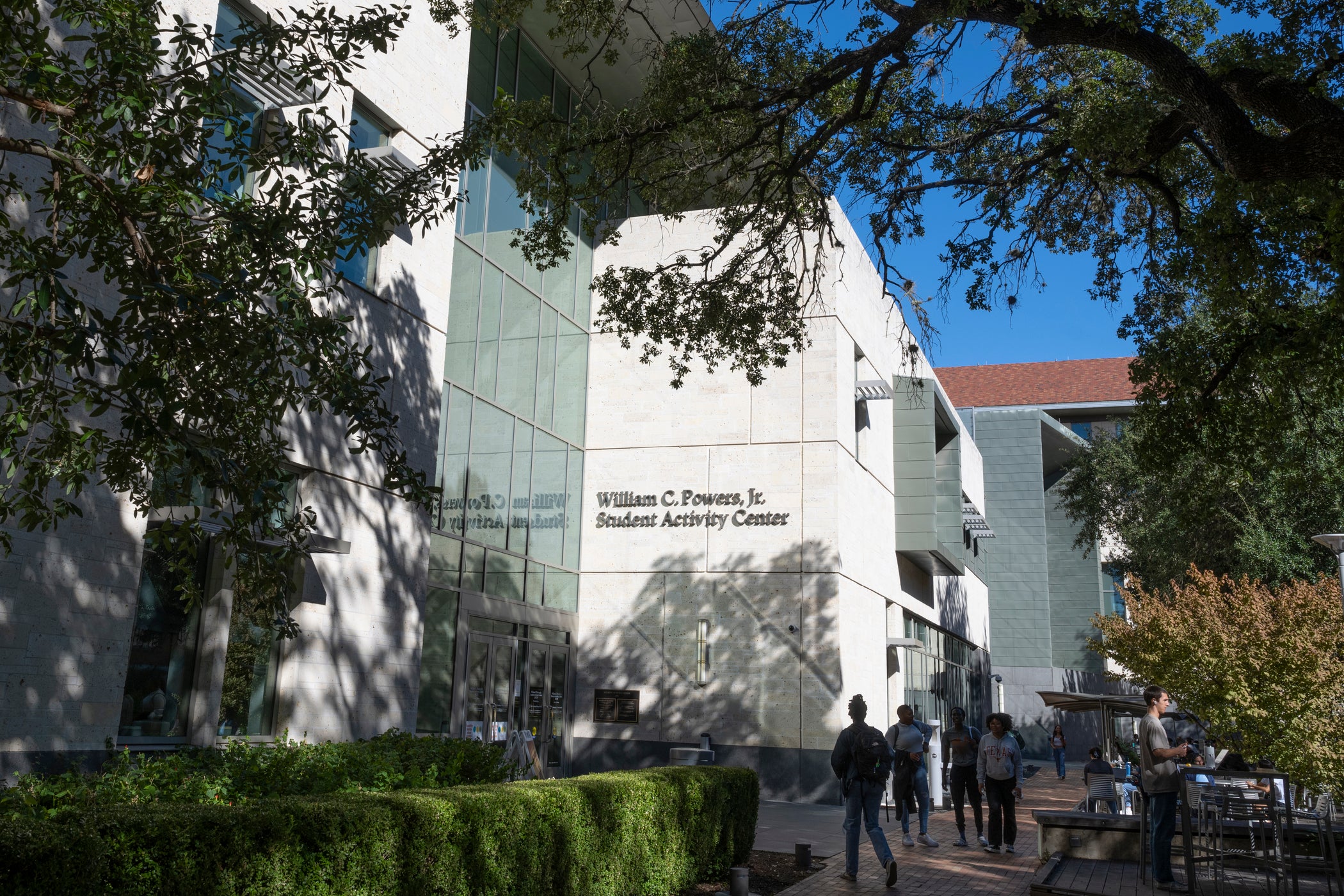
5. “Serve all students.” In addition to more on-campus housing, the plan called for two additional student unions, one in the north part of campus and one south near Clark Field. Instead, we now have the William C. Powers, Jr. Student Activity Center (2010), which is on the East Mall. “Now,” Stringfellow said, there’s “a much more comprehensive view of student life. It’s not just where you’re living and where you eat; it’s recreation. It’s also looking at the wellness factor. Is the design of the campus contributing to the students’ mental health? Those were things that probably weren’t that well considered unless under the more generic ‘pleasant campus experience’ piece.”
6. “Concentrate future construction in the core campus.” The Pelli Plan sought to get back to the building density of the original Forty Acres. On this point, Stringfellow gave high marks to the aforementioned William C. Powers, Jr. Student Activity Center. “The Powers Center is a big building that tucks in well, it activates the East Mall, students seem to like it, and it’s got a really good flow.” Next door on the East Mall, the Patton Building — home of the College of Liberal Arts that replaced the smaller Steindam Hall in 2012 — is another example of how the campus has been filled in while also leaving malls and courtyards for what the plan called “outdoor classrooms.”
7. “Build gateways.” “The plaza on University Avenue will serve as a visitor entry to campus, with a visitor center somewhere along that street. The dormitories along Speedway at MLK Blvd. will act as a main entrance to campus …” wrote The Alcalde’s Shenk. Instead, the Blanton Museum of Art opened in 2006 at the site where Pelli and Associates envisioned a grand entrance formed by a gauntlet of dorms, and in 2008, the AT&T Hotel and Conference Center sprang up at University Avenue, which, to be fair, is a gateway to campus of sorts. Stone signs at University Avenue and MLK and on the West Mall at Guadalupe have made it clearer when one is entering the campus. As for a visitor’s center, that now resides on the ground floor of the Perry-Castañeda Library, in the scheme of things, not too far from where the master plan predicted it, though like many things, this was more happenstance than the execution of the plan.
The New Master Plan
The University did a master plan in 2013, but it had little fanfare and not as much campus involvement. “It picked up on a lot of themes of the Pelli Plan and extended them to get us to where we are now,” Stringfellow told me.
The new campus master plan will echo more the scale of the Pelli Plan, with a steering committee whose chair — David Vanden Bout, dean of the College of Natural Sciences — was appointed by the president and with leadership from across the University organized into working groups.
The new plan will of course deal with what the campus looks like but will bring data and technology to bear by better discovering how the campus is actually used and seeing how we could get more out of it rather than simply expanding it, said Stringfellow.
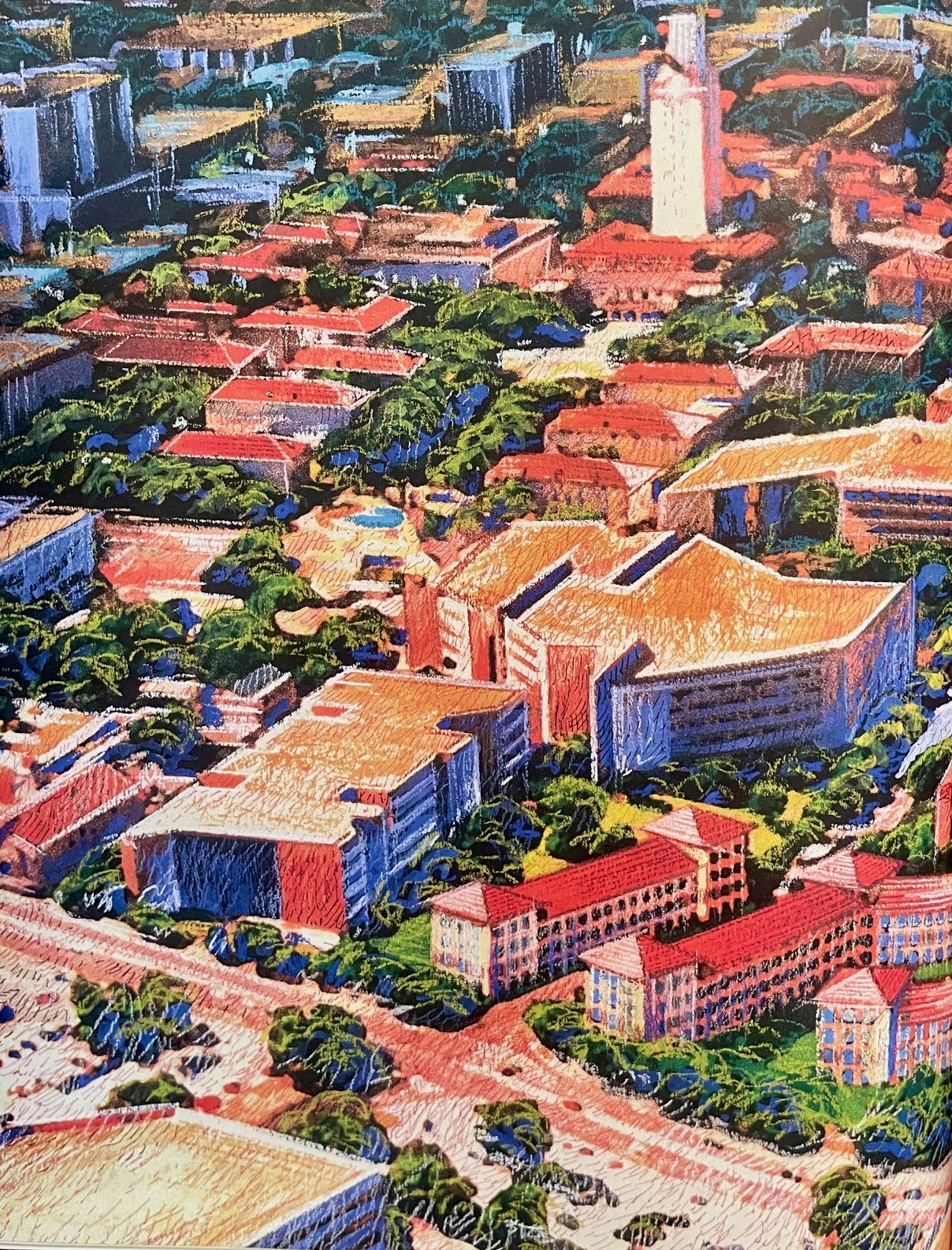
In the 1996 Alcalde article, Gleeson said the Pelli Plan would make a great coffee table book. And it did, coming out in 1999 (and providing most of the images in this story). “The coffee table book was very much of its time,” Stringfellow said with a smile. The new plan will have no book and instead will live as a digital model, “a living plan, so that as we make decisions, it will evolve.”
When I asked why master plans were important, Stringfellow said, “Primarily, the master plan gives us and our successors guidance to make the best decisions for the physical development of the University. There are huge investments, huge costs to capital investment, and the master plan helps to guide that decision-making while also helping to consistently improve the overall experience of the University as a place. That’s fundamental. We’re fortunate right now to have leadership that is recognizing how critical having a well thought out plan will be.”
We’re trying to figure out a 25-year forecast, he said, because 10 years isn’t long from a development perspective. During the mid-1990s, smartphones and apps, personal scooters and driverless cars didn’t exist. Trying to plan for whatever technology is now just on the horizon is a tricky challenge.
And even mission-related changes were not foreseen: “There wasn’t a medical school when [the Pelli Plan] was conceived, so we have a new school that’s going to be behind building a major hospital. You have big, significant initiatives — the types of research we’re looking at, the semiconductor, quantum physics research work around computing. There was a focus on computing then but not at the level we’re looking at now. The emergence of life sciences is another critical factor.”
Stringfellow also noted a focus on our heritage buildings in the coming plan. The Pelli Plan put great focus on repeating the style of Cret and Gilbert, he said, but we didn’t do many building renovations during the plan’s life. That has changed, with recently finished restorations of Hogg Memorial Auditorium and Battle Hall and ongoing restorations of the Tower and Main Building, Gearing Hall, the Biology Building and others, and the new plan will continue that.
“If you think about the complexity of a university campus, we have a million things going on here, and we’re asked to make decisions about the physical infrastructure. In the absence of having gone through a process to understand how a project decision impacts all these different aspects of life at the University, it can be very dangerous; you can unintentionally do some things that cause unintended consequences,” he told me. “A master plan is really a way to get ahead of that and to make sure that it enables the leadership of the University to make thoughtful decisions about where we’re building, how we’re organizing the campus, and ensuring it’s in alignment with the mission and values and goals and aspirations.”
It also ensures we are building in a way that enhances the coherence and the identity, “of dare we say the brand of the University, so that there is a consistency that defines The University of Texas as a place.” It’s the guide, and like any guide, it’s not absolute. “We will come up with a plan, and inevitably we or our successors will deviate from the plan, but at least you can understand why you’re deviating from the plan and the impact of doing so from that plan. Buildings aren’t cheap. Infrastructure is not cheap. We really want to make sure that when we’re doing it, it’s the right way.”
I didn’t expect to still be on the UT campus in the futuristic year of 2026. Will I be hanging around this place in 2050 to see the result of this master plan? Well, I think there might be laws against staff working here past a certain age, but I’ll look forward to visiting in my flying car.
Explore Latest Articles
Mar 31, 2026
UT Geodynamicist Thorsten Becker Elected to German Academy of Sciences

Mar 27, 2026
Charles Taylor Named Member of the Bavarian Academy of Sciences and Humanities