The University of Texas at Austin offers unmatched opportunities for undergraduates to conduct research firsthand — for some, as soon as their freshman year. Situated within the College of Natural Sciences, the Harlan J. Smith Scholars program invites astronomy students to observe and take data on a 107-inch telescope at McDonald Observatory in the Davis Mountains of West Texas.
Karl Gebhardt, chair of the Department of Astronomy, started the program a year ago, and he continues to bring students to the observatory each semester. The students aren’t just learning how the instruments work; they’re contributing to active faculty research.
“The idea was to bring undergrads out here, train them on the telescope, and then they can take data and match with one of the researchers,” said Gebhardt, the Herman and Joan Suit Professor in Astrophysics. “One of my main priorities in this whole program is that any data we take is for state-of-the-art science.”
During this visit to McDonald, the students looked at a globular cluster in the Andromeda galaxy, trying to find a black hole in the center. They were tasked with taking spectra, or graphs of light intensity, during the night to understand how the black hole is affecting its surroundings. They stayed up all night capturing data, and although the work sometimes was be tedious, it’s rare that undergraduates have opportunities to contribute to astronomy research in this way.
Having the individual take the data themselves gives them an affinity for what we're doing as researchers.
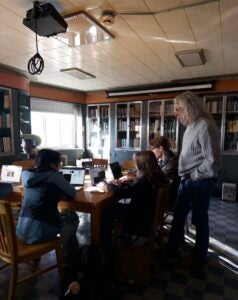
“The actual process of recording the data is a lot simpler than you would expect just sitting at the control center,” said Camden Adams, a freshman astronomy major. “I think that there’s just something special about being with the telescopes and going out and actually hitting the buttons, seeing them move and controlling them.”
Besides being opportunities to learn how to use the telescope, the trips to McDonald provide students with something they might not often experience — a clear night sky.
“I grew up in a really dense city, so I could count the number of stars that I saw on my hands,” said Ananya Gupta, a senior astronomy major. “This was the first time that I’ve ever seen shooting stars. The quiet and the calm and the beauty of the sky … it was magical.”