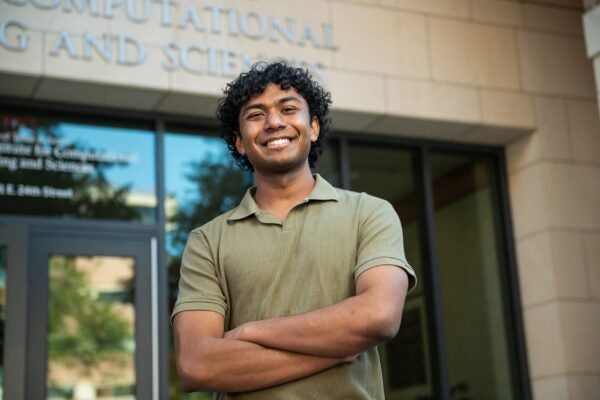
Several of the world’s best-known fellowships and scholarships deliver students to exciting new chapters in their learning journeys, often at elite institutions overseas. In the case of the Churchill Scholarship, up to 18 U.S. science, technology, engineering or mathematics students each year are selected to study at the University of Cambridge, based on outstanding track records in academics and research. This year, College of Natural Sciences and Cockrell School of Engineering senior Krithik Vishwanath, who will be graduating with degrees in computational engineering, chemistry and mathematics, was among the selected Churchill Scholars. We sat down with Vishwanath to learn more about the opportunity and his time at UT. Answers have been edited for clarity and length.
1.) You’ve had a lot of research experiences as an undergrad — pursuing multiple projects in computational oncology, co-authoring papers in medical journals, and presenting at conferences. What have you learned from those experiences?
The hardest part of translational research is not building a model, but rather more about defining the right problem and making the output useful to the clinic. One of the most valuable parts of my work was interviewing oncologists and hearing how they think about trade-offs and what information would actually change a decision.
I also was very fortunate to learn under Thomas Yankeelov and Ernesto Lima. They were my first research mentors and introduced me to translational modeling. Their mentorship shaped how I think about research. At the Center for Computational Oncology at the Oden Institute, I’ve worked on mechanistic models of tumor growth and therapy response. That experience taught me how to move from differential equations to patient data and from theoretical predictions to clinically interpretable quantities. I had the incredible experience of meeting so many dedicated physicians, scientists and people in the collective pursuit of advancing cancer care.
Both Yankeelov and Lima have been role models and initial inspirations for my pursuit of a research career. They pushed me to think carefully about assumptions, validation, and how computational work fits into improving human health.
2.) What do you ultimately plan to do in your career?
I want to build translational tools at the intersection of artificial intelligence, mathematics and medicine — systems that can reason clinically, support better treatment decisions and ultimately improve human health. In the near term, I’m excited to deepen my training in AI in medicine and continue working on clinically grounded modeling and decision-support research. At Cambridge, I hope to work on building hospital-scale models based on their Electronics Health Records (EHR). In the long term, I aspire to work as a physician-scientist focused on making medicine more powerful, personalized and equitable through computational technologies.
3.) How did UT help prepare you for graduate school?
I have been pushed in many directions while also being given the freedom to explore a unique mixture of ideas. I’m incredibly grateful for the opportunity to move across disciplines, jumping from courses in existentialism and classical Chinese philosophy to fluid dynamics and mathematical analysis. That breadth has largely formed how I think and operate today. Beyond that, UT gave me the chance to engage seriously in research, where I learned how to work through uncertainty and learn from brilliant mentors, like Douglas Bruster, Robbie Kubala, Tina Thomas, Ayush Noori, and many others who were instrumental in supporting me as I developed my application.
I am also grateful to my academic advisers, Renee Babcock and Holly Bhasin, whose steady guidance helped shape my academic direction at UT. In addition to Yankeelov and Lima, Eric Oermann, Anton Alyakin, Daniel Alber, Chirag Patel, and Richard Bouchard played an equally important role in mentoring me in my research journey. I am deeply thankful for their support and belief in me.
4.) What’s the most valuable lesson you’ve learned as an undergraduate?
The most valuable lesson I learned was the importance of finding people who care about your growth and who model the kind of scholar and person you hope to become. I’ve learned that surrounding yourself with people who elevate your standards significantly changes the trajectory of your work and your confidence. UT has an incredibly diverse and brilliant student body, and I feel fortunate to spend my time among such thoughtful, driven individuals. I know that the relationships I’ve formed at UT will stay with me and continue to shape who I become for the rest of my life.
5.) Looking back as a graduating senior, what advice would you share with new students?
I would say try lots of things early, and don’t be afraid to be a beginner. Seek mentors who challenge you and genuinely care about your growth. And have a fun, balanced time at UT. You’ll never again have this combination of freedom, structure and community.