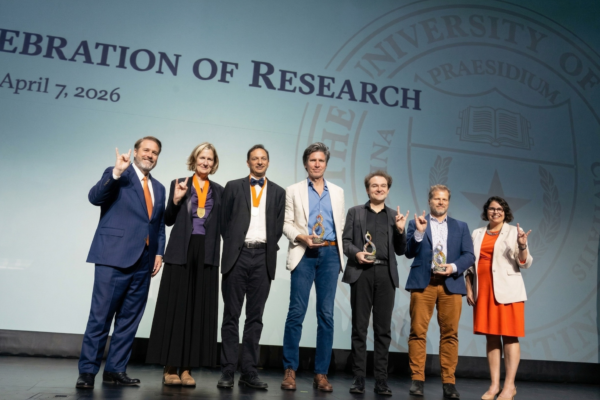
Earlier this month, more than 600 leaders in academia, industry, government, nonprofits and the greater Austin community came together at The University of Texas at Austin to explore the latest research in artificial intelligence, machine learning and robotics. As rapidly changing technologies force us to confront complex questions around the role of AI and intelligent systems in the workforce, health care, defense and other sectors, these leaders tackled pressing issues head on, connected research to practice, and generated bold new ideas for collaboration.
Organized in partnership by Texas Robotics, the Machine Learning Lab and Good Systems — Ethical AI at UT Austin, the inaugural Texas Symposium on Machine Learning, Responsible AI, and Robotics illustrated that UT research across these fields, and at their dynamic intersection, is creating a robust foundation for responsible innovation that transforms lives for the benefit of society.
The symposium addressed topical issues through interdisciplinary and cross-sector discourse, with programming that included panels and research presentations on:
- Agentic AI and the changing landscape of work
- The role of robotics in health care
- The harmful traits of AI companions
- Speech generation technologies
- Advances in robotic surgery
- Fair and transparent data use
- Music and creative work in the age of generative AI
- And more
Attendees engaged with experts to examine ethical considerations and leading-edge interdisciplinary research during the two-day event. Common themes emerged, including the value of collaboration between academia, industry and government; the increasing importance of critical thinking, creativity and continuous learning as key practices to hone for students, faculty and practitioners alike; and the need to work together to better define and safeguard human agency and responsibility as we develop and use robots, AI agents and autonomous systems.
“Right now, we’re in a moment where machine learning, artificial intelligence — especially generative artificial intelligence — is changing the world in many ways,” said Peter Stone, department chair in Computer Science. “This is the first time these three organizations have come together to give a joint symposium, but I think, especially in this moment, it’s fitting to have machine learning, robotics and Good Systems Ethical AI all together in this room.”
Tuesday’s opening panel set the tone for the event, with a bold exploration into the role of intelligent systems across society. Moderated by Stone, the faculty leaders of Texas Robotics, Good Systems, and the Machine Learning Lab — José del R. Millán, Ken Fleischmann and Adam Klivans, respectively — shared what they most look forward to for the future of AI, ML and robotics at UT and beyond.
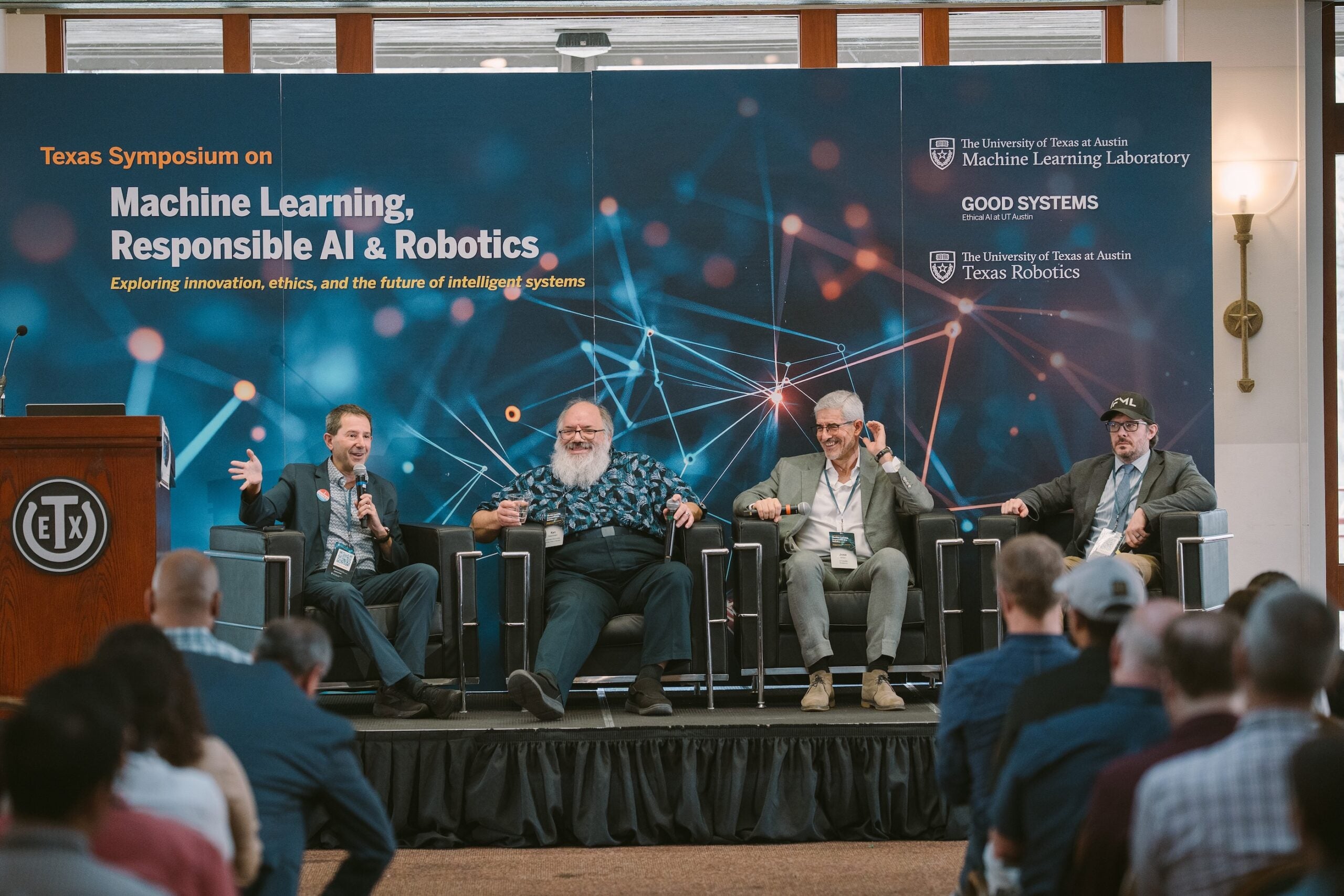
Klivans discussed the value of open-source AI models in advancing responsible research and technologies, such as those being developed by the Machine Learning Lab, the Institute for Foundations of Machine Learning, and the Center for Generative AI, all powered by vast computing resources, including the largest compute cluster in academia at the Texas Advanced Computing Center. “We’ll be able to train close to frontier-size models and try out a lot of ideas to find out what’s really going on at these closed-source companies,” said Klivans.
Millán highlighted how UT’s unique collaborative culture enables the University to lead in interdisciplinary fields such as embodied AI and robotics as well as build transformative resources for the community: The University’s emerging academic health system will include a state-of-the-art, digitally enabled hospital. “We have the possibility to start thinking about and start implementing how artificial intelligence, how robotics will be integrated into that future hospital,” shared Millán.
Fleischmann spoke about considerations for the future of work, including government work and national security, and the importance of a people-centered and values-driven approach to AI adoption and use. “There’s never been a more important time to question — what should we do?” Fleischmann emphasized.
Stone, reflecting on the unique environment at UT where researchers propel scientific discovery and technological advancement while considering the ethical implications of their work and collaborating with colleagues in the humanities and social sciences, offered encouragement.
We have the opportunity to choose what technology we build and also try to shape it in a way that the positives will outweigh the negatives, and I’m optimistic that that’s possible
Keynote presentations anchored discussions around advances in fair and transparent data sets, interactions with AI-enabled robots and agents in the physical world, and the future of language models. Those sessions featured:
- Alice Xiang, global head of AI Governance at Sony Group and lead research scientist at Sony AI, who shared insights from Sony AI’s Fair Human-centric Image Benchmark (FHIBE) data set. FHIBE set new standards for ethical and trustworthy data collection by obtaining consent from contributors, compensating them for data that is used to train AI tools, and allowing them to opt out of having their data used in the image training set at any time.
- Gregory Hager, professor of computer science at Johns Hopkins University, who considered new capabilities in agentic AI and their implications for General Physical Intelligence (GPI) — the ability for robots and AI-enabled tools to quickly understand, robustly plan for, and efficiently execute novel physical tasks — as well as how the combined efforts of academia, industry and the government can lead to advances in GPI.
- Kilian Weinberger, professor of computer science at Cornell University, who discussed a new class of language models that treat parameters as computation rather than storage, prioritize external memory, and are designed with deliberative, globally structured reasoning.
As AI and robotic technologies are increasingly part of our lives and work, Good Systems, the Machine Learning Lab, and Texas Robotics at UT Austin will continue to ask big questions that drive research innovation and impact, inform new courses and teaching practices, and prepare the next generation of leaders to move forward responsibly.
View recorded sessions from the symposium on YouTube.
Learn more about Good Systems, Texas Robotics, and the Machine Learning Lab and get involved at ai.utexas.edu.