“The peregrine lives in a pouring-away world of no attachment, a world of wakes and tilting, of sinking planes of land and water. The peregrine sees and remembers patterns we do not know exist: the neat squares of orchard and woodland, the endless varying quadrilateral shapes of fields. He finds his way across the land by a succession of remembered symmetries.”
—J.A. Baker, “The Peregrine”
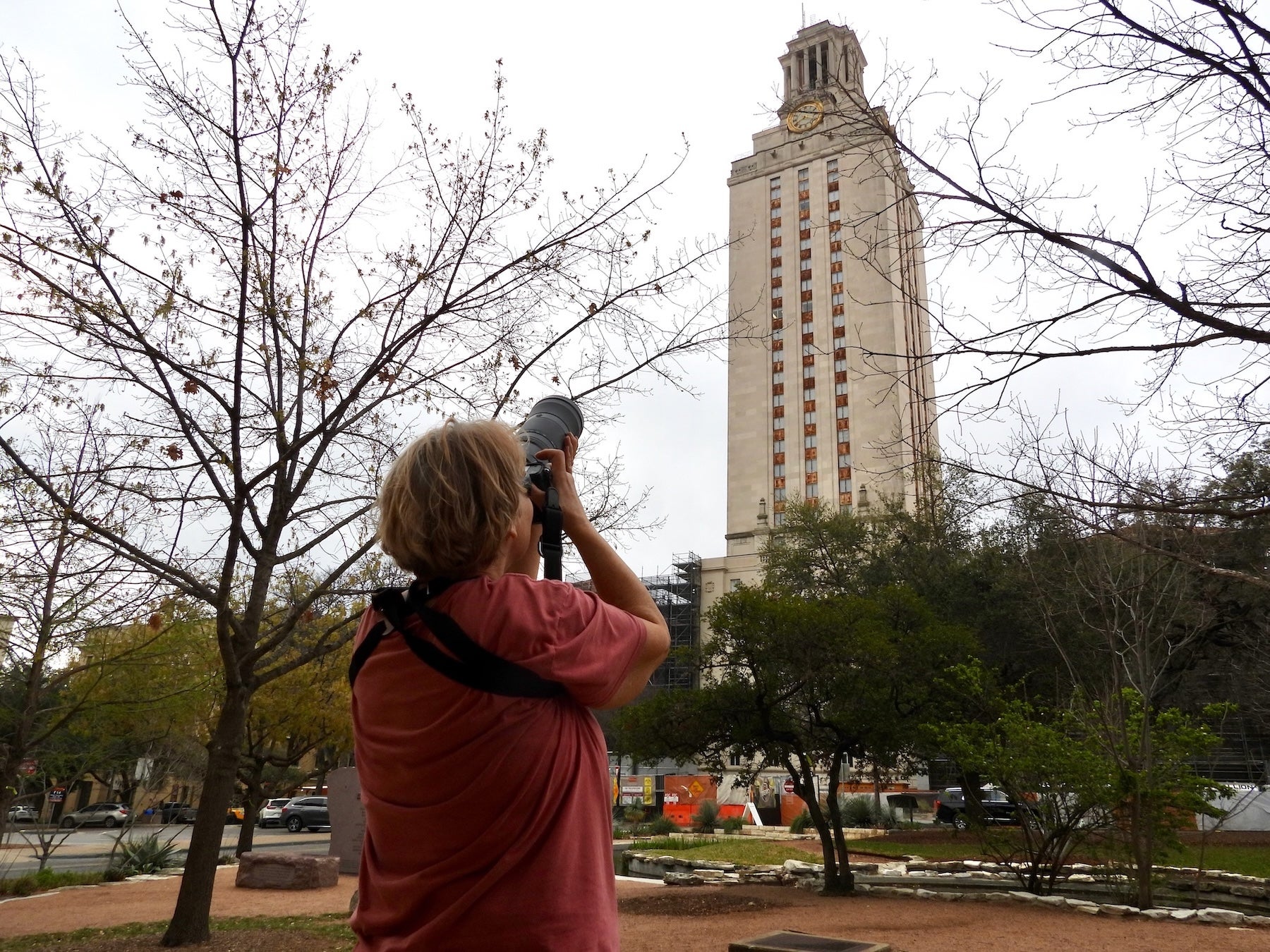
Virginia Hoffman is not a Texas alumna. She is not on our faculty or our staff. But despite this lack of formal connection to The University of Texas at Austin, throughout February and March she has reported to the UT Tower half an hour before sunrise almost every day.
Rising in the dark, she gathers her binoculars and camera with 600 mm lens and drives from her home north of campus to Dean Keeton Street, where she pays for city street parking. “I pay a heck of a lot,” she says. “You always pay for whatever it is you’re most fascinated with.”
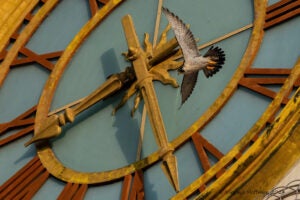
From the moment she exits her car, through binoculars she often can see whether Tessie is home. She knows each and every smudge on the Tower’s upper reaches and can tell if one of those smudges is Tessie, or perhaps a male that has come calling. It’s easiest to know she’s present when she is on the edge, disrupting the symmetry of the ornamental stone scrolls, or the very top, breaking the 307-foot building’s silhouette.
Hoffman strolls three blocks toward the Tower and posts up on the south side of the Biological Laboratories building, sometimes perching in an alcove, when it’s raining, taking advantage of a slight eave over the doorway. There, she cranes her head skyward, past the turtle pond, in search of Tessie.
Hoffman is endlessly fascinated by the peregrine falcon — both the species and this individual bird. A retired programmer for IBM who moved to Texas in 1977 as a contractor in the Space Shuttle program, Hoffman meticulously notates everything she learns about the birds. She knows that at least as early as 1982, peregrines were living rent free with a penthouse view courtesy of the University.
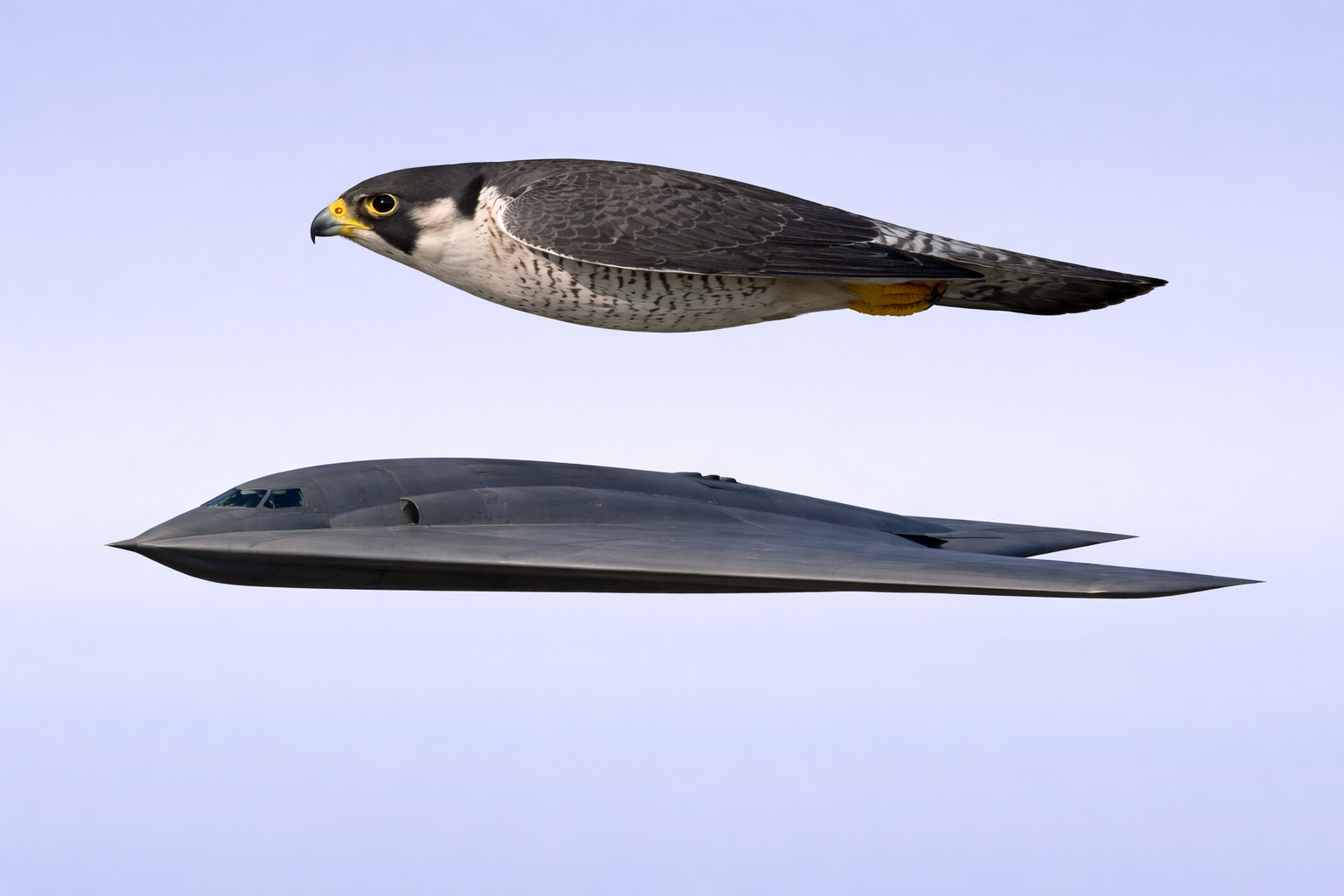
We might think of the falcons as friends in high places, but if you’re another species of bird, they’re not your friends in the least. Peregrine falcons are the fastest animals on Earth, having been clocked flying 242 miles per hour during their hunting “stoops,” which are more like falling with style, dive-bombing birds in flight to lethal effect with a “death punch.” The design of the B2 “stealth” bomber was partly inspired by their profile in flight. Another of their adaptations has been copied in jet engines, a cone in the middle of their nostrils that breaks up air so their lungs don’t explode with the air pressure such extreme speeds can generate.
The circle of life can be grisly business atop the University’s iconic building, its Greek temple harkening not only to classical architecture but also to sacrificial offerings: One construction worker laboring at the base of the Tower was hit by a falling grackle head. Others have been rained on by bird hearts, according to Brian Muttee, a supervisor for SpawGlass.
The modern era of continuous observation at the Tower began when alumnus Bruce Calder (B.S. 1981), a falconer, noticed a female peregrine falcon was habitually on the Tower. When he encountered then-President Bill Powers on campus, Calder pitched the idea of building a nest box for her, and in 2014, UT’s Biodiversity Center placed a box at the top of the building.
That job was entrusted to Neil Crump, a manager in UT’s Project Management and Construction Services, who had the idea of also mounting a webcam on a pole that projected out over the ledge and aimed back at the box. “We had to take the nesting box up in two pieces since the scuttle hole is just big enough for a single person to climb through,” Crump remembers.
Once through that hole, you come to a sort of attic, where the low ceiling forces you to crawl or awkwardly duck walk to access the ladder that leads to the roof. There he finished assembling the box. Yet another ladder allows one over a concrete wall to walk along the edge where nesting box was secured.
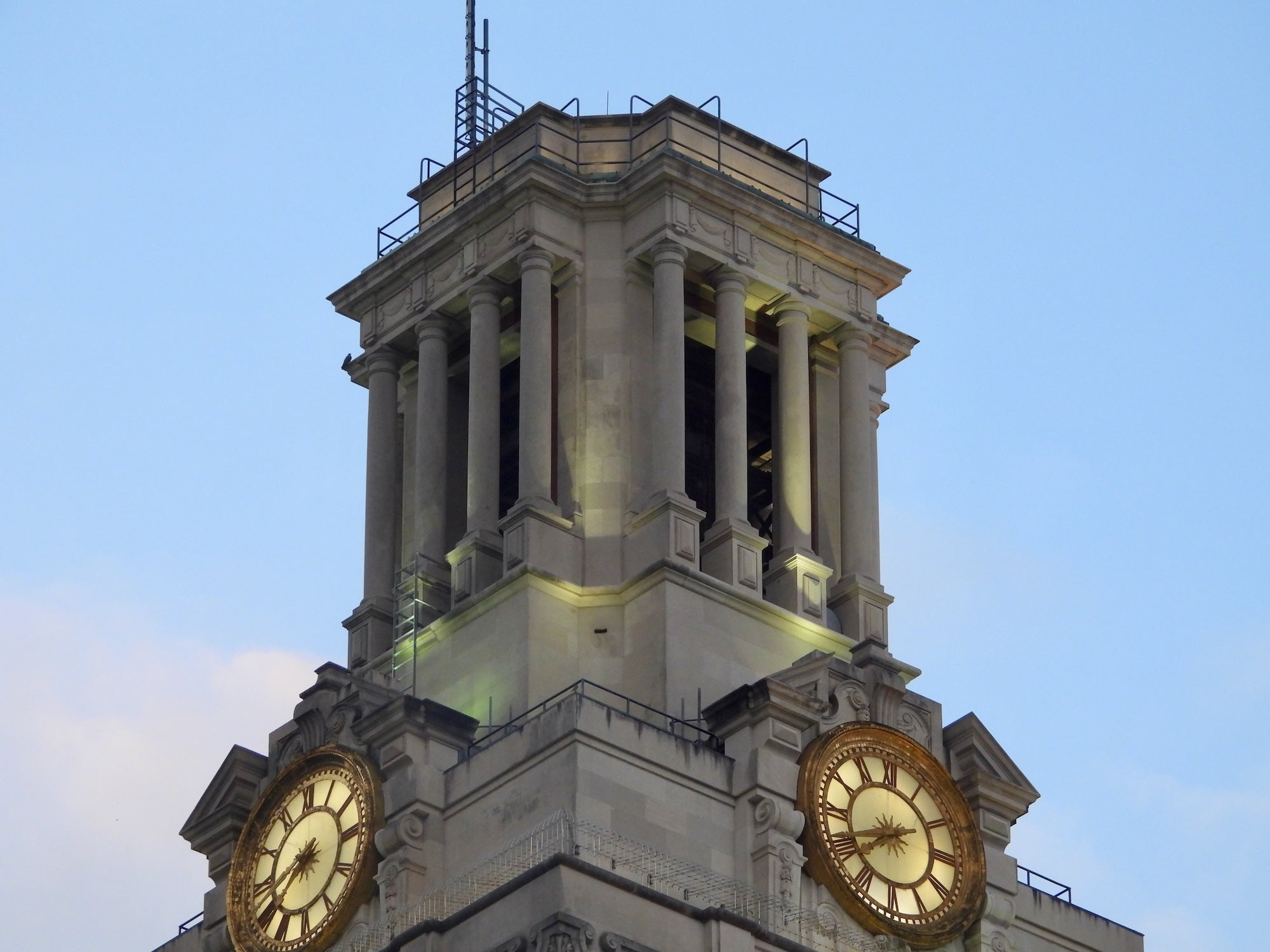
Wind can definitely complicate things that high off the ground, Crump says. Once, his cap blew off and landed on top of the Flawn Academic Center. “I was able to retrieve it!” he recalls.
Tower Girl, as the falcon was known, laid eggs from 2016 through 2020, but none hatched. Twice, Crump retrieved the eggs after such time as they would have hatched. “She hovered against the wind, waiting to dive bomb me,” he recalls. “It was a bit frightening when I was getting the eggs as she angrily flew inches away from me.” The eggs were tested, and both clutches were found to be infertile.
In 2017, alumnus Calder co-authored an article in The Southwestern Naturalist titled “New Nesting Record of the Peregrine Falcon (Falco Peregrinus) in Central Texas.” “This finding documents the first nesting in Travis County and broadens the range of peregrine falcons in the state,” he wrote.
Crump retired in 2019 but remained a volunteer who would service the box and its camera.
In November of that year, Hoffman began following the increasingly famous Tower Girl. Hoffman then started coming to campus to see her in the feather. “I was coming down trying to get outside the webcam and see what she was doing. And she definitely was mating. I was seeing courtship and copulation.”
At that stage, Hoffman decided to lean into the rabbit hole by traveling back to her native Pennsylvania and volunteering at the Rachel Carson Building in downtown Harrisburg at Falcon Watch, where she picked up a tremendous amount of experience and knowledge. (Carson’s book “Silent Spring” was a seminal work of the environmental movement.)
Before Tower Girl, Hoffman knew little about birds. Or photography. “Then I realized, well, if I’m going to do this, I need a camera, because it helps you know what’s going on better. I literally walked into the store at the beginning of the pandemic, and I didn’t even know how to turn the camera on or off.”
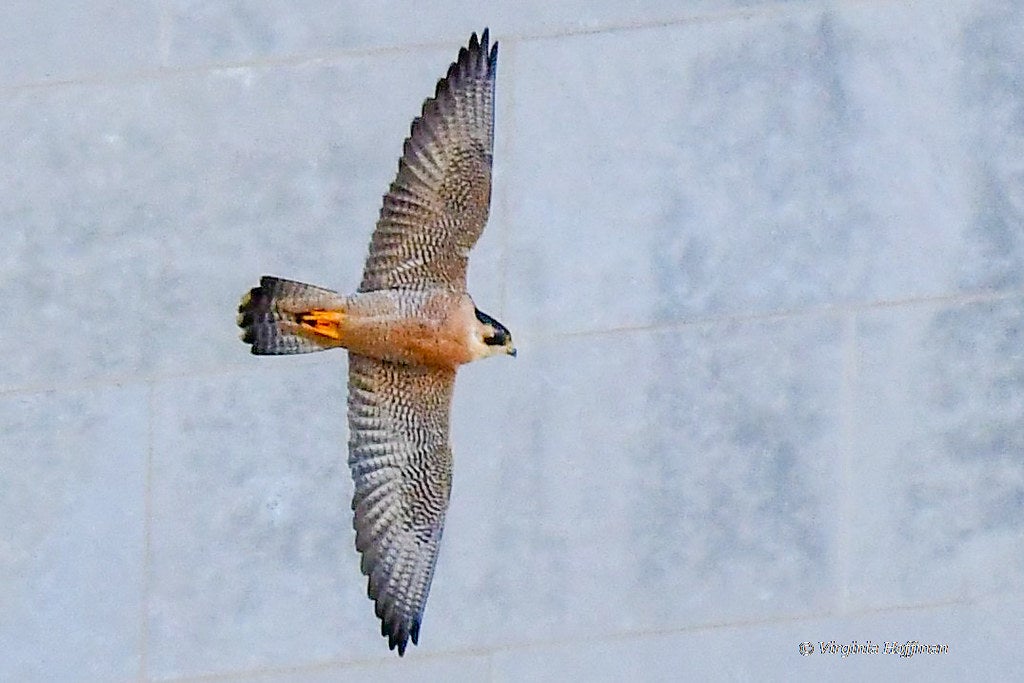
After that, she was off and running. “I had this grandiose idea that I’d be able to figure out where the peregrine goes when it’s not on campus. That failed terrifically,” she says with a laugh. She began frequenting Austin birding hot spots where Tower Girl might be — Mount Bonnell, Roy G. Guerrero Park, Hornsby Bend. “I would climb up every parking garage in the city, because if you go up there, you get to see what’s flying over. Every now and then, I’d have to come back down to UT just so I could see a peregrine and feel like I’d accomplished something!” Hoffman watched Tower Girl year-round through the pandemic.
In February 2021, winter storm Uri crippled the state, and Hoffman recalls the community’s worry. “Whenever there’s some really severe event, I’ll come back down and check. She made it through the ice storm, and there was a male with her, too. They looked really ragged. They were getting ice on them. But I was elated, thinking, this is great; she made it through!”
Based on research, Hoffman knew Tower Girl was at least 13 years old and probably 15, which was “getting up there,” and she knew the falcon was already weak before the storm. It did not help matters that the cold killed a huge number of birds that would have been prey. A week or so later, at the time of year she would be on the Tower more and would start building a nest, she was gone. When several weeks passed with no sign, Hoffman made the call that Tower Girl was no longer with us. “It was pretty sad for everyone,” she remembers.
But within weeks, another female arrived. By this time, Hoffman had logged so many hours observing peregrines that she felt confident it was the same bird occupying and defending the Tower and not just another passing through. Tower Girl had been easy to ID from a scar on her wing. The new one, not so much. Because feathers fall out every year and can grow back quite different, Hoffman relies on her body shape and behavior, but she concedes it’s quite difficult to be certain.
Additionally, peregrine migrations are perplexing. Some do, some don’t. Those that migrate from Texas follow the central flyway used by many species, flying to the Coastal Bend, then crossing the gulf and heading to northern South America. In Tower Girl’s case, because of her scar, many theorized she was injured and so didn’t have the strength to migrate.
Tessie is a migrant, and every fall, Hoffman waits a while before declaring the falcon on the Tower is Tessie. “I’ll compare my hundreds and thousands of pictures I’ve taken, and say, ‘It looks like the same body shape. But you really can’t identify her. She doesn’t have distinctive markers. She doesn’t have bands. So at some point, I just have to say, yeah, she’s kind of exhibiting the same habits. She’s claiming the Tower as her territory. She shows up about the same time every year. It’s got to be Tessie.”
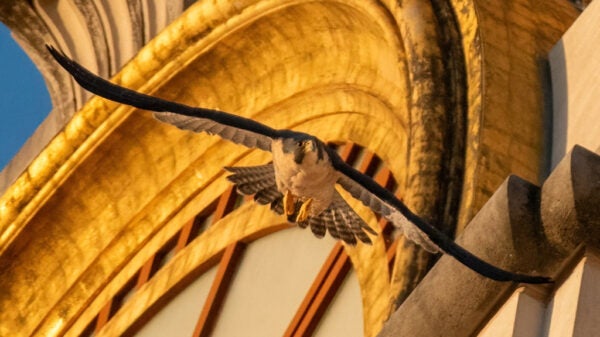
So why the name? By fall 2022, when the same female returned and started to defend the Tower as hers, Hoffman had become a frequent poster on the Facebook group “Tower Girl – UT Austin Peregrines” (now with 2,600 members). Posting so often, she needed a name for the bird, and she asked Crump to do the honors “because of his love and dedication to Tower Girl.” Over the years, Crump had hauled plywood to the top of the Tower, climbed 70-year-old ladders, hung out on scary ledges, constructed the nest box, moved the box to get it out of the sun, run cable for the webcam, and more. “Plus, he was from UT; I was not.”
Crump picked Tessie, which means “hunter” or “harvester” (Greek to English).
And what is it about the Tower that attracts these birds? They like wide-open spaces they can hunt around but need enough greenery to attract the prey birds. They only eat birds and bats. “I think bats are a delicacy,” she says with a laugh, having personally seen Tessie take a bat in flight. Hoffman says Tessie likes to face the sunrise, theorizing it is to better see other birds in silhouette.
Moreover, the Tower is a whole ecosystem unto itself. The building’s bright lights bring in insects, which in turn bring in birds. American kestrels, a smaller falcon than the peregrines, come in for the insects, feeding off the walls. “Grackles all come in, and the peregrines say, ‘Yum, I’ll take the grackle,’” she says. And the prey can get even bigger. Crump once took a picture of Tessie dining on a duck, specifically, a blue-winged teal.
For beginners trying to tell a falcon in flight from, say, a hawk, she says the key is the wing silhouette: The tips of a hawk’s wings are rounded, whereas falcons’ are pointed. As in most raptors, the females are larger than males, so if a pair is together, the size comparison will tell you which is which. If they’re alone, it’s much harder to identify the sex, but Hoffman can tell by the speed of wing beats: “Because the male is smaller and has shorter wings, it has a little bit faster tempo.”
What is it about them that has captivated her so? “They’re a beautiful bird. Also, it’s the fact that they were almost extinct.” The widespread use of the pesticide DDT during the 1960s and 1970s caused peregrine eggshells to thin, dooming the chicks inside. By 1975, their lowest point, experts believed there were only 324 nesting pairs in North America. Bald eagles and ospreys suffered the same fate. When DDT was banned, all the affected species rebounded.
“The thing is, they’re never fully restored,” Hoffman says. “We let our Earth get to the point where we devastate another animal species, and then we take all this time and effort to restore them, which is great and wonderful for the ones we can restore. But there’s part of me that thinks we need to stop before we get to that stage. We really need to put more emphasis on keeping all the species alive. We’re just one species. There’s so much more we can do to protect birds and make them part of our world.”
But considering her passion for these birds, she takes a nuanced view of human development. “I’m never going be that person who screams, ‘You can’t do this because it’ll harm the bird!’ It might or might not. The more knowledge you have, the more you can protect them.”
When Tessie leaves, which she does for months at a time, Hoffman does too, but she monitors the Facebook group and keeps one eye on the eBird app for any news. Hoffman spends three to four months each year back in Pennsylvania, chasing other wildlife with her camera, from goshawks to Allegheny woodrats. “My migration basically mirrors that of the peregrine,” she muses.
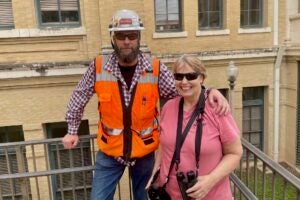
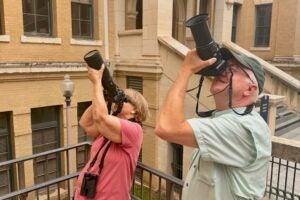
Tessie spent at least a year without a male, but this year a male was with her much longer. “I turn into a little kid every time I see them fly. ‘Oh, man! Look at that!’ It’s just spectacular.” As much as she wishes peregrine-watching were full time, alas: “There are the other parts of my life that demand I actually do things,” she says laughing, “pay bills, errands, chores. Sometimes those interfere!”
In May 2025, the nest box was removed for the Tower restoration. So, will the restoration work scare off the falcons, and if so, for how long? “If we are lucky, the work on the upper levels will take place during the time when the peregrines are normally gone (mid-March to October). The schedules seem to be aligning that way,” she says, having befriended many of the contractors. She believes when the scaffolding reaches the top, it will scare off the falcons for a while. But she says, “I fully support this necessary work. It’s the yin and yang existence of humans and wild creatures. We can co-exist.”
What would sweeten the deal for all the peregrine lovers, she says, would be if the nest box and the webcam were replaced when the restoration is complete. And Crump stands ready to repeat his high-wire performance for the cause.
“If the peregrines do leave, I firmly believe they will come back,” Hoffman says. “It could take a year or two. But even without a nest box to catch their eye or a webcam to follow them, I believe peregrines are going to return again in the future, and I intend to find out.”
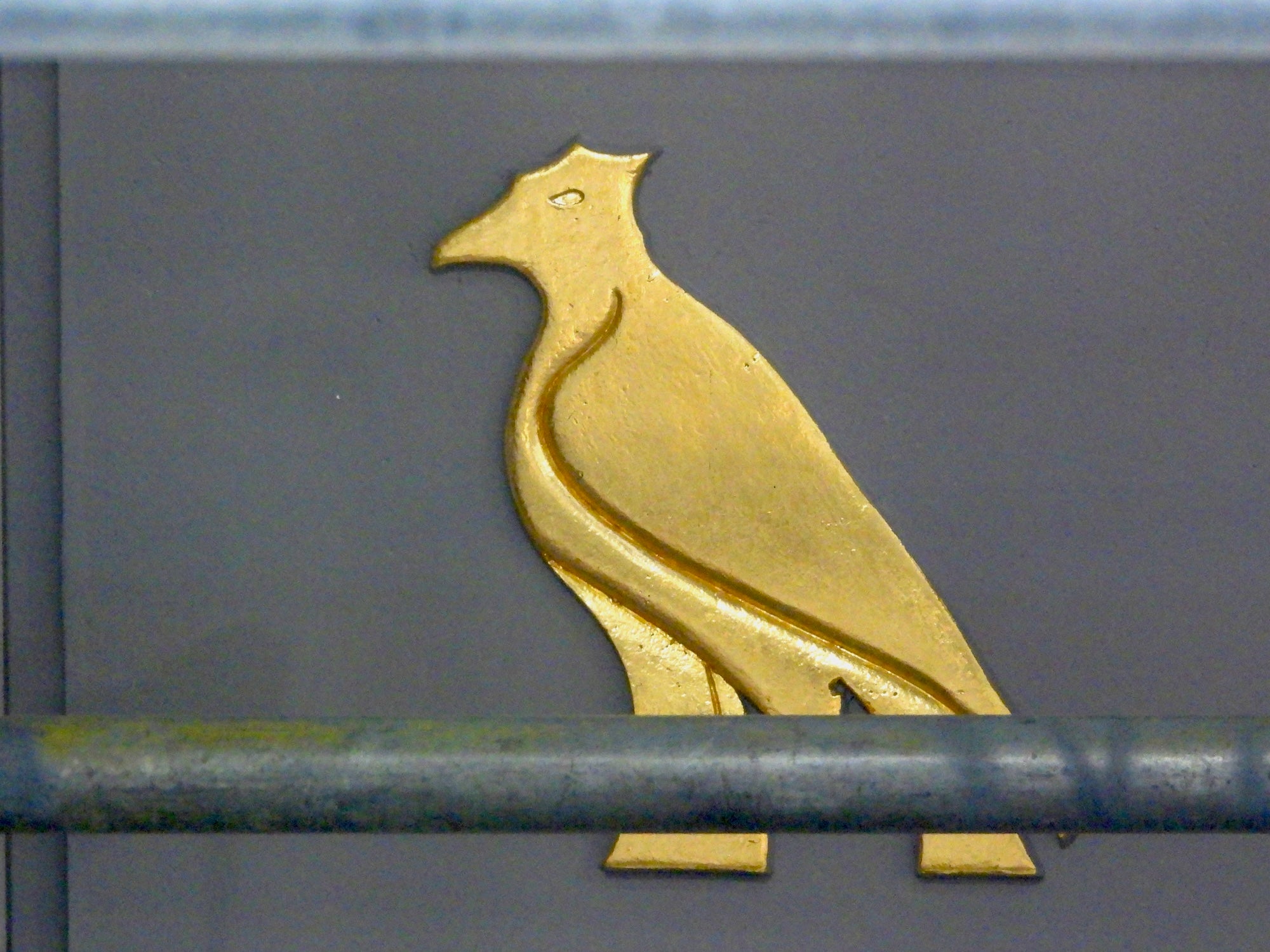
After our interview, we make our way out of the Main Building, and as we pass a window that overlooks the east courtyard, Hoffman stops and points to a recently restored panel in the shade of scaffolding. “There’s one right there.” Among the gilded Egyptian hieroglyphics, a falcon. And since peregrines are worldwide including in northern Africa, “a peregrine,” she says.
So whether high or low, falcons have indeed been on the Tower since its beginning.
Explore Latest Articles