A quartet of astronauts is on the way back from an historic trip around the Moon—the first crew to do so in more than 50 years—and a handful of Texas Engineers are playing an important role in the mission.
NASA’s Artemis II is the second in a series of missions that aim to set up a permanent presence on the Moon and prepare for future missions to Mars. This mission sent the four astronauts on a 10-day trip around the Moon, breaking the record for the furthest distance humans have traveled from Earth at more than 252,000 miles.
Alumni from the Cockrell School of Engineering helped make this mission a reality. And they will continue to play a key role in the Artemis program as it progresses the nation’s space ambitions.
“Artemis II is a powerful example of what it takes to send humans deeper into space. It requires not just spacecraft design, but guidance, structures, safety, and systems all working together,” said Clint Dawson, chair of the Department of Aerospace Engineering and Engineering Mechanics at The University of Texas at Austin. “Our alumni represent that full spectrum, and we’re incredibly proud to see Texas Engineers playing such a critical role in this mission.”
Here’s a look at the Texas Engineers across multiple disciplines contributing to the mission:

Emily Nelson (B.S. mechanical engineering 1998) is NASA’s chief flight director, leading human spaceflight missions from the Johnson Space Center in Houston. Nelson manages 31 active flight directors and flight directors-in-training who oversee a variety of human spaceflight missions, including the Artemis missions.
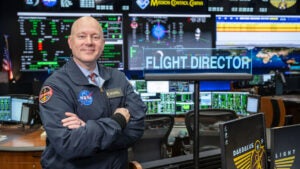
Judd Frieling (B.S. aerospace engineering 1996) leads the ascent control team. Per NASA, he oversaw the crew’s ascent to space, including the performance of space launch system core stage engines, solid rocket booster and propulsion systems that got Orion off the ground and then separated from the spacecraft as it transitioned to the Interim Cryogenic Propulsion Stage.

Dave Korsmeyer (M.S. aerospace engineering 1988) is the deputy center director of NASA’s Ames Research Center. He is supporting analysis of the heat shield for the Orion spacecraft on its return to the Earth and examination and analysis of high-resolution images of the Moon with the Artemis II science team.
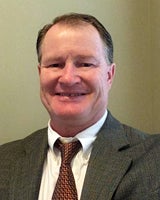
Jack Brazzel (B.S. aerospace engineering 1989) is the acting division chief of the aeroscience and flight mechanics division. He supports mission design and the trajectory of the Orion spacecraft as well as Guidance, Navigation, and Control systems, which includes flight paths, system checks and thruster firings.

Nathan Vassberg (B.S. aerospace engineering 1991) is the acting chief of safety and mission assurance for Artemis II. His team evaluated risks during the launch process and monitors flight operations to respond to any unforeseen events that arise throughout the mission.
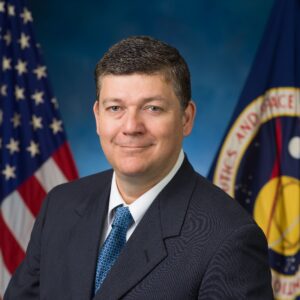
Edgar Rivera (B.S. aerospace engineering 1995) is a safety and mission assurance specialist, whose work crosses over many NASA missions, including Artemis.