The UT Tower is full of history, much of it its own. Within its 27 floors sit many libraries, offices and administrators, but did you know that the primary occupants of some floors are plants?
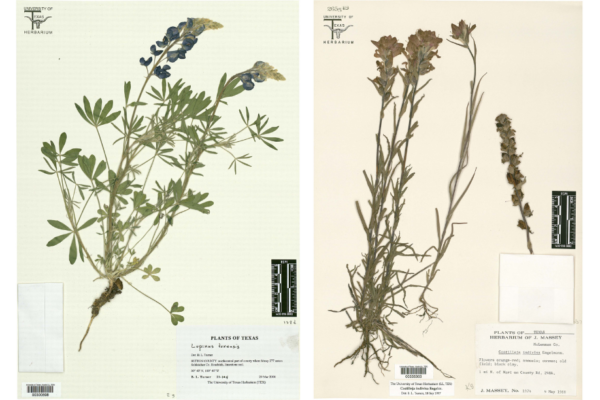
The Billie L. Turner Plant Resources Center, a collection of preserved plant specimens for botanical research and classification, occupies 10 floors of the Tower currently less suitable for people’s work or studying. Established in 1890, the herbarium contains over a million specimens, including one collected by Charles Darwin in 1835 during the voyage of the Beagle. The oldest specimen is over 250 years old, and the most recent one was collected this year.
A part of the College of Natural Sciences’ Biodiversity Center, the center is the second-largest herbarium in Texas and contains the most holdings of Texas plants in the world. Specimens from the collection are cited in at least 250 papers and books annually, and that number is growing thanks to the team’s work to make the collections digitally accessible.
For the past 40 years the collection has been housed in the Tower, spread between the second and 20th floors, growing at a rate of over 5,000 specimens per year. And the 5,000 is just what’s officially processed. George Yatskievych, the center’s current curator, leads a small but dedicated staff that receives more donations than can be processed in a year. Even with the 25-40 undergrads who work during the fall and spring semesters, if the center were to stop taking in specimens, they would still have a backlog that would take almost a decade to fully process, Yatskievych says.
In the grand scheme of herbaria, ours is relatively young. The first records of an herbarium appeared during the 1500s in Italy and began primarily because doctors needed to know not just how to identify local plants, but the different uses and dosages for treatment. Their establishment coincided with the creation of botanical gardens and acted as an educational resource, rapidly accelerating the study of botany.
In an herbarium, plant specimens are pressed to remove moisture and stored on acid-free paper. The drying process originated out of necessity when samples were collected during the 16th and 17th centuries on long sea voyages, and it was too challenging to keep plants alive. At the Plant Resources Center, folders of preserved specimen sheets are kept in tall, beige insect-resistant cabinets that cover the walls of the center’s 10 floors.
Even samples that are hundreds of years old in the collection are still scientifically useful, Yatskievych said.
“These are essentially little plant mummies, and as long as they aren’t mistreated in various ways — like fire or flooding or eaten up by insects or mishandled by people — they’re essentially permanent,” he said. “There are often specimens from a small geographic region, so people still use them for research on how abundance and diversity in local floras have changed.”
Alongside the three full-time staff members — Yatskievych, Assistant Curator Lauren Hoff and Collections Manager Mara Hosaka — student workers play a huge role in helping the center run. The students come from a variety of majors, and occasionally, they leave their position with a newfound passion for botany. Just this year, one student turned the part-time job into acceptance in a biology doctoral program. Another is spending the summer setting up an herbarium in Botswana with professors from the College of Liberal Arts’ Department of Geography and the Environment.
The center essentially acts as a training program for students, teaching them how to process samples, correctly press and preserve specimens, and all the steps of digitization, including photographing and cataloging the collection.
Access to the collection is available to everyone on campus and the public. Visitors can use the collections for both research and educational purposes related to plant classification, and people can learn from them as they would at a museum.
Both U.S. and international visitors travel to campus each year to use the specimens for novel studies or research projects. This summer, a group from the University of Arizona will use the collection to further research phytoremediation, the process of using plants to treat environmental pollution. Using X-ray technology, investigators can see which plants are better at extracting metals and other toxic materials.
Researchers have also used the herbarium’s specimens to learn more about Texas-specific flora. A group from South Korea studied specimens of plants that grow naturally in Texas but have become introduced as weeds in Korea.
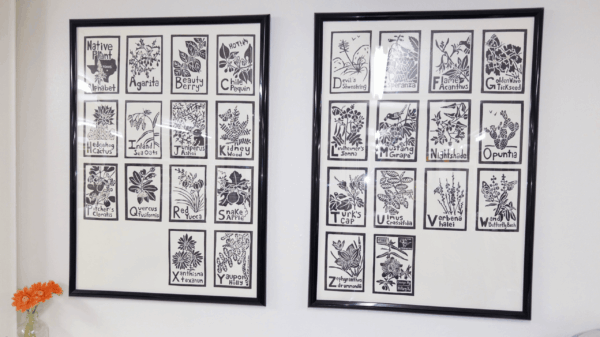
During the past year, the Plant Resources Center has hosted tours from different parts of campus as well — geography, landscape architecture, and even fine arts. Megan Hildebrandt, an associate professor of practice in the Department of Art and Art History, takes students in her first-year drawing classes to the collection each year.
“In my Foundations Drawing course, we take many field trips. Over the last decade, I noticed again and again that students could get stuck working in the same way, the same style, and choose the same subject matter or imagery to depict when given the choice in a studio,” Hildebrandt said. “I calculated that I could increase the amount of creative risk-taking by sometimes removing the students from the comfort of the studio classroom and encouraging them to see the world as their studio.”
Aside from hosting hundreds of visitors each year, the herbarium is taking on its next big project — a comprehensive book on the flora of Central Texas. Centered on the Hill Country, the book would be used as an encyclopedia and identification guide for both burgeoning and established botanists.
Part of the research for the book includes visiting public and private sites across Central Texas to look for already established samples and discovering new ones. Once finished, its descriptions will be an incomparable resource for those studying plants in the area and will further cement the Plant Resources Center as a vital resource in Texas botany.