UT’s Sports Mom
As the University’s faculty athletics representative, Mechele Dickerson is the hyphen in student-athlete.
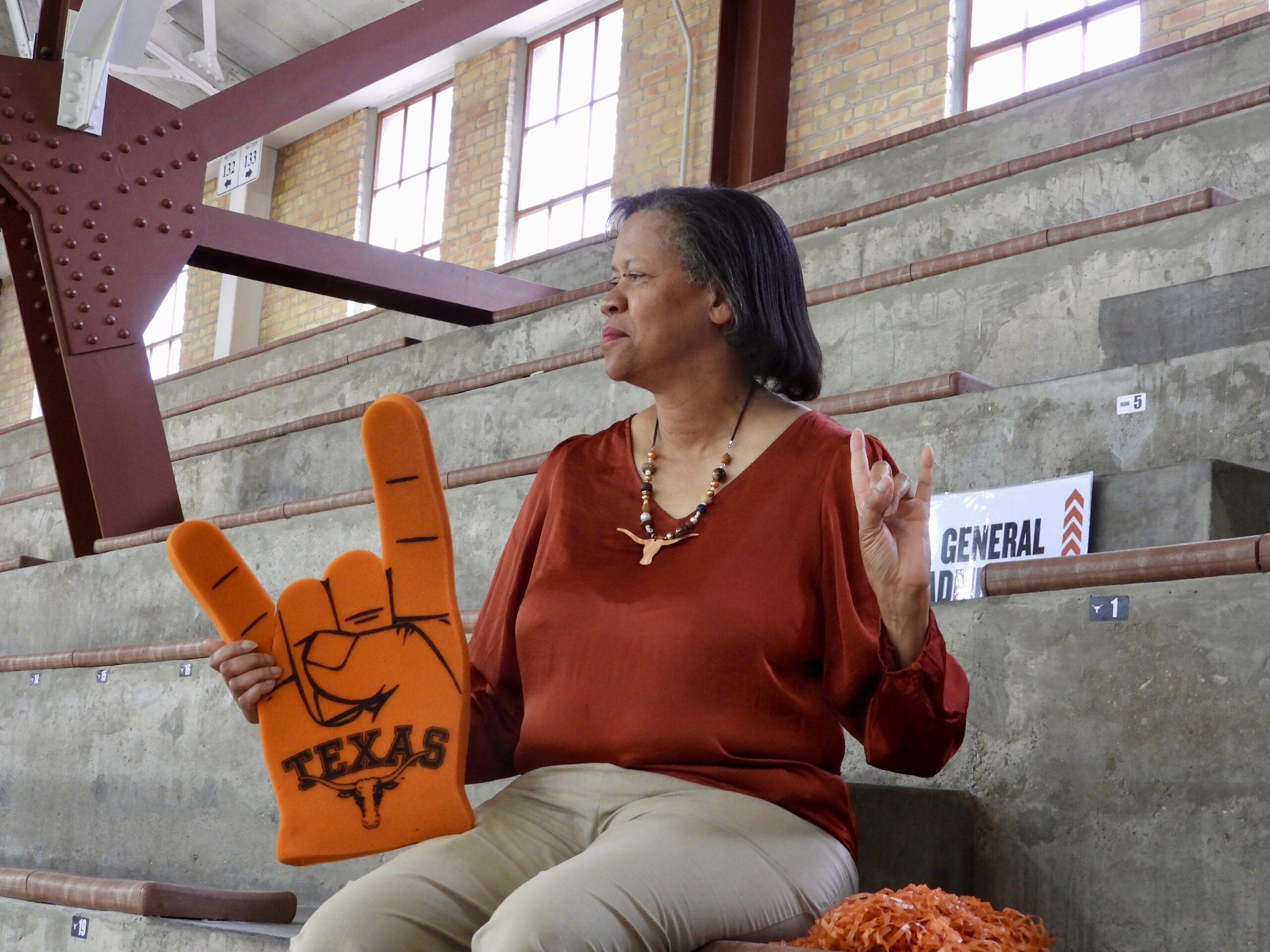
Mechele Dickerson in Gregory Gymnasium. Photo Avrel Seale.
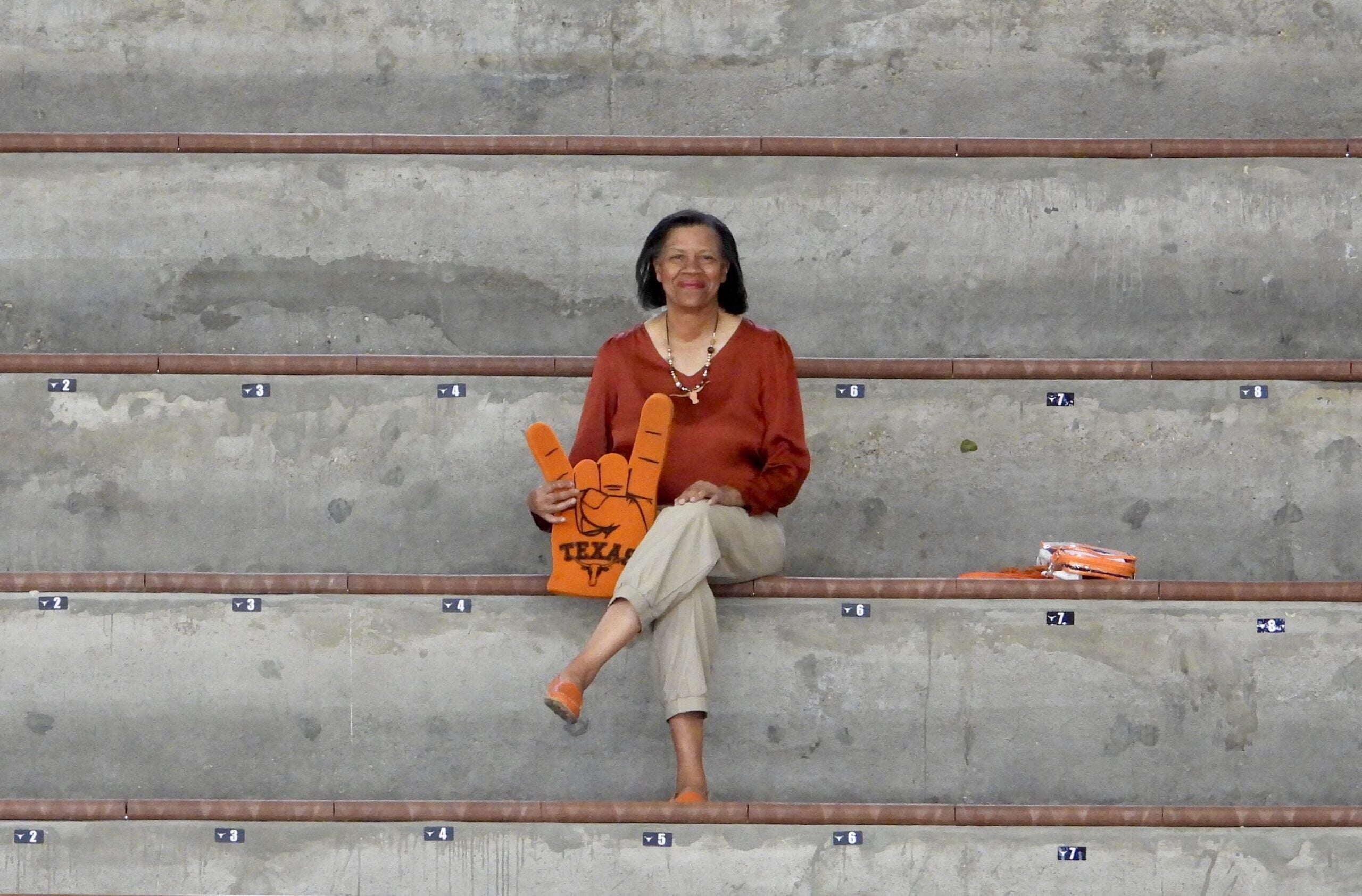
Law professor Mechele Dickerson tried to get her two boys into music — and theater. “Mommy was an artsy-fartsy nerd,” she says with a laugh. But when they chose sports instead (“That’s just how they were wired”), she dutifully became a sports mom. When they graduated from high school, she thought she was done with the constant football games and track meets. Little did she know that she was about to adopt more than 500 young women and men, every one of them an athlete.
For the past four years, Dickerson has served as the faculty athletics representative (FAR) at The University of Texas at Austin. Every university that participates in the NCAA must have one, and only one, FAR, who serves as the link between the academic features of the campus, the NCAA and the athletics conference.
Dickerson remembers that when her sons left home, she thought, “Oh, I get my life back now. But then I realized I had become the sports person that I thought I was just pretending to be because my kids were jocks.”
Nowadays, her life looks like this: “I started Friday at beach [volleyball]. I think it was Friday — yeah Friday, and softball. Oh, I also went to baseball, and men’s tennis. They were basically all in the same timeframe, and thank goodness they were all in the same space. I’m hopping back and forth — scan in and out, come back, scan in, come back.” Her spectating gear is dialed in: seat cushion, sunglasses, hat, clear bag with sunscreen bottle hanging from it. On a winter morning, she sits in the tennis bleachers covered in blankets (she keeps six in her car) at a match watched only by her and a few parents.
Chris Plonsky, UT’s executive senior associate athletics director attests: “Mechele attends home events religiously” in addition to her robust travel schedule.
The point of all this is to experience, as much as is possible, what student-athletes experience, looking at it through the eyes of a professor, to watch for concerning trends that might affect their experience as students, and then to report those to both the president and to the athletics director. Embedded with UT’s 21 NCAA teams, she is — you could say — the hyphen in student-athlete.
I realized I had become the sports person that I thought I was just pretending to be because my kids were jocks.
Mechele Dickerson
To experience what the students experience, she travels with the teams on planes and buses. She stays where they stay, eats what they eat. But she doesn’t leverage her position for the hot tickets or the cushy trips. For example, she stops attending games, meets and matches when their regular seasons are over because, fun as it might be, following them to tournaments would take her away from attending the other less spectated sports, which, though less hyped, are equally important. (The exception to this is football because its post-season does not overlap anything else.)
Likewise, when one of her fellow FARs at another university told her she was traveling with their golf team to a tournament in Hawaii and added, “If I’m going to pick trips, I know the trips to pick!” Dickerson held her tongue, but thought, “That’s not why I’m doing this.”
Rather, she’s on the bus to College Station with women’s swimming and diving, eating the little sandwiches everyone else is, and coming back that night. She attends these dozens of events not only because she genuinely enjoys them, and loves the students, but because, “then if I’m walking down the hill to DKR and see somebody, I can say, ‘Ooh, I saw that touchdown!’ or whatever it was.”
She says she wants to visit all the Southeast Conference cities, especially the more logistically challenging ones. During the previous weekend, she traveled with the softball team to Tuscaloosa, Alabama. She traveled with men’s basketball to Auburn, for which one must fly into Columbus, Georgia, in Eastern time and then take a bus to Auburn, Alabama, in Central time. She traveled with football to Mississippi State, which requires a flight into Tupelo and an hour bus ride to Starkville. Plonsky says Dickerson wanted an up-close look at what the SEC travel and competition schedule looked like compared to Big 12.
She can’t talk about what traveling with a team is like if she doesn’t see it. And as someone who was not a college athlete, she started her service without any “in my day” notions. “I wanted to see what we do for our student-athletes when they’re on the road,” she says. “If it’s midweek, are there tutors? Do they have time for study hall?”
On the third floor of the School of Law, where she has taught since 2006, Dickerson’s office is painted lavender, and nearly every piece of furniture — two desk chairs, two visitors’ chairs and a sofa — is her favorite color, purple. She explains that in her previous role as associate dean for academic affairs, she often dealt with angry students, but that in this office, with its colorful furnishings, Teletubbies and other eclectic tchotchkes, “You can’t be stressed out. You can’t be angry.”
Among those decorations is a Harvard pennant (undergrad and law), kid art, family photos galore, window sill plants, and a tote bag and water bottle from her recent appearance on “The Daily Show,” where Jon Stewart interviewed her about her research area and her new bestselling book, “The Middle Class New Deal: Restoring Upward Mobility and the American Dream.”

UT did not appoint just any professor to be its FAR. She is the Moller Chair in Bankruptcy and Practice and a University Distinguished Teaching Professor. During Dickerson’s first year on campus, she won the Texas Exes’ Faculty Teaching Award. In 2015 she was inducted into UT’s Academy of Distinguished Teachers, and in 2022 she won the Law School’s Massey Teaching Excellence Award. She also was involved with athletics before being appointed FAR, as a member of the Intercollegiate Athletics Council.
Plonsky says, “That IAC ‘runway’ complements her distinguished teaching career and her MVP (most valuable parent) role for her sons, Josh and John, who are elite student-athletes themselves. Just by raising her ‘broncos,’ she understands the discipline, rigor and time-management requirements of our student-athletes and appreciates the role of coaches and support staff in influencing their lives through mentorship, training and competition.”
To be clear, there are scads of people who support UT’s athletes in their academics — tutors, academic advisers, counselors. Likewise, there is a whole office devoted to making sure the University is following the NCAA’s numerous rules regarding student-athletes: compliance officers. But all of those are employees of Texas Athletics and report ultimately to Athletics Director Chris Del Conte.
Dickerson, by contrast, reports to the president. “I’m the only person who’s really involved in Athletics that isn’t paid by Athletics. There are some FARs that have part of their appointment in Athletics. I think that is a very bad idea, but that’s because I’m a lawyer, and I like nice clean lines.” She calls herself “the academic nerd in Athletics.”
To maintain those clean lines, she also buys all of her own tickets, which include season tickets for football, volleyball, women’s basketball, softball and baseball.
She is compensated for this intensive time commitment with a reduced teaching load, which still includes two classes each year: Civil Procedure and another that rotates between other topics such as College Sports, and Remedies (what one gets at the end of a case such as an injunction and damages).
Another way she monitors the student experience is by dropping in unannounced to one of the athletes’ study areas. Three times a term, she assigns herself study hall. “I take my laptop and go over to the fifth floor of the North End Zone, and I sit there for two to four hours.” Plonsky says Dickerson keeps these “office hours” in the UFCU Student-Athlete Academics Center “so she can be accessible and visible when students are in their study/learning environment.”
Every other Monday, she meets with the Student-Athlete Advisory Committee, on which each team has two to four members as representatives. “I don’t want a student to ever say, ‘I didn’t know whom I could go to.’ So, that’s one of the reasons I try to show up at as many of these places as I can. The student leaders know that there is a FAR. So, should something come up with a team, they know there’s at least one person that didn’t get paid by Athletics.”
Plonsky says, “Like all of our IAC faculty members, she continues to be a voice of accuracy and information when her colleagues have questions or want clarity on athletics’ impact on campus.”
She also gets to have conversations with parents. A couple of years ago on a baseball trip, she was sitting near some parents, when she overheard one say, “We went to dinner with our son last night, but it was a little bit of a bummer, because he kept saying he had to leave early, and we had to cut dinner short because he had to turn in a paper that night.” “Of course, I’m thinking, ding-ding-ding — that’s what I want to hear.”
After gathering all that input, she meets with Del Conte about every six weeks to discuss concerns, ask questions and talk collegiate sports. “But also, if I’m appointed by the president, I’m going to need to meet with the president,” she says, which usually happens in January and in summer.
One reason she spends so much time with the athletes is to be able to answer with authority what she sees as unfair criticism of the system. “People in general have this view that our student-athletes don’t care about academics.” Not so, she says, adding that this notion “offends me on so many levels.” When she asks them how their classes are going, she says they’re not athletes in that moment; “they’re full-out students” and enthuse, “Oh, I like this class!” Never in four years has a professor contacted her about an athlete’s lack of effort in the classroom, she says.
She adds, “One of the reasons student-athletes are highly sought after by employers is because — you talk about time management? Oh, they can do some time management for you!” She recalls a typical encounter in her office recently with one student who had her laptop open with color-coded charts for time management.
“This notion that students are being mistreated, they don’t have any guidance, they don’t have any support on the academic side — it’s just not true. But in order for me to be able to say that, I needed to see it.”
So, what does concern Dickerson? Her time as FAR has been marked by enormous changes in athletics, perhaps most notably the House v. NCAA case, which allowed student-athletes to be paid, including lucrative “name, image and likeness” deals. She acknowledges this has brought pressure to athletes but is quick to point out that NIL deals affect only a “really narrow band” of student-athletes. Many of the more than 500 UT student-athletes have NIL deals, but most are small, think $25 for an autograph. Perhaps 20 Longhorns — stars on the football, basketball or volleyball teams — enjoy the big deals that get media attention. “But in terms of these eye-popping numbers, it’s not our swim team. It’s not our tennis team.” Beyond scholarships, most students aren’t getting much of anything. Which makes the academic component — the degree — as important as ever.
“At the end of four years, that little bitty band [of large NIL deal recipients] may be going on to something pro. The rest of them need to have a four-year degree,” she says. “Particularly in this job market, if you don’t have a bachelor’s degree, you will never make it.”
Even for the few who are receiving big money, “this is not generational change,” Dickerson says. “It’s good for now, and it means you don’t come out of your undergraduate with debt. But for most of them, they need that bachelor’s degree, because in five years, even for the ones who go pro, you’re drafted at 21, and you’re there for five years. That’s a whole lot of life left. If they go and they make millions, and they invest it right, they may be fine. But most guys who go pro — they’re lucky if they’re there three years. Now you’re 27. What are you going to do for the rest of your life?”
Of the college athlete experience, the NCAA surveys student-athletes, and the one thing they consistently say they need is more sleep. “It’s always going to be sleep,” says Dickerson.
But she says, “My biggest fear now is the sports betting.” A few years ago, she was sitting with her son at a football game when some guys behind them — “granted, they were a little bit lubricated by then” — kept screaming at the coach, even as the Horns were ahead. She asked her son, “We’re winning! Why are they screaming at Sark?” To which her son answered, “It’s because he’s not going to make the spread.”
The first part of this is social media ugliness. “These are the attention seekers,” she says. “They want to get whatever rush I guess you get when you say something mean about somebody online.”
That’s not great, but it isn’t the worst form of harassment. That would be the direct messaging of threats, which “is gendered in ways that no man gets. The level of violence that is directed at NCAA female athletes is unheard of,” she says. “You just don’t see that when you’re walking around and talking to them at a volleyball game. You don’t understand what it may have taken for somebody to make it on the basketball court or volleyball court because of what may have hit their DMs. It is sick.”
Dickerson says her current “obsession” is to make sure that UT has people in place who are monitoring social media and “anything nasty that’s said about UT student-athletes, and also that we have people in place who the student-athletes can talk to both from a security perspective and also from a counseling perspective.” The University does.
“We’ve done really well athletically, but we’re also doing really well academically. And so that’s the piece that I really, as the FAR, want everybody to understand: Yes, we’re The University of Texas, and therefore, we expect excellence athletically, but we’re also The University of Texas, and we expect excellence academically as well.”
Longhorn athletes are enrolled across nine UT colleges and schools in more than 100 unique degree programs.
- The average GPA for Longhorn athletes is 3.4, with some 60 earning a 4.0.
- In Fall 2025, every sport recorded a semester GPA above 3.1.
- Nearly 90% of student-athletes held a cumulative GPA of 3.0 or higher following the Fall 2025 semester.
People in general have this view that our student-athletes don’t care about academics, which offends me on so many levels.
Mechele Dickerson
At a recent tennis match, Dickerson spotted players who were on the team two years ago. After they hugged, one of them asked her what team is her favorite. “I said all of my teams are my favorite.”
“I knew you were going to say that!” he replied.
“It was just sweet to be able to see student-athletes from a couple of years ago, and particularly for something like tennis, which isn’t the one that has the largest attendance. But from my perspective, if I’m the FAR, I’m the FAR for all of our student-athletes.”