A Century of Questions: UT’s Mark Raizen on Quantum Mechanics and the Future of Medicine
Researchers at Raizen’s UT lab are searching for new possibilities in health and medicine linked to quantum mechanics.
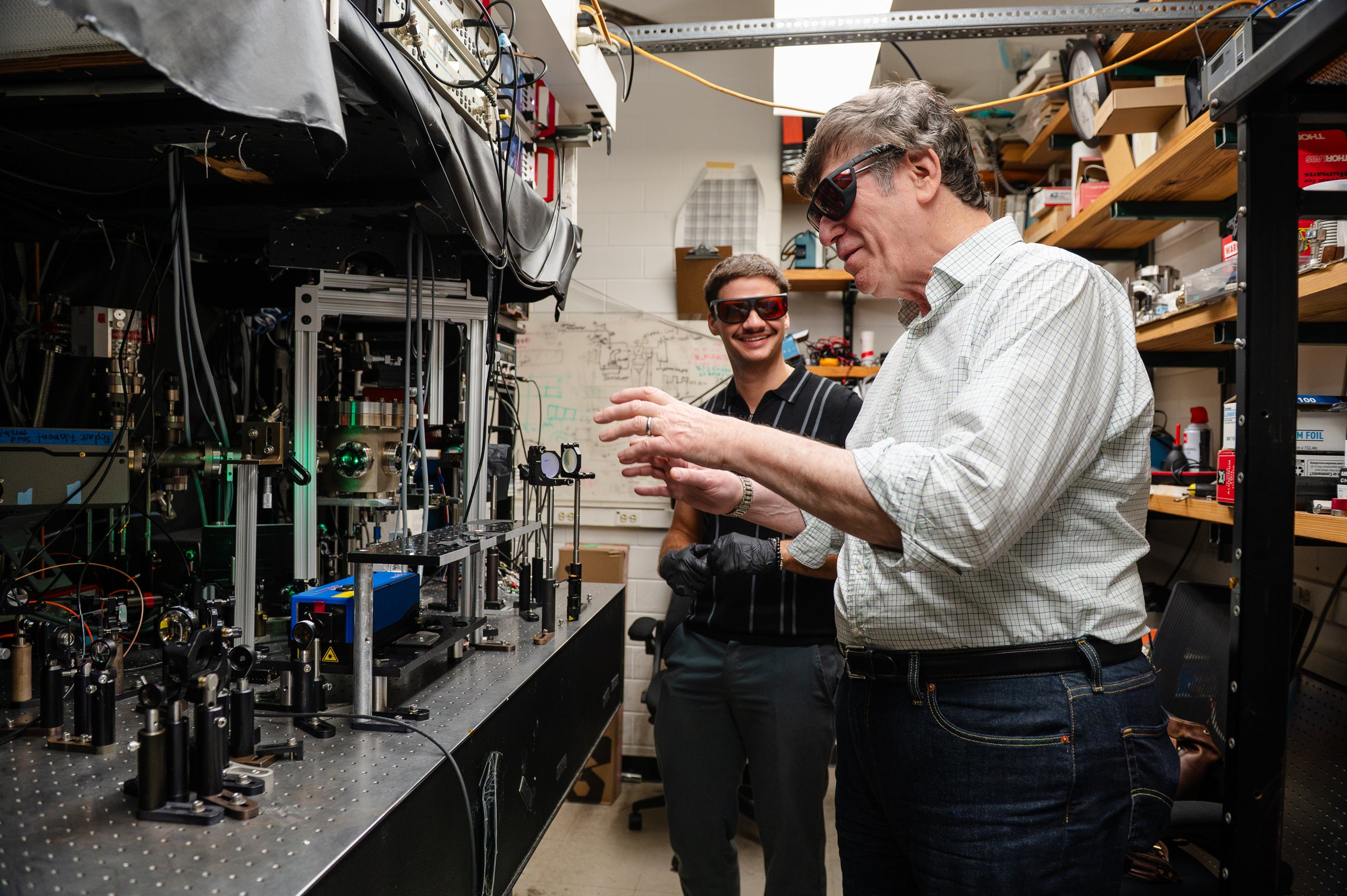
Mark Raizen’s physics research at The University of Texas at Austin marries theory and experiments, pushing the boundaries of quantum mechanics — the branch of physics that studies how matter and energy behave at the scale of individual atoms and subatomic particles — most notably in the field of medicine.
“There are still things about quantum mechanics that we don’t understand,” said Raizen, professor of physics and pediatrics. “And once you understand them, who knows what becomes possible?”
Raizen and other researchers at his UT lab are searching for new possibilities in health and medicine linked to quantum mechanics. Work at the lab, which delves into atomic, molecular and optical physics, drives research that spans:
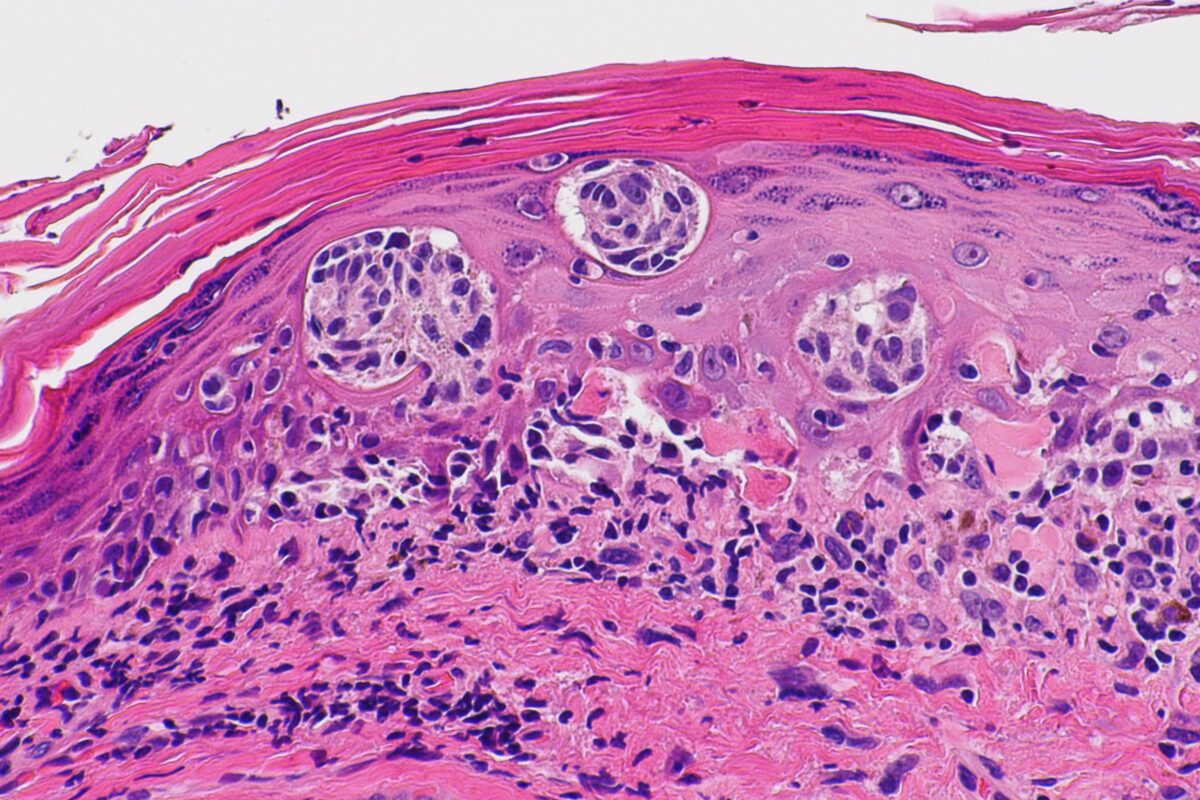
- Early exploration of how to develop an electronic “nose” capable of detecting melanoma from skin odor and radioisotopes precise enough to destroy individual cancer cells.
- Identification of potential new biomarkers to develop more efficient, reliable ways to diagnose chronic kidney disease using quantum sensing.
- Use of medical isotopes to better understand radioactive decay, the process of an unstable atom breaking down and releasing energy, and applying that knowledge to disease detection and treatment.
In 2024, Raizen’s lab became involved in the newly established Copenhagen Center for Biomedical Quantum Sensing, a nearly $22 million initiative funded by the Novo Nordisk Foundation. Raizen is one of three co-principal investigators for the center, where he’s exploring how quantum sensing can aid the global fight against iron deficiency.
What follows is a conversation with Raizen about quantum mechanics — its century-old unanswered questions, its practical limits, its place at UT, and the new frontier of quantum sensing, which he believes could transform how we detect and treat diseases.
How would you describe quantum sensing in everyday terms?
Quantum sensing reaches the sensitivity of counting atoms or counting photons — you’re really limited by the discreteness of the particles that you’re measuring. One of our projects, still under development, is to develop a quantum-limited electronic nose — a device that would literally be able to smell a patient. We envision it could even one day lead to a home test where a patient would use something like a little handheld vacuum cleaner, put an activated charcoal filter on it, and sniff their skin.
One of the deadliest forms of cancer is melanoma. It metastasizes, and the cure rate of Stage 4 melanoma is low, but it’s easily preventable. It’s been proven that trained dogs can smell melanoma. The cancer is on the skin, so it actually has an odor — some cocktail of volatile organic compounds. The dog doesn’t know what they’re smelling, but they’ve been trained through biopsies. There’s never going to be enough trained dogs to do it at scale.
The prediction we have — which I think is realistic — is that the electronic nose could be far more sensitive than any dog. Plus, dogs get tired.
How do you envision quantum sensing being applied to our understanding of the human body and diseases?
There is potential for a cure for cancer. There’s potential for curing infectious diseases — eradicating bacteria, viruses, fungal infections. These are big goals, and we have a lot more work to do before we can deliver on them all. But when you have a breakthrough in a new approach, big things become possible. This is the promise of basic science, of foundational discoveries. We learn what is possible only when we work hard on a problem and put resources behind unlocking answers to some of the most perplexing and persistent questions in all of science. Even today, all of us live under the shadow of cancer — ourselves and our loved ones.
What is it like to study phenomena that can’t be seen?
We’re building on tools that have been developed over the years. It’s not like I have to invent everything. We take what has been done, build on it, refine it and improve it.
Breakthroughs sometimes are enabled by new methods. My group has the patents on how to separate isotopes much more efficiently, isolate them and detect them. It’s like building a house. You have to have a solid foundation, which is the serious scientific work, and then you build on that. But the end result has to benefit people. The translation to real life is very important. I can’t emphasize that enough. That’s what really guides what I do.
What developments in quantum have enabled applications you work on to move from idea to a healthcare setting?
Laser technology, mostly. The laser is a quantum device in a way — a coherent beam of light. The laser was invented in the ’50s and continues to develop, but we couldn’t do this work without it. We also rely on nanofabrication, which allows us to fabricate things on the nano scale.
What else are you researching in quantum mechanics?
We’re building new experiments to test quantum mechanics in a very fundamental way. What I’ve proposed — and what we are going to do in my lab — is build an atomic clock with a radioactive atom. This has not been done before. Now, past work with atomic clocks has offered unprecedented accuracy in terms of measuring units of time, and that in itself connects to applications in everything from GPS satellite navigation to deep space exploration.
What we hope to do, however, is in some ways even more ambitious. We can trap individual ions and measure their clock frequency and see if it changes as they head toward decay. A radioisotope is born, created in a reactor, and then it decays. It has a half-life. We’ll work with an isotope that has a half-life of about 50 days, and we can hold on to a single atom and just keep measuring it day after day until it decays. Our hope is that all of this will point the way to new answers in quantum mechanics that have been especially hard to pin down with satisfying answers in all of these years. While we can’t know the outcome today, having that expanded foundation for understanding could prove revolutionary.