5 Questions for Edoardo Baldini
Assistant professor of physics discusses his quantum materials research, what inspires his work, and how it could impact the future.
Image credit
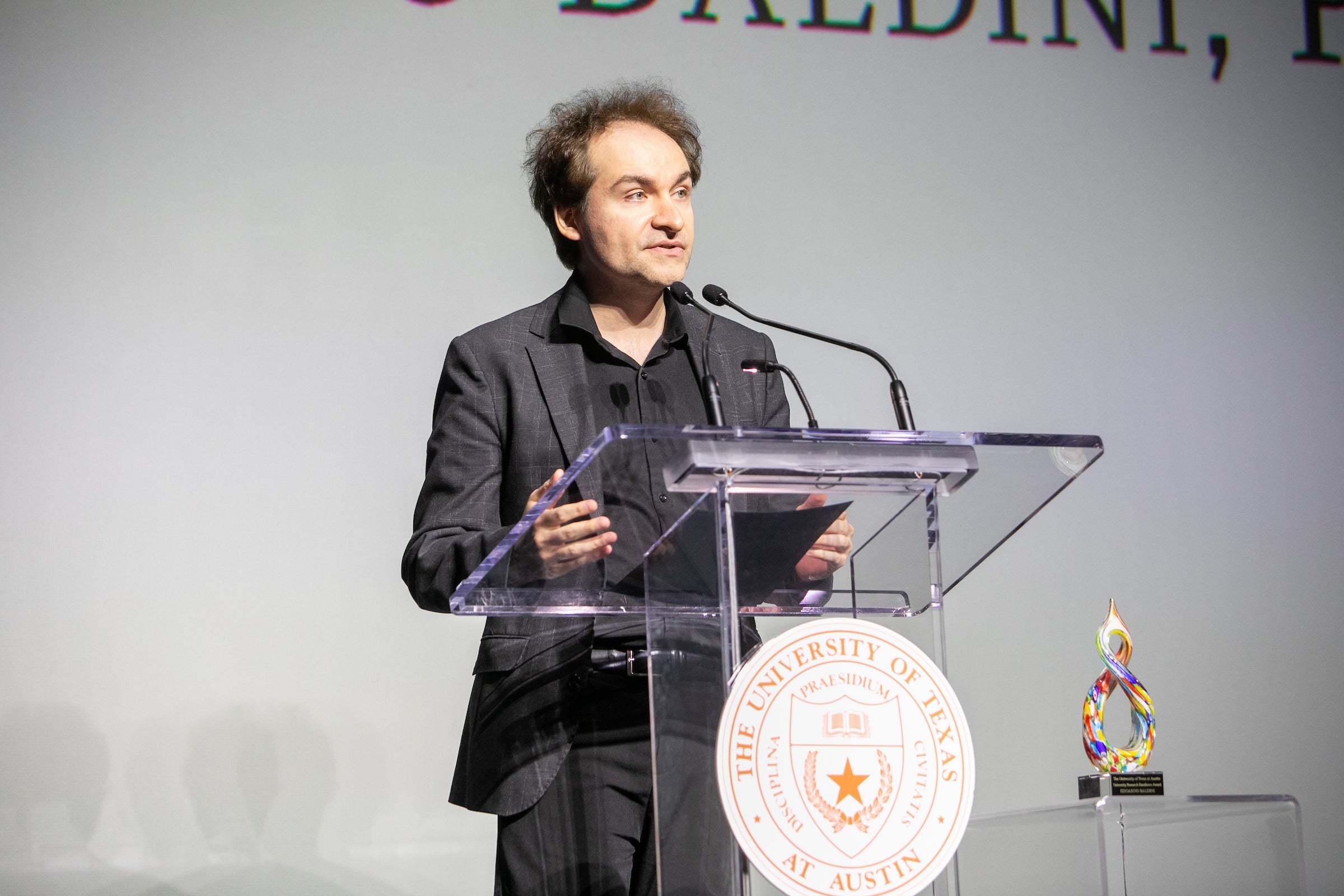
Edoardo Baldini is an assistant professor of physics in the College of Natural Sciences and a recipient of the University’s 2026 Research Paper Excellence Award. His research focuses on quantum materials. These materials are unusual because large numbers of interacting particles can organize into collective states with properties not found in ordinary matter. In the lab, researchers study how these behaviors form, what holds them together, and how they can be guided using light. This work helps reveal the hidden rules of nature and lays the groundwork for technologies that reduce energy loss, improve sensors and process information more efficiently.
Read on to learn more about Baldini’s research, what inspires his work, and how it could impact the future
What drew you to this research, and what inspires you?
I was drawn to science by a long-standing curiosity about how order and structure emerge from complexity. Physics has always been a way for me to confront the natural world with clarity rather than simplification, and quantum materials offer some of the most complex forms of matter we can study in a controlled way.
I’m inspired not only by discovery, but by the creative process of invention — transforming theoretical ideas into instruments that allow us to observe phenomena that would otherwise remain hidden. Science is also a shared human endeavor. Designing experiments brings together students, postdocs and collaborators, and watching them turn ideas into working experiments is deeply rewarding. I’m motivated by the cultural values embedded in science, including intellectual honesty, humility in the face of uncertainty, and a willingness to revise our views when evidence demands it. At its best, science replaces fear and division with understanding and provides a shared foundation for cooperation.
What is a recent discovery your research has uncovered, and how would you explain it to someone outside your field?
In recent work published in Nature, we studied an ultrathin quantum material in which electrical and magnetic properties are linked through an unusually strong and dynamic interaction. Using custom instruments developed in our laboratory, we demonstrated that very small electrical signals can drive large, coordinated magnetic responses at ultrafast timescales. This enhanced magnetoelectric effect arises from collective quantum behavior within the material and is far stronger than in conventional systems. This could point to future technologies that process information faster and use less energy.
What impact could your research have for future generations?
The most lasting impact of this research is the knowledge it creates. Discovering new quantum behaviors and learning how to control them generates foundational insights that can guide science and technology for years to come. Some phenomena once considered purely academic, like superconductivity, are already part of everyday technologies such as MRI machines and emerging quantum computing platforms. Looking ahead, advances in quantum materials could enable more energy-efficient electronics, new sensing and imaging methods, and faster, lower-energy ways to process information. Beyond specific devices, this work strengthens the foundation for future innovation and trains the next generation of scientists to tackle complex challenges, expanding what’s possible for society over the long term.
How could your research help solve big challenges in technology, energy or society?
Many of today’s biggest challenges, from using energy more efficiently to processing information faster, depend on the materials we rely on. My research studies how large ensembles of particles interact to give materials new capabilities, such as carrying electricity without losing energy or sensing tiny changes in their environment. The goal is not a single device but understanding which behaviors can be controlled and scaled for future technologies. This work also trains the next generation of scientists to solve complex problems, think across disciplines, and approach innovation with creativity and rigor, helping build long-term solutions for society.
How does donor support make your research possible?
Donor support is essential because it allows us to pursue bold ideas at the frontier of science, where new tools often must be invented before discoveries can happen. Support from Love, Tito’s enabled the construction of one of the few time-resolved momentum microscopes in the world, allowing us to see how electrons move and reorganize in quantum materials over time. The W.M. Keck Foundation supports our effort to create artificial electromagnetic environments that let us actively tune quantum material properties and explore forms of matter that do not naturally occur. The Robert A. Welch Foundation has been critical to our work on chiral phenomena, enabling precision techniques to detect and control subtle forms of order that shape how materials interact with light and energy. Together, these philanthropic investments do more than fund projects. They create an environment where students and researchers can take intellectual risks, build entirely new experimental capabilities, and pursue questions whose answers may shape science and technology for decades.
Philanthropic investments create an environment where students and researchers can pursue questions whose answers may shape science and technology for decades.
Edoardo Baldini
If you would like to support innovation at UT, please consider making a gift as we enter the final months of the What Starts Here campaign.