The Smallest Longhorn Ever, A Breakthrough at the Nanoscale
New insights into DNA assembly could streamline the design and manufacturing of nanostructures for medicine, materials and beyond.
Researchers at The University of Texas at Austin have uncovered key principles that govern how DNA “origami” structures fold, findings that could make nanoscale materials faster and easier to manufacture.
DNA origami is a technique that uses strands of DNA to self-assemble into tiny, programmable shapes. Although the method has shown promise for applications ranging from drug delivery to advanced materials, scientists have struggled to consistently achieve high yields, especially as structures become more complex.
In a new study published in Small, the research team led by Alex Marras, assistant professor in the Walker Department of Mechanical Engineering, systematically analyzed how design choices affect the folding process. Using a combination of real-time fluorescence measurements, electron microscopy and theoretical modeling, they identified the energetic forces that determine whether a structure assembles correctly.
“By understanding the fundamental thermodynamic factors that drive folding, we can design DNA nanostructures that assemble more reliably and much more quickly,” said Marras.
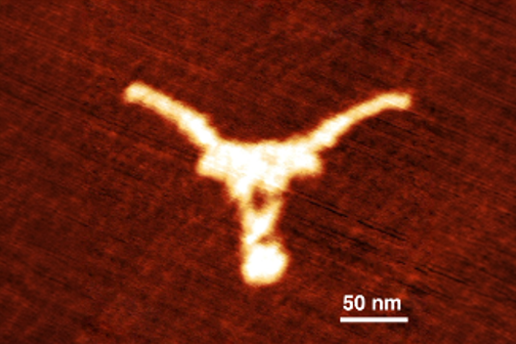
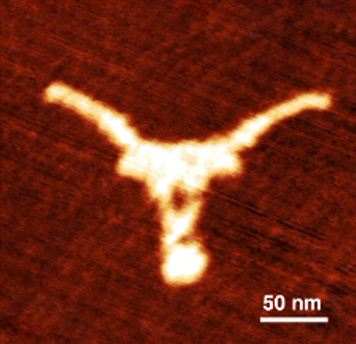
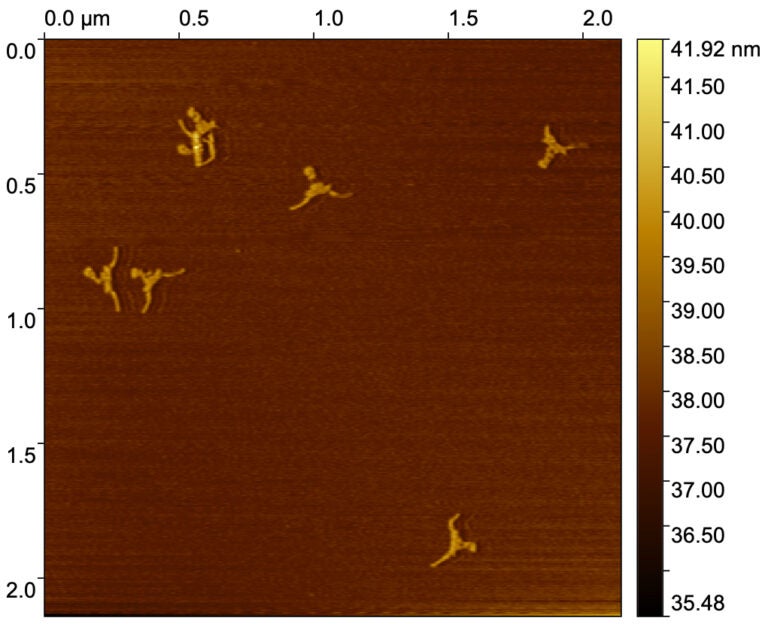
As part of the work, Ph.D. students James Houston and Meysam Mohammadi Zerankeshi created what they think is the smallest Longhorn logos ever made. It is a structure entirely made of DNA, measuring about 100 nanometers across and just 2 nanometers thick, demonstrating the precision and complexity achievable with their approach.
These Longhorn logos are thousands of times smaller than the thickness of a human hair, meaning approximately 10 million tiny Longhorns would fit in the volume of a grain of sand.
The researchers found that folding depends on a delicate balance between favorable DNA binding interactions and unfavorable energy costs associated with forming loops in the structure. They also showed that “cooperativity,” or how different parts of the structure influence one another during assembly, plays a central role in determining success.
The researchers found that reducing the number of inter-helical connections in the DNA nanostructure design increases cooperative behavior and improves folding yields. In contrast, simply strengthening binding between strands is less effective because it introduces entropic penalties that hinder assembly.
The team also demonstrated a practical improvement. By using a shorter, more focused heating-and-cooling process lasting just one to two hours instead of a traditional multiple-day process, they were able to boost assembly yields by up to 17%. This means that with the advanced understanding gained in this research, they were able to fabricate millions of copies of the Longhorn in less than two hours.
Together, the findings provide a clearer framework for designing DNA nanostructures with higher efficiency and reliability. As DNA origami continues to expand into areas such as medicine, electronics and materials science, the ability to predict and control folding could help accelerate real-world applications.