Data Centers Are Growing in Texas, But Big Questions Remain About Water Use
New report finds Texas data center growth could raise water use to as much as 9% by 2040, highlighting the need for more awareness, shared standards, and integrated planning to manage rising demand.

Researchers from The University of Texas at Austin are working with the data center industry and other stakeholders to help manage the impact of the growing industry on Texas. Credit: iStock/quantic69
Data centers could potentially account for 3% to 9% of Texas’ water use by 2040, according to a new white paper from The University of Texas at Austin that recommends greater transparency in the industry’s water use and better coordination among stakeholders to reduce the impact of data centers on the state’s water supply.
The estimate, which includes both water used for cooling and to produce the power needed for data centers, is part of a study that investigates water issues associated with the booming industry in Texas. Currently, data centers account for less than 1% of the state’s water use. Researchers estimate that number could increase depending on industry growth, the cooling technologies used, and the source of electricity powering the data centers.
For comparison, manufacturing accounts for about 7% of the state’s water use, according to the current state water plan.
“There’s a lot of uncertainty surrounding the water use for data centers,” said Mariam Arzumanyan, a postdoctoral fellow at the Bureau of Economic Geology, a research unit of the UT Jackson School of Geosciences. “People don’t know the scale of how much water is going to be needed. There is not a unified understanding of the technologies used for cooling, or how much water that technology would use.”
The white paper, “Water Use Requirements for Data Centers in Texas,” was developed by the COMPASS research consortium, which was created by the Bureau of Economic Geology. COMPASS works closely with industry leaders, policymakers and local communities to help understand and manage the impact of the growing data center sector on issues such as power use, land use, infrastructure planning and workforce issues.
The boom of data centers in Texas and across the country is fueled by the growing computing needs of artificial intelligence. Researchers said more than 400 data centers are operating or under construction in Texas and that more are planned. However, it is difficult to know how many of the facilities in the planning phase will come to fruition.
The water use estimates in the study primarily include the water used on-site to cool the computer servers housed by the data centers and the water needed to produce the energy that powers the facilities. The latter is significant because data centers use a lot of power, and much of the state’s power production comes from natural gas, coal or nuclear energy, which themselves consume significant volumes of water for cooling — about 5% of the state’s water use.
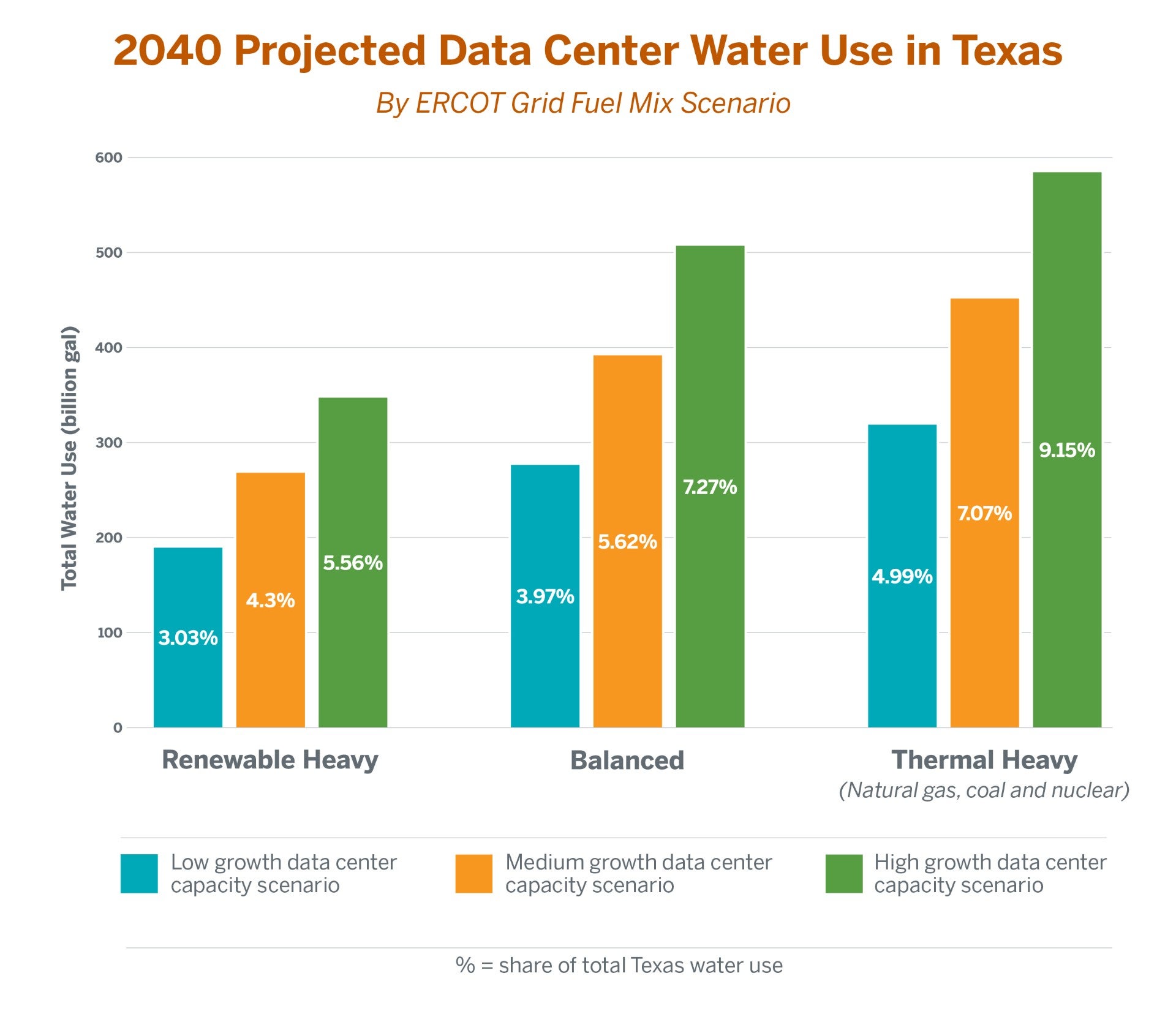
The white paper covers these water requirements in detail in addition to water quality requirements, water treatment solutions and their cost, regional water planning issues, and policy recommendations.
“What we’re trying to do via this white paper and the work that follows is come up with tools and techniques to predict water use, both direct and indirect, and help inform the community, city planners and local government about the water needs of emerging data centers,” said Vaibhav Bahadur, an associate professor in the Walker Department of Mechanical Engineering at the UT Cockrell School of Engineering.
Policy recommendations include:
- Greater awareness and systematic communication among key stakeholders, including data center operators, utilities, municipalities, state agencies, and private developers.
- Better mapping and accounting for projected industry growth in water-stressed regions of the state.
- Working toward integrated planning frameworks that combine hydrologic projections, grid capacity models, land-use constraints, and permitting processes.
Arzumanyan said an integrated planning framework is vital because Texas water is governed and influenced by so many entities — including cities, groundwater conservation districts, private suppliers, river authorities, the state Water Development Board and the Texas Commission on Environmental Quality.
Another priority that has been identified during COMPASS’ meetings with industry representatives, state and municipal officials and community organizations is the need to come up with a consistent framework to discuss and analyze water issues related to data centers.
“We need shared definitions and a common framework. Right now, conversations around data center water and energy are often inconsistent because people are using different assumptions and metrics,” said Ning Lin, chief economist at the bureau and COMPASS principal investigator. “This is where COMPASS can play a key role. As an independent research institute, we can provide objective analysis that helps align how industry, academia and policymakers understand these issues. We can create a common language that supports better decisions and more productive conversations by building a clear and consistent framework.”
UT researchers are advancing solutions to address the demands of growing data center development. Researchers with the Bureau of Economic Geology are conducting applied energy research, including studies of geothermal energy as a potential source of reliable, low-carbon power for data center operations. And Cockrell School of Engineering researchers are tackling wide-ranging innovations across the power delivery spectrum — from an advanced thermal interface material that reduces cooling demands to developing converters and next-generation power technologies to accommodate load growth.