
Love Coffee? Make Sure Your Brew is Sustainable
Before you brew that next pot of coffee, see why one UT professor says you should make sure it’s shade-grown.

A UT researcher says coffee drinkers should stick to shade-grown brews, which help promote sustainable agriculture. (Image and latte art courtesy of Monkey Nest Organic Coffee and Bakery.) Think twice before making that next pot of coffee.
When you’re deciding between regular or decaf, and black or cream and sugar, you also need to ask: shade or sun-grown?
One University of Texas at Austin researcher says that choice can help improve sustainability practices in the $100 billion global coffee industry.

To explain the impact your morning cup of joe can have, Shalene Jha, an assistant professor in the Department of Integrative Biology in the College of Natural Sciences, starts with the basics.
Coffee comes in two species: robusta, a plant that produces a lower-quality coffee, is able to grow in direct sunlight and at lower elevations and is typically produced using an intensive farming style; or, Arabica, a plant that produces a higher-quality coffee that flourishes under the cover of shade and is grown in more sustainable and environmentally friendly ways.
Coffee evolved in shaded environments, Jha says. It thrives in rain forests and under layers of trees patching together a blanket of shade from different heights.
“It’s amazing to walk through a shade-grown coffee farm and see that vertical structure and diversity,” says Jha, whose research has taken her to a coffee farm in Mexico that is also home to 150 species of birds. “It’s just so full of life.”
But across the globe, more and more farmers are using the intensive style of production rather than growing coffee under shade. Jha and her colleagues found in a recent study that the proportion of land used to cultivate shade-grown coffee has fallen nearly 20 percent since 1996.
“Even now, very little of the market is shade-grown coffee,” Jha says. “The amount of coffee produced in the world has increased, and a large fraction of that is sun coffee, not shade-grown coffee.”
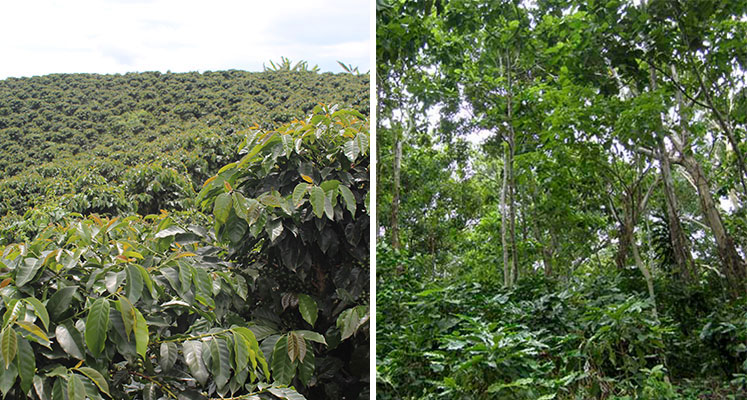
This picture shows the difference between the types of coffee farms. On the left, an intensive style of farming is used to produce lower quality sun coffee. On the right, a shade-grown coffee farm not only produces higher-quality coffee but also preserve wildlife habitat and promotes sustainable agriculture. (Image courtesy of Shalene Jha.) Jha’s study, published in the journal BioScience last April, shows that although global production of coffee has increased since 1996, the area of land used for non-shade-grown coffee is growing at a much faster rate than areas producing shade-grown coffee. That disparity caused shade-grown coffee to fall from 43 percent of total cultivated area in 1996 to 24 percent in 2014.
Shade-grown coffee usually tastes better and is of higher quality, but the production method also comes with five environmentally friendly advantages that can help make the coffee industry far more sustainable in the long run, benefitting both growers and coffee lovers for generations:
- Provides habitat: Compared to empty pastures, wildlife thrives on shade-grown coffee farms. Thousands of migratory birds take shelter in the canopies that cover shade-grown coffee farms when they fly from the tropics to more temperate regions during seasonal shifts. (Bonus: The birds prey on insects, which means farms can use fewer pesticides.) “Shade-grown coffee became popular in the ’80s when people started thinking about coffee as an important corridor and refuge for migratory birds,” Jha says.
- Increases pollination: Shade-grown coffee farms support the ecosystems needed to sustain a diverse range of pollinators, from bees to bats. These native pollinators help increase yields of other crops, from coffee to berries. Bees, for instance, pollinate more than $15 billion worth of fruits, nuts and vegetables in the U.S. each year. The number of managed honey bee colonies, however, has fallen from 6 million beehives in 1947 to 2.5 million in 2014, prompting President Barack Obama to launch a multiagency task force to help stop the rapidly diminishing populations of honey bees and other pollinators.”The greater the diversity you have in terms of flowering trees within the coffee farms, the greater the abundance and diversity of native pollinators,” Jha says.
- Purifies water and air: The dense vegetation needed to produce shade-grown coffee helps purify air and filter water, improving the quality of both.”With shade management, there’s a lot of secondary benefits to the local water supply without a cost to the community,” Jha says.
- Prevents landslides: The large and numerous trees at shade-grown coffee farms, which are often on mountainsides in hurricane-prone areas, help hold soil together, keeping chunks of farmland from eroding. Landslides caused by more intensive farming can claim lives and ruin infrastructure. “Having sustainable, shade-grown coffee reduces the landscape’s vulnerability to extreme climate events, and thus is a benefit to entire communities,” Jha says. “The production style of coffee really affects the quality of life for all organisms, including humans, around them.”
- Replenishes the land: Intensive farming methods exhaust the soil after a couple of decades, which often leads to farmers cutting down forest for new fields. But shade-grown coffee farming techniques store carbon and replenish soil nutrients, letting the farms thrive for centuries. “Sun coffee systems largely focus on short-term inputs and extraction, while shade system can naturally provide the soil with organic matter and nitrogen,” Jha says. “Once the soil quality is depleted the landscape is more likely to be turned into pasture because it can’t really be used for much else.”
But despite the benefits shade-grown coffee offers, high demand for inexpensive and instant coffee causes some growers to move to the intensive style of farming, which has lower land and labor costs and higher short-term yields.
The solution for increasing the number of shade-grown farms, Jha says, is twofold.
First, governments and conservation groups should incentivize shade-grown coffee production and help farmers find better ways to handle the expensive, up-front costs of getting certified to sell specialty coffees, like shade-grown blends.
Second, she says, coffee drinkers should stick to shade-grown brews.
“With any ecological or social challenge, there are multiple ways to work on it,” Jha says. “This happens to be one issue that consumers can actually participate in. By purchasing shade-grown and organic coffee, you can make a difference by voting with your dollars to increase more responsible agriculture practices.”
But while Jha has immersed herself in the coffee world, don’t ask her for detailed flavor profiles of your next-favorite blend.
“I’m not a coffee connoisseur,” Jha admits. “I’m a biologist who happens to study coffee ecosystems because they’re great examples of how to produce a crop and do it in a way that’s sustainable, biodiversity friendly, supports farmer livelihood and is sustainable in the long term.”