From the Forty Acres to Pluto: Longhorns in Space
As NASA’s New Horizons approaches Pluto, one alumnus will have particular cause to celebrate the accomplishment. From leading historic missions to out-of-this-world research, explore how Longhorns are changing the world with space-related projects.
Astronomers, scientists and those who dream of space are all eagerly watching as a NASA spacecraft flies three billion miles from Earth near the edges of our solar system.
When New Horizons reaches its closest approach to Pluto, one Longhorn will have particular cause to celebrate the historic accomplishment: Alan Stern, the mission’s leader.
Stern, who holds bachelor’s degrees in physics and astronomy and master’s degrees in aerospace engineering and planetary atmospheres from UT, is the principal investigator on the New Horizons mission. After nearly 10 years in flight, New Horizons will spend five months studying Pluto and its moons. On Tuesday, July 14, shortly before 7 a.m. Texas time, the spacecraft was set to get as close as it will to Pluto, some 7,800 miles from the surface.
The New Horizons mission has already helped scientists determine Pluto is larger than many prior estimates and will ultimately help us understand worlds at the edge of our solar system. Equipped with high-tech cameras, the spacecraft lets astronomers see Pluto in never-before-seen detail.
But Stern’s mission is just one example of Longhorns dreaming of beyond infinity.
Our geologists help train astronauts for trips to the International Space Station. And when asked their occupation, 12 of our alumni reply “astronaut.”
Students can now even earn a master’s degree in space entrepreneurship. The program is part of the Masters of Science in Technology Commercialization and focuses on combining space exploration and business management.
This past April, Michael Watkins, who oversaw operations of the Curiosity rover that landed on Mars in 2012, announced his return to UT as the next director of the Center for Space Research in the Cockrell School of Engineering.
Watkins, who earned his bachelor’s and doctoral degrees in aerospace engineering from UT Austin, worked at NASA’s Jet Propulsion Laboratory for 22 years and led various teams for many of NASA’s most high-profile missions.
This summer, officials announced UT scientists and a team of international partners are helping to build the Giant Magellan Telescope, which is poised to be the largest optical telescope in the world. Addressing some of the most important issues in astronomy today, the Giant Magellan Telescope will let astronomers look deeper into space and further back in time than ever before.
“It says something very deep about humans and our society, something very good about us, that we’ve invested our time and treasure in building a machine that can fly across three billion miles of space to explore the Pluto system.” –UT alumnus Alan Stern, who is leading NASA’s New Horizons mission, in an interview with the Smithsonian.
And while distinguished alumnus and Oscar winner Matthew McConaughey, B.S. ’93, boldly goes where no Longhorn has gone before, other students, faculty and alumni are also changing the world with space-related projects.
Here’s a look at some out-of-this-world ideas to come from the Forty Acres:
- When a NASA spacecraft sets off to explore Jupiter’s icy moon Europa, equipment designed by a UT team will help search for the ingredients of life. Radar equipment designed to pierce the ice of Antarctica developed by the Institute for Geophysics in the Jackson School of Geosciences, will let researchers see the subsurface landscape of Europa’s ice shell all the way to the ocean below when the spacecraft launches in the 2020s.
- In 2012, UT astronomers and NASA discovered the first multi-planet system around a binary star. Like something out of “Star Wars,” the Tatooine-like system proves planetary systems can form in a disk around a binary star.
- The Hubble Space Telescope has enable humanity to look more clearly than ever before into the cosmos. From learning how galaxies grow to discovering a new class of black holes, here are 10 discoveries related to the Hubble Space Telescope that Longhorns have helped uncover.
- From NASA’s original generation of brainpower to the future of human space flight, the Cockrell School of Engineering has made deep and wide contributions to space exploration over the years. Here’s a rundown of some of the Contributions in Space made by Cockrell School alumni.
- Celebrity astrophysicist Neil deGrasse Tyson, M.A. ’83, is director of the Hayden Planetarium and perhaps the country’s most well-known scientist. Tyson, who hosted the reboot of Carl Sagan’s 1980 science documentary television series “Cosmos” in 2014, testified before the U.S. Senate about the value of funding NASA. “Epic space adventures plant seeds of economic growth,” Tyson said, “because doing what’s never been done before is intellectually seductive (whether deemed practical or not), and innovation follows, just as day follows night.”
[Watch Neil deGrasse Tyson, M.A. ’83, testify before congress about the value of funding NASA, and check out four other great speeches from Longhorns.]
- In 1969, about a month after the first moon landing, astronomers at UT’s McDonald Observatory measured the Earth-Moon distance by beaming a laser from a telescope to reflectors placed on the Moon by Apollo astronauts. Still underway today, the lunar laser ranging experiment is the longest-running experiment from the Apollo program.
- Researchers at the Center for Space Research help answer questions about the Earth’s gravity field, weather forecasting, the environmental impacts of oil spills and mapping ocean circulation, among other topics.
- The Texas Petawatt Laser lets scientists conduct fundamental research into exotic states of matter. Using an intensely focused laser beam, UT scientists create the sort of dense matter found at the center of stars and recreate conditions characteristic of planetary cores.
- In 2013, a team of UT scientists used instruments on the Mars rover Curiosity to analyze samples of sand and dust.
- Nearly 90 percent of undergraduate students engage in research during their time at UT. Rebecca Larson, an astronomy and physics student, presented at 2015 Research Week her research on how “The Herschel Space Telescope confirms the decay of supersonic turbulence.”
[Across the Forty Acres, students are conducting all sorts of research. Explore these 30 Seriously Impressive Undergrad Research Projects.]
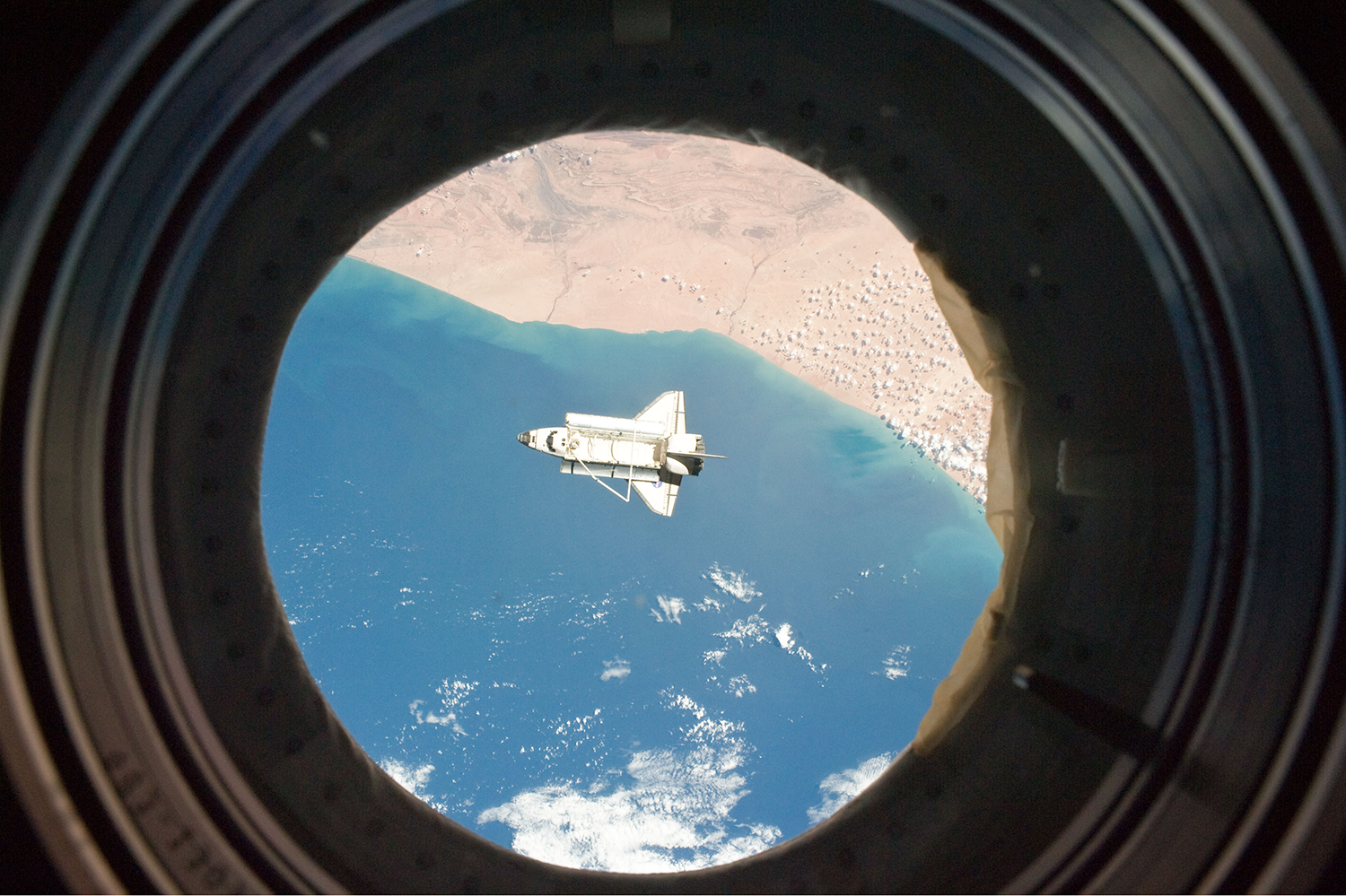
This picture, taken from the International Space Station, shows the space shuttle Discovery over the northern Atlantic Ocean in 2011. Photo courtesy of NASA’s Marshall Space Flight Center
- James Yoder, an electrical and computer engineering freshman, created the data visualization website Stuff in Space to show, in real time, the human-made debris and technology orbiting Earth.
- Hans Mark, a professor emeritus in the Cockrell School of Engineering, had a legendary career in the space industry before coming to the Forty Acres. He was in mission control for the first moon landing and the first space shuttle lunch. He taught Carl Sagan, and he urged President Ronald Reagan to to adopt the Space Station program. Mark, who served as Secretary of the U.S. Air Force under President Jimmy Carter and as deputy administrator of NASA, is now pushing for a manned mission to Mars.
- Scientists at McDonald Observatory are installing and testing instruments for the Hobby-Eberly Telescope Dark Energy Experiment. Later this year, they’ll begin searching for the mysterious “dark energy” that seems to pervade all of space. The first major experiment of its kind, the project could eventually help researchers better understand how the universe was born and tell us if the laws of gravity are correct.
- And, in his famous 1962 speech, President Kennedy said, “We choose to go to the moon in this decade and do the other things, not because they are easy, but because they are hard.” To illustrate that point (and perhaps the Longhorns’ dominance on the field), JFK asked the crowd gathered at the Rice University football stadium, “Why does Rice play Texas?”
[Hayley Fick, a 2015 graduate, left the Forty Acres with public relations degree. Now she works for NASA, where she leads tours and helps reporters cover the agency’s work. Learn more about her story and see how other recent graduates are changing the world.]