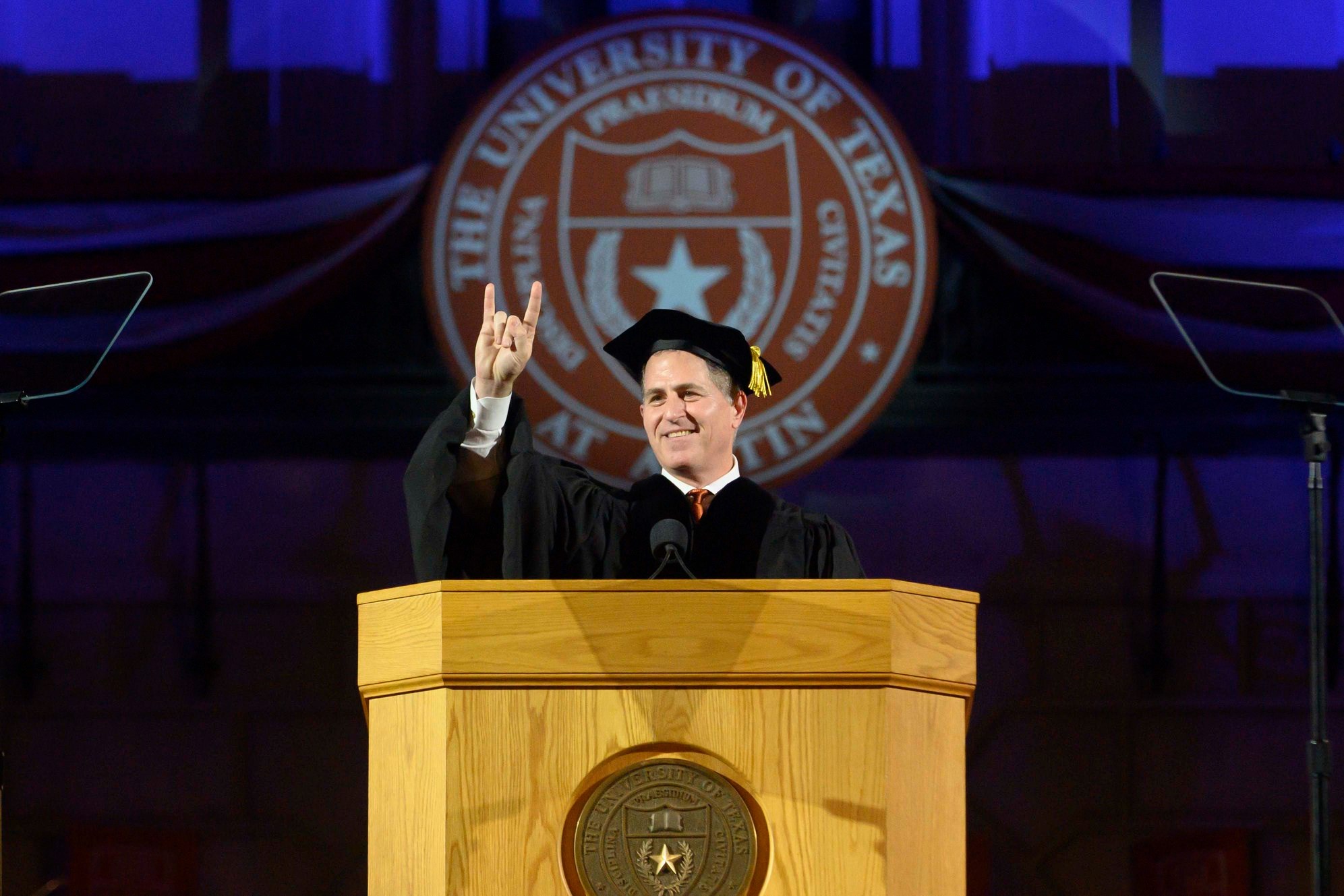
Following is a transcript of the May 25, 2019 spring commencement address at The University of Texas at Austin delivered by Michael S. Dell, chairman and chief executive officer of Dell Technologies and co-founder of the Michael & Susan Dell Foundation.
Congratulations, Class of 2019!
Thank you, President Fenves… both for inviting me here today and for that kind introduction.
And of course I’d be happy to sign that floppy disk for you.
When we’re done here, just shoot me a telegram and we’ll get it taken care of.
Seriously, it’s an honor to share the stage with some of UT’s incredible faculty.
To the parents and family members here today: you did it.
Today my family is sharing the celebration. Our daughter Juliette is graduating.
Which, as she knows, is something I never quite managed to do.
If you don’t know, I should confess: I dropped out of UT after two semesters.
Let me explain.
As far back as I can remember, I always wanted to go faster. When I was young, I was flipping through a magazine when I saw an ad in the back. By taking one simple test, the ad explained, I could skip high school. Well, I thought that offer was too good to pass up. So I clipped out the ad and sent away for my high school equivalency exam.
My plan was foolproof… except for one problem: I was eight years old.
A few weeks later, our doorbell rang. My mother answered the door. It was a woman from the testing company. “Is Mr. Michael Dell home?”
Right on cue, my mother answered: “Yes, he is… he’s taking his bath.”
To make a long story short, I graduated from high school—ten years later.
Almost as soon as I got to college, I wanted out—and not just because I was living at Dobie.
I’d started a business. It was growing exponentially, and at the time, it felt to me like college was a distraction. Real life, I thought, was out there.
One point of clarification: when a college freshman says he’s dropping out because he’s selling something out of his dorm room… it’s probably not 10MB hard drives.
But that is what I was selling, and it put me on a path that’s been more interesting, more challenging, more fulfilling and more fun than I could have ever imagined.
Thirty-five years later, I’m here to tell you that what you’ve gained here, by completing your degree, will be indispensable “out there.”
In a world that doesn’t wait, you should be proud for taking the time to finish what you started. It took me a lot longer than four years to learn the value of patience.
You’ve also gained the trust and respect of your friends and mentors. Don’t take that for granted, because trust and respect are two things that you earn very slowly and can lose all at once… like a 10-win football season.
And by the way, you didn’t just complete your degree. You completed your University of Texas at Austin degree.
This university is a remarkable place. The scale of its ambition… the diversity of its people and ideas… the emphasis on making a difference…
Take it from someone who spent two semesters in Longhorn Nation—and three decades, give or take, in the neighborhood: there’s just no place else like it.
I appreciate that now in a way that maybe I didn’t as a student, when I was in such a hurry.
As a kid, I was fascinated by computing—the idea that we could program a machine to exceed our capabilities. That we could use the power of what’s possible to do the impossible.
It started when I got my first calculator in elementary school. By junior high, I was staying after school to write programs on my math teacher’s Teletype computer terminal. When I finally got my first computer, at age 14, I did what any normal, well-adjusted teenager would do: I took it apart, piece by piece, and examined the circuits.
A few years later, I got unbelievably lucky: the National Computer Conference relocated to my hometown of Houston. Thankfully, I had my driver’s license—because I couldn’t have paid anyone in Houston to take me to the 1982 National Computer Conference.
To understand why, I want you to close your eyes and imagine a state-of-the-art technology conference. The epic stage with space-ship lighting. The photogenic “founders” and “creatives,” wearing hoodies and gliding around on scooters.
Now imagine exactly the opposite of that.
Imagine a fluorescent-lit room filled with men—and yes, at that time, it was nearly all men—and some of them even wore pocket protectors.
To give you a taste of what was on the menu in 1982, the theme of the conference was “Advancing Professionalism.” Not, you know, “Changing the World.” Advancing. Professionalism.
Well, I was in heaven. I probably couldn’t have explained why at the time, but I think I know now.
What excited me most were the words “personal computer.” Now, that, to most of you, probably sounds about as cool as “Advancing Professionalism.”
But you have to understand: in 1982, we weren’t so far from a time when, if a university had a computer, it was so big they had to build a special building around it. And it took a team of people to operate it. And it had about as much computing power as a vending machine.
To go from that to a personal computer… in a word, I knew it would be empowering. I didn’t know that computers would become a gigantic industry. I just knew that they were going to help more people do the impossible.
When I look back now, it’s clear that 1982 was just the beginning. And sooner than you think, you’ll look back on 2019 and see: it’s still the beginning.
The question is, the beginning of what?
After all, these days, many people are frightened by technology. Rightfully so.
Technology is evolving faster than we—and our laws—can keep up. Technology is displacing workers from their jobs, and very possibly, displacing humans as the most intelligent species on Earth.
The truth, though, is that I’m a massive optimist. Let me tell you why.
First, even in light of some very serious problems, I find it impossible to overstate technology’s potential for good. We know the role technology plays in empowering us—in enabling us to improve our own lives—and we’ve seen how it empowers others around the world.
The democratization of technology over the past few decades has helped to drive a huge increase in human progress. And we’re just getting started.
Both my company and our family’s foundation are investing in projects that use cutting-edge technologies to solve age-old problems. We’ve seen a simple banking app help families break out of the cycle of poverty. We’ve seen massive information networks help girls access education. Tiny satellites are helping us track toxic debris from wildfires.
You’ve probably heard about what’s coming down the pike. Self-driving cars. Drone deliveries. But how about some real progress, like the eradication of deafness… and blindness… and paralysis? Neural implants, robotics, and AI will make all these these miracles possible.
When I started Dell 35 years ago, I couldn’t have imagined any of this.
That’s why I made sure people were at the center of everything we did. Not technology. People.
In the early days, that meant selling PCs directly to customers.
Then came the rise of the internet, smart phones, the cloud and a massive increase in the amount of digital data in the world.
To succeed and grow we are constantly learning, transforming, evolving, and staying curious.
Just like you will do over the course of your careers. Because this is how progress happens.
That transformation required me to take some of the biggest risks of my life. I wanted to accelerate the pace of our transformation, innovate more aggressively. So after 25 years as a public company, I decided to take the company private. It was at the time the largest company in the world, by revenues, ever to go private.
It worked very well and then we decided to take an even bigger risk—making the largest acquisition in technology history.
Everything really is bigger in Texas.
There were plenty of skeptics and back-seat drivers. Actually, I thank them, because for me it was just motivation to prove them all wrong.
Now we are public again, stronger than ever, and having our best year ever. More relevant and able to serve more customers than ever before. We are pleased but not satisfied. We’re in a race with no finish line and the pace just keeps getting faster.
But our goal is not just to make our company grow. Our goal is to enable human progress and potential… and in that regard, we—all of us—have a lot of work to do.
I believe we have a responsibility to help ensure that the next generation of even more powerful technology reflects our humanity and our values.
Which brings me to the second reason I’m optimistic about technology:
I have faith in what you’re going to do with it.
Technology itself is neutral. It’s neither good nor bad. Technology can amplify human genius, but it can also amplify human frailty. The choice is ours.
The choice is yours.
And that is why I’m optimistic.
Your generation has already made it clear that you’re committed to fairness and justice for all.
You are as engaged as any group of graduates who ever walked the 40 acres. You’re going to demand that technology not only do new things, but do the right things.
And you see your role in making that so.
You have the drive to align your work with a greater purpose.
You have the ambition not only to succeed but to serve.
This, you might say, is humanity’s source code.
It’s not a coincidence that these values are central at UT.
Whatever you majored in, whatever you do after today, living up to that code will not only “Advance Professionalism.” It really will change the world.
Of course, living up to that code is hard. It’s going to demand that you step up… and take risks.
Many people never realize what they’re capable of because they’re afraid to make mistakes.
Many people don’t stand up for what’s right because they’re afraid to be wrong.
But that’s not how changing the world works. Unless you’re willing to take risks, you won’t have a chance to use your talents when and where they matter most.
Class of 2019, you have used those talents well in your years here at UT.
The world needs your talents now. The world needs you now.
The eyes of Texas and the world are upon you.
So step up… and take risks.
Because the rewards—for you and the lives you change—will be worth it.
Congratulations and hook ‘em horns!