UT Austin, MD Anderson Announce First Collaborative Projects in United Fight to End Cancer
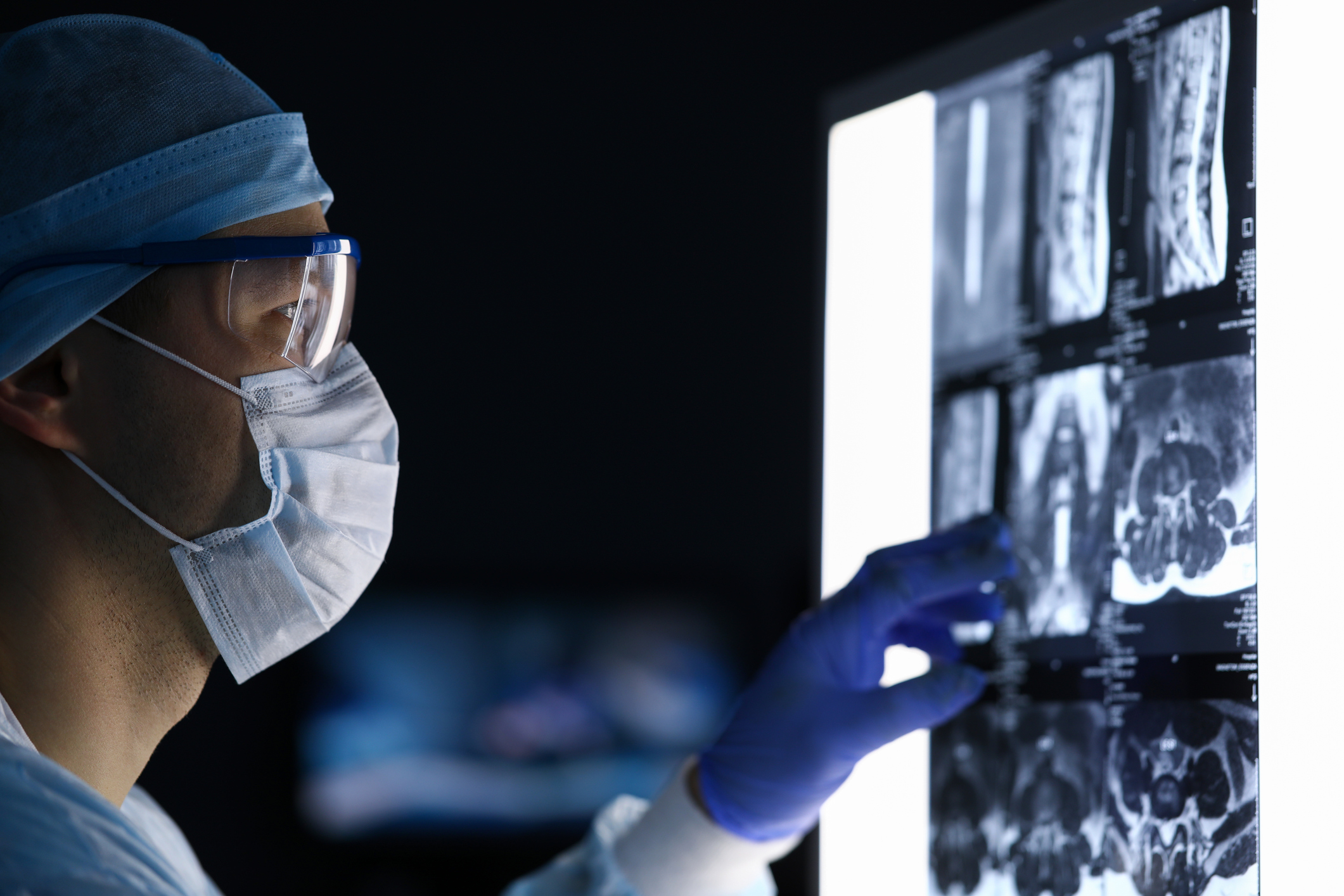
Image Credit: Male doctor in surgical clothes looking at vertebral mri scan headshot
AUSTIN, Texas — Cancer remains one of the leading causes of death worldwide. While advances in cancer diagnoses and treatments are promising, more is needed to address this devastating disease.
Earlier this year The University of Texas MD Anderson Cancer Center, UT Austin Oden Institute for Computational Engineering and Sciences, and UT Austin Texas Advanced Computing Center (TACC) launched a new collaboration in oncological data and computational science. The strategic initiative creates a unique opportunity to align mathematical modeling and advanced computing methods with oncology expertise to bring forward new approaches that can improve outcomes for patients with unmet needs.
Following are the first five projects to be funded through the collaboration:
- Angela Jarrett of the Oden Institute and Maia Rauch of MD Anderson will develop a patient-specific mathematical model for forecasting treatment response and designing optimal therapy strategies for patients with triple-negative breast cancer.
- Caroline Chung of MD Anderson and David Hormuth of the Oden Institute are using computational models of the underlying biology to fundamentally change how radiotherapy and chemotherapy are personalized to improve survival rates for brain cancer patients.
- Ken-Pin Hwang of MD Anderson and Jon Tamir of UT Austin’s Department of Electrical and Computer Engineering and the Oden Institute will use mathematical modeling and massively parallel distributed computing to make prostate MR imaging faster and more accurate to reduce the incidence of unnecessary or inaccurate biopsies.
- Xiaodong Zhang of MD Anderson and Hang Liu of TACC will advance both the planning and delivery of proton therapy via a platform that combines mathematical algorithms and high-performance computing to further personalize these already highly tailored treatments.
- Tinsley Oden and Prashant Jha of the Oden Institute and David Fuentes of MD Anderson will integrate a new mechanistic model of tumor growth with an advanced form of MRI to reveal underlying metabolic alterations in tumors and lead to new treatments for patients.
“These extremely exciting projects sit at the interface of cancer, mechanism-based modeling, and computation, and promise to significantly advance our ability to fight this disease,” said Tom Yankeelov, director of the Center for Computational Oncology at the Oden Institute. “The vision and quality of these investigators are extraordinary, and one would be hard-pressed to assemble such talents anywhere else in the country. This team sets the stage for many more such collaborations between the Oden Institute, MD Anderson and TACC.”
“These five research teams, made up of a cross section of expertise from all three stakeholders, represent the beginning of something truly special,” said David Jaffray, chief technology and digital officer at MD Anderson. “Our experts are advancing cancer research and care, and we are committed to working with our colleagues at the Oden Institute and TACC to bring together their computational expertise with our data and insights.”
“Texas is globally recognized for its excellence in computing and in cancer research. This collaboration forges a new path to international leadership through the combination of its strengths in both,” said Karen Willcox, director of the Oden Institute. “We are thrilled that leaders in government, industry and academia see the potential of this unique Texan partnership. We’re looking forward to a virtual retreat on October 29 to continue to build upon this realization.”
The retreat will bring together these new research teams with academic and government thought leaders to accelerate a future in which computational models guide the path to potential cures.