
UT Austin Selected To Help Lead National Expansion of Semiconductor Workforce
Ten-state network will connect employers, educators and workforce partners to build talent pipelines across America’s most semiconductor-dense region.
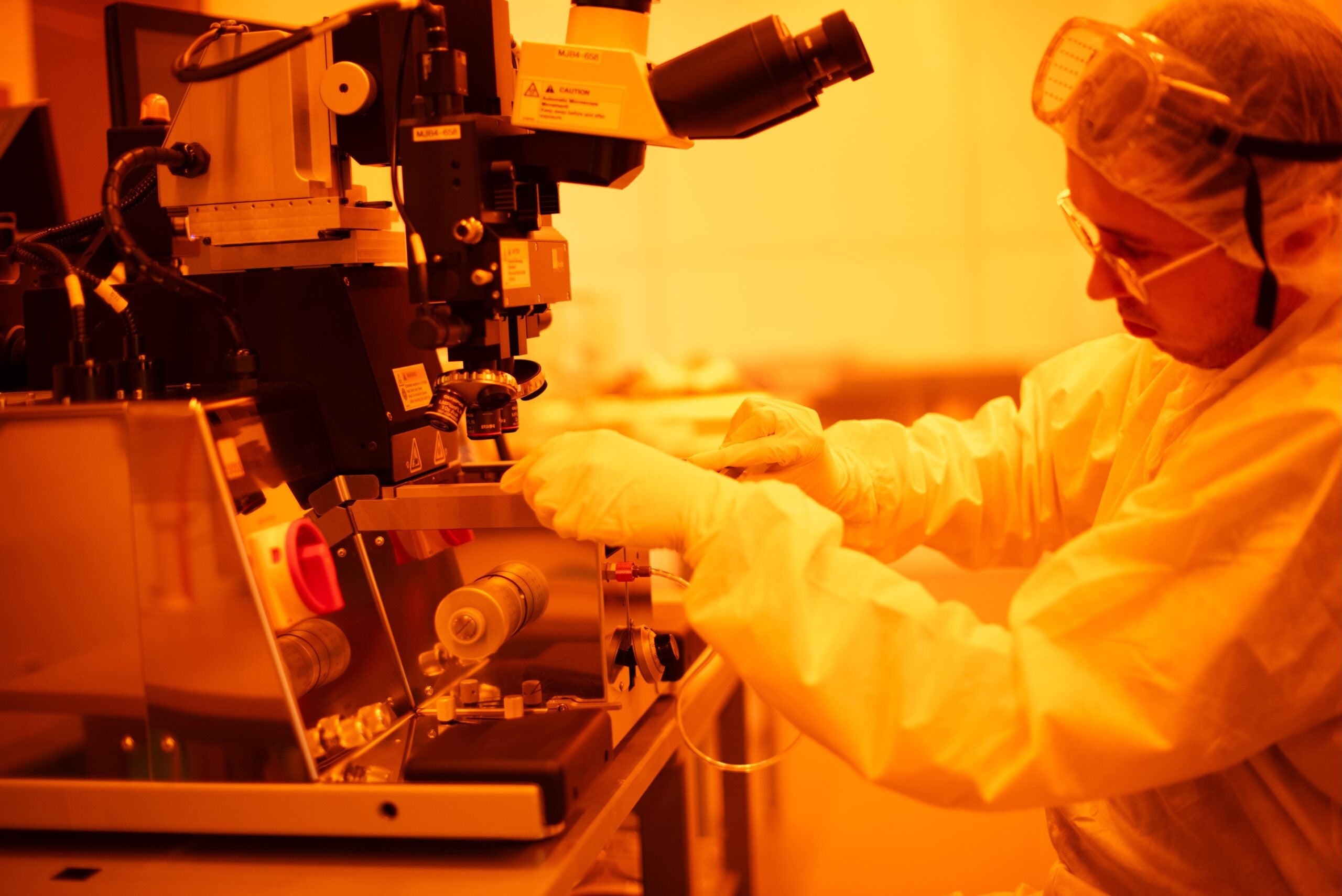
Photo: Cockrell School of Engineering, 2024
As the U.S. increases domestic production of semiconductors to diminish reliance on foreign countries, The University of Texas at Austin has been selected to lead part of a coordinated national strategy to expand the semiconductor workforce. The U.S. semiconductor industry is expected to add 115,000 new jobs by the end of the decade, with more than half of those positions at risk of going unfilled, according to the Semiconductor Industry Association.
Funded by the National Science Foundation and U.S. Department of Commerce, UT will lead the southern node of the National Network for Microelectronics Education (NNME South), operated by the SEMI Foundation. UT’s Texas Institute for Electronics (TIE) will bring together a consortium of 104 partner organizations including universities, community colleges, industry, workforce organizations and economic development agencies across 10 states to build clearer pathways into semiconductor and microelectronics careers.
NNME South is a rapidly expanding semiconductor ecosystem. It is the most semiconductor-dense region of the U.S. and has the most urgent need for workers. The region, which includes Texas, Florida, Georgia, Louisiana, Oklahoma, Arkansas, New Mexico, Utah, Mississippi and Alabama, comprises one-third of the country’s semiconductor manufacturing capacity and more than 92,000 semiconductor workers. It is projected to add approximately 29,000 new positions during the next decade.
“This award is the activation of years of deliberate coalition-building across Texas and the South,” said Alyssa Reinhart, director of workforce development at TIE and the NNME South Node Lead. “Throughout my time at TIE, I have watched employer partners, universities, community colleges and workforce agencies converge around a unified understanding of the problem and a commitment to solving it. NNME is helping us scale these partnerships and the infrastructure necessary to deliver on this shared vision. I am grateful to SEMI, NSF and Commerce for their support and commitment.”
Connecting Students and Workers to Semiconductor Jobs
NNME South is designed to address the workforce challenges facing the semiconductor industry across the region — talent shortages at every level, fragmented education pathways, and limited access to hands-on training. The node will focus on three interconnected priorities:
- Aligning training programs with what employers need.
- Expanding access to hands-on learning, including cleanroom training, apprenticeships and internships.
- Building clear career pathways for students, veterans and career changers who have historically had few on-ramps into the field.
Leveraging Industry Integration
That effort is grounded in relationships UT has built with the semiconductor industry over decades. Industry leaders including Samsung Austin Semiconductor, AMD, Texas Instruments, Emerson, NXP Semiconductors, and Intel have made sustained investments in UT spanning research, curriculum development and talent. These relationships are the foundation on which the NNME South’s employer-driven model is built.
Samsung Austin Semiconductor and its parent company Samsung Electronics have invested nearly $6 million in UT since 2023, funding research, undergraduate and graduate student support, capstone projects, and related facilities — as Samsung expands its operations in Central Texas and relies on UT as a critical talent pipeline; AMD helped found TIE and has maintained an endowed chair in computer engineering since 2007; Texas Instruments’ long-standing relationship with UT spans philanthropy, research, and workforce development, including TI Laboratories; Emerson supports semiconductor graduate fellows, lab infrastructure, and AI/ML research across UT; NXP counts UT as its second-largest source of U.S. university talent with nearly 300 graduates in its workforce; and Intel’s partnership extends from the Cockrell School of Engineering to the Texas Advanced Computing Center, home to the fastest academic supercomputer in the United States.
Year One: Scaling Up Regional Impact
In its first year, NNME South will focus on standing up governance and placing trainees directly into semiconductor employment, enrolling learners in programs, providing regional outreach to K-12 students and educators, and launching new training programs. TIE will bring industry partners together to define what semiconductor roles require, and all state leads will activate their networks for implementation. The goal is a continuously expanding ecosystem in which shared standards, portable credentials, and employer relationships grow stronger across the region over time.
“We are building a workforce that is not only skilled but adaptable, one that can grow with the demands of the industry and create real economic opportunity across the region,” said Reinhart. “That is what this coalition has been working toward and what the NNME South will deliver.”
Industry and Academic Partners
NNME South enters Year One with commitments from 32 employer partners including seven that have each made five-year employer commitments to NNME South: AMD, Arm, Cadence, NXP Semiconductor, Samsung Austin Semiconductor, Synopsys and Texas Instruments. The partnership includes 35 academic institutions including six state leads:
- The Texas A&M Semiconductor Institute leads Texas, bringing statewide university system reach and deep engagement with Texas industry.
- The University of Florida and Florida Semiconductor Institute leverage a $1 billion statewide investment in semiconductor career pathways.
- Georgia Institute of Technology carries strength in semiconductor research and close ties to Georgia’s rapidly growing advanced manufacturing sector.
- The University of Louisiana at Lafayette, University of Oklahoma and University of Arkansas represent state ecosystems with distinct strengths in industrial workforce capacity, engineering education, and semiconductor-adjacent manufacturing.
A list of all industry and academic partners can be found on the NNME South website.
Facts About the Texas Semiconductor Ecosystem
- More than 51,000 Texans have semiconductor jobs. Texas has led the nation for 15 years in the export of semiconductors and other electronic components. Since 2023, the Texas Legislature has invested more than $1.25 billion — including $552 million in UT’s Texas Institute for Electronics — to drive technological innovation.
- NNME South builds on existing momentum in Central Texas. Austin Community College, which trains more than 3,000 semiconductor and advanced manufacturing workers per year, developed a rigorous, employer-driven model to systematically engage with companies to define their workforce needs and translate them into programs that match not just the skills but the business cycle needs of employers.
- TIE partnered with ACC in that effort and has been expanding this work through undergraduate and graduate engineering, working closely with an industry advisory board they jointly chair.
- In parallel, The University of Texas at Dallas and its North Texas Semiconductor Institute had been doing similar work with key companies including Texas Instruments and Qorvo and a North Texas community college consortium. Recently, the Central Texas and North Texas groups combined forces with the Texas A&M Semiconductor Institute to bring these efforts together into a unified strategy for the state of Texas, and the NNME South will now scale up that collaborative, employer-driven model across all 10 states in the region.
- That work is visible across UT’s semiconductor programs. The new Master of Science in Engineering in Semiconductor Science and Engineering — the only in-person master’s program at a top 10 engineering school exclusively dedicated to semiconductors — brings industry directly into the classroom. Students work on industry-sponsored research projects and engage with local employers including SkyWater Technology, Applied Materials, and others through internships, scholarships, student group partnerships, and recruiting.
- At the undergraduate level, U-STARS, a hands-on skills development program built in partnership with ACC, was piloted with 11 UT students in 2025 and is expanding this year to multiple UT, Texas A&M, and other undergraduate cohorts across the region. A planned, joint training center between UT, ACC and TIE, co-located next to TIE’s 66,000-square-foot pilot fab on Montopolis Drive, will provide more than 20,000 square feet of dedicated training space to serve the full pipeline from entry-level technician through industry professionals.