America 250: Time for Texas
The ‘Pursuing Our Promise’ series at the LBJ Presidential Library turns its spotlight on treasures from Texas housed at the Briscoe Center for American History.
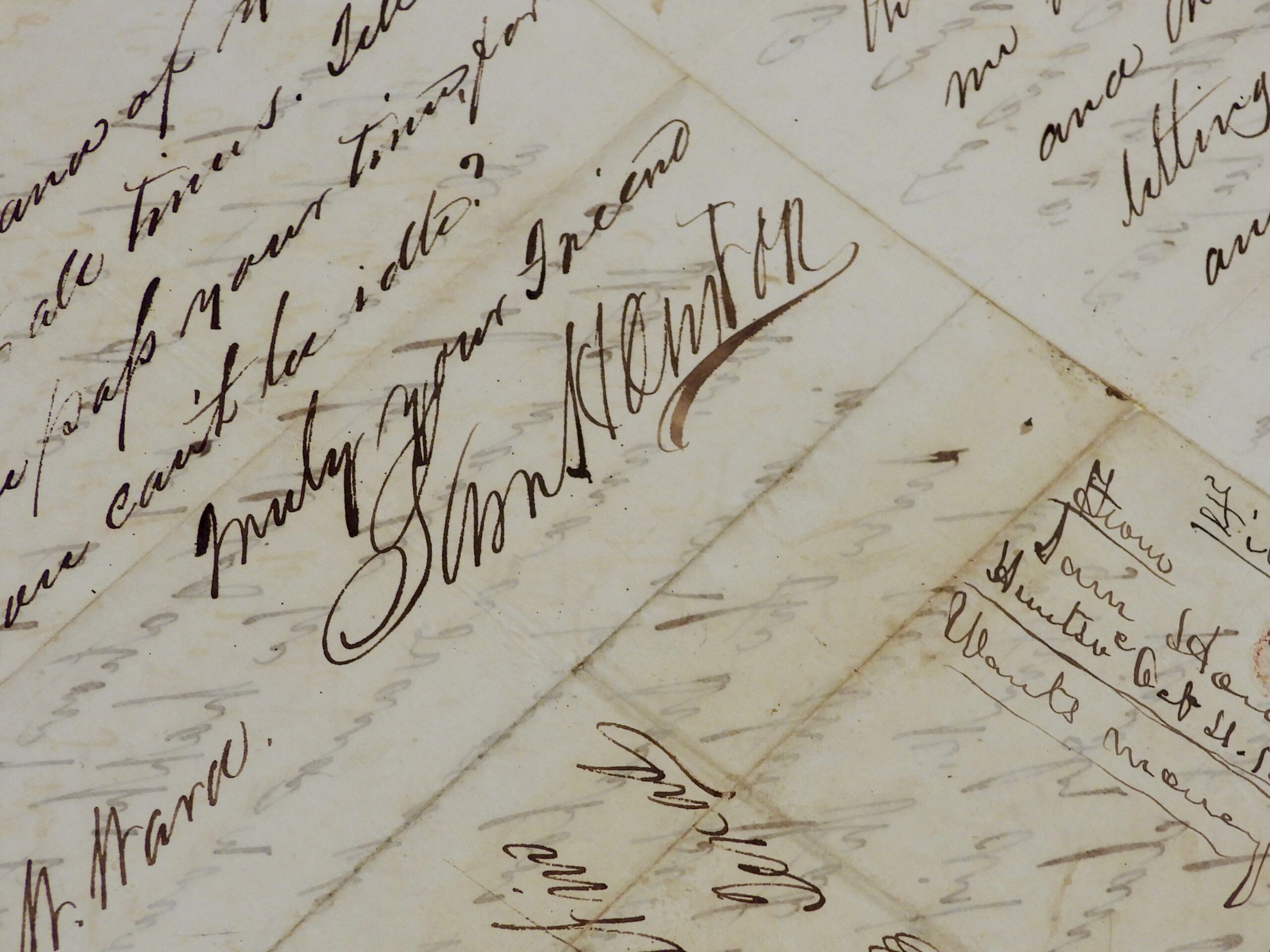
In the third of four exhibits at the LBJ Presidential Library celebrating America’s 250th anniversary, Texas takes center stage, and all the documents on display are from UT’s own Briscoe Center for American History. This installment of “The American Experiment: Pursuing Our Promise” opened Aug. 15 on the 10th floor of the LBJ Presidential Library and will remain up until Oct. 18.
The exhibit includes the documents that separated Texas from Mexico, that joined the republic to the United States, and that separated it again at the start of the Civil War.
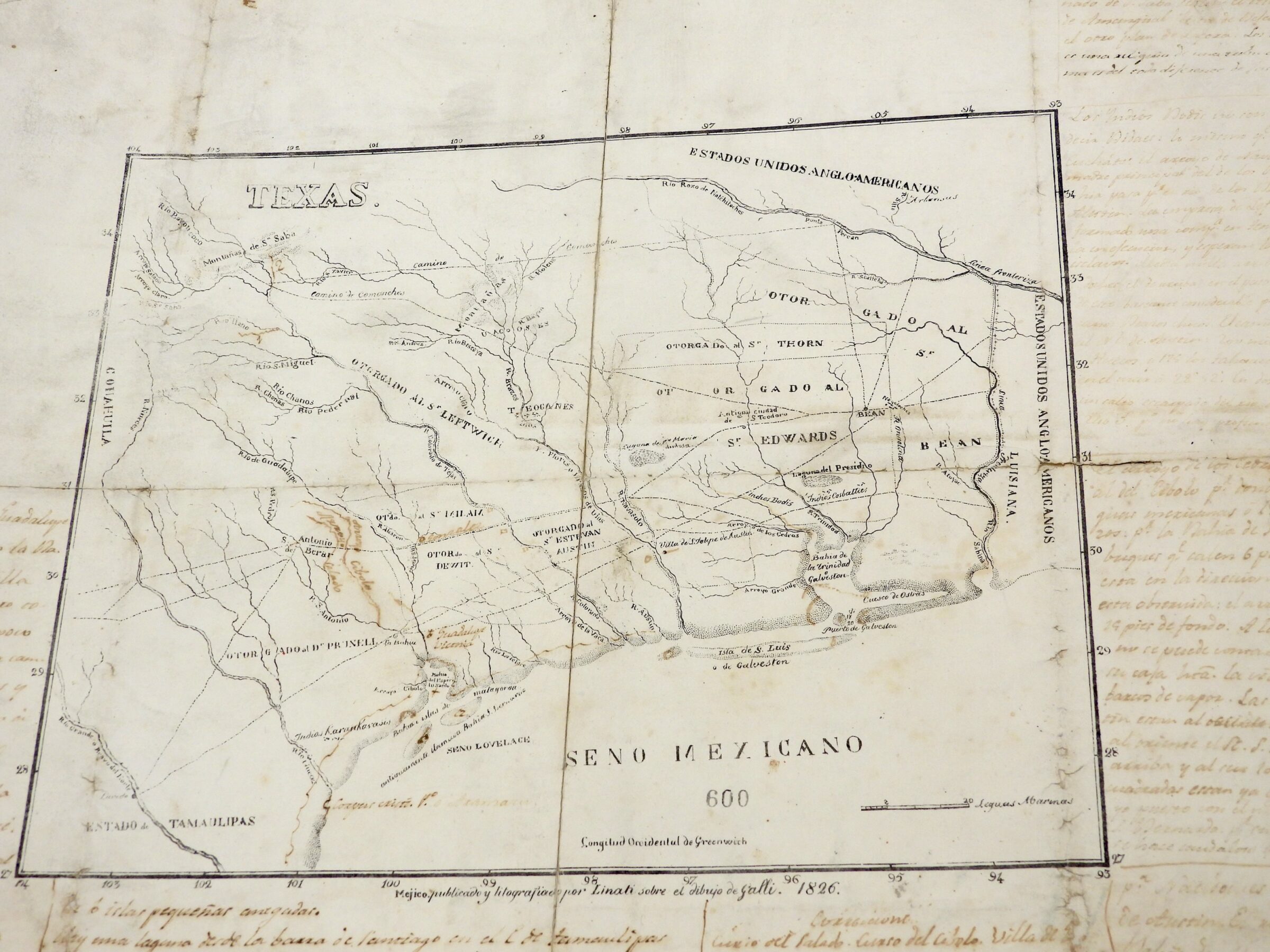
1826 – Galli Map
The earliest artifact is an 1826 map of Texas by Fiorenzo Galli, which is thought to be the first charted map of Texas. It shows the “Mountains of San Saba,” the Karankawas living north of the Nueces, other rivers including the Guadalupe, San Antonio, Colorado, Brazos, “Pedernal, Trinidad” and “Sabina.” In several cases the map acknowledges boundaries and places that go by multiple names, such as the “Rio Grande o Rio Bravo del Norte,” or the “Isla de S. Luis o de Galveston.” The grants or “otorgados” of “Estevan Austin, Milam, Dewit [sic], Prinell, Leftwich” and others are here. The Red River, which constitutes the “Linea fronteriza,” is labeled the “Rio Roxo de Natchitoches,” and the U.S. is called the “Estados Unidos Anglo-Americanos.”
The Briscoe Center’s maps and cartographic resources comprise some 35,000 printed and manuscript maps, many depicting Texas from European contact to the present.
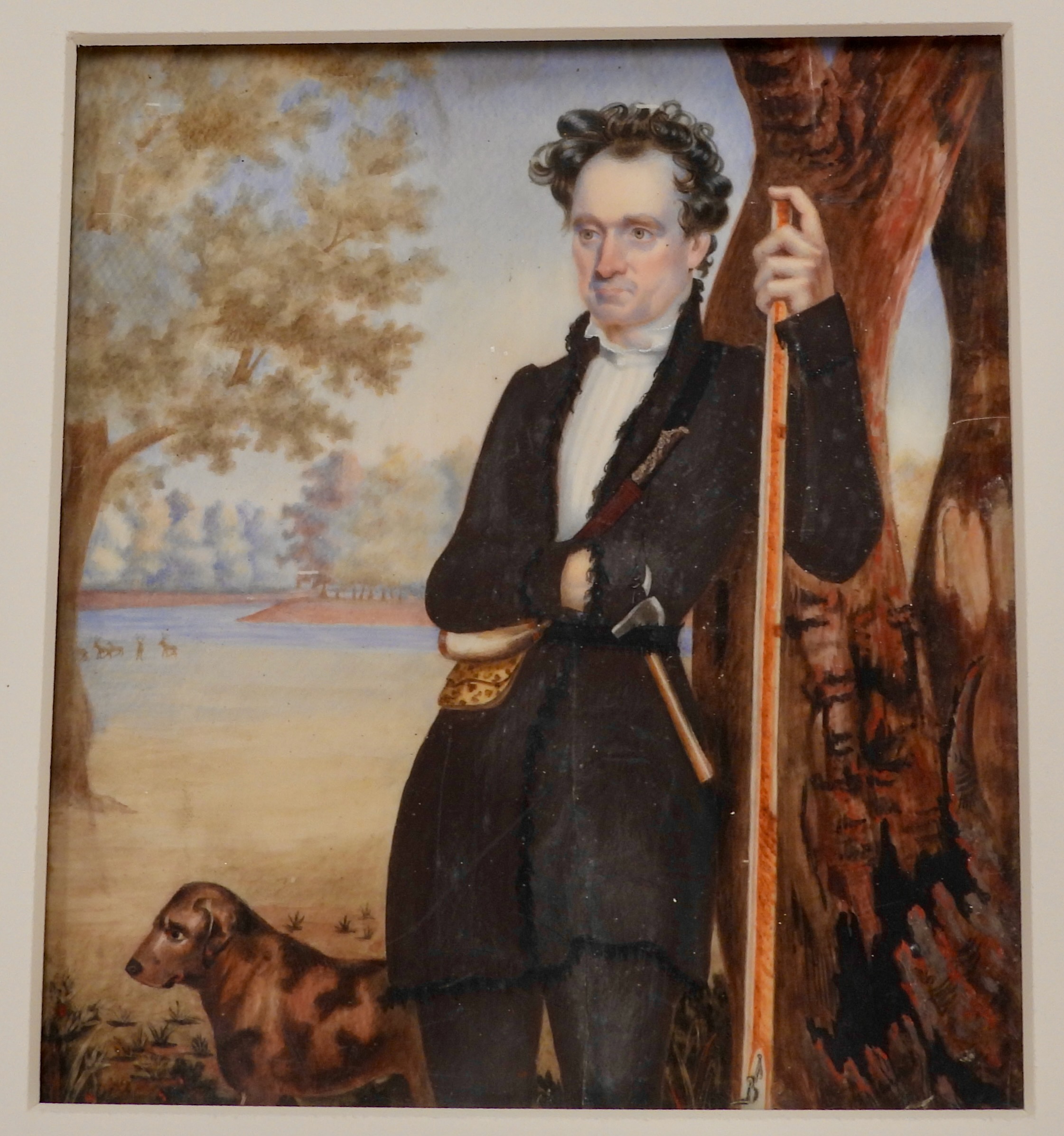
1833 – Stephen F. Austin Portrait
In 1833 in Mexico City, William Howard painted a watercolor portrait on ivory of Stephen F. Austin in his hunting costume with his dog, Cano. Soon after, Austin was arrested on his way back to Texas. He arranged to have the portrait, which had been in his luggage, sent to his sister, Emily Austin Perry.
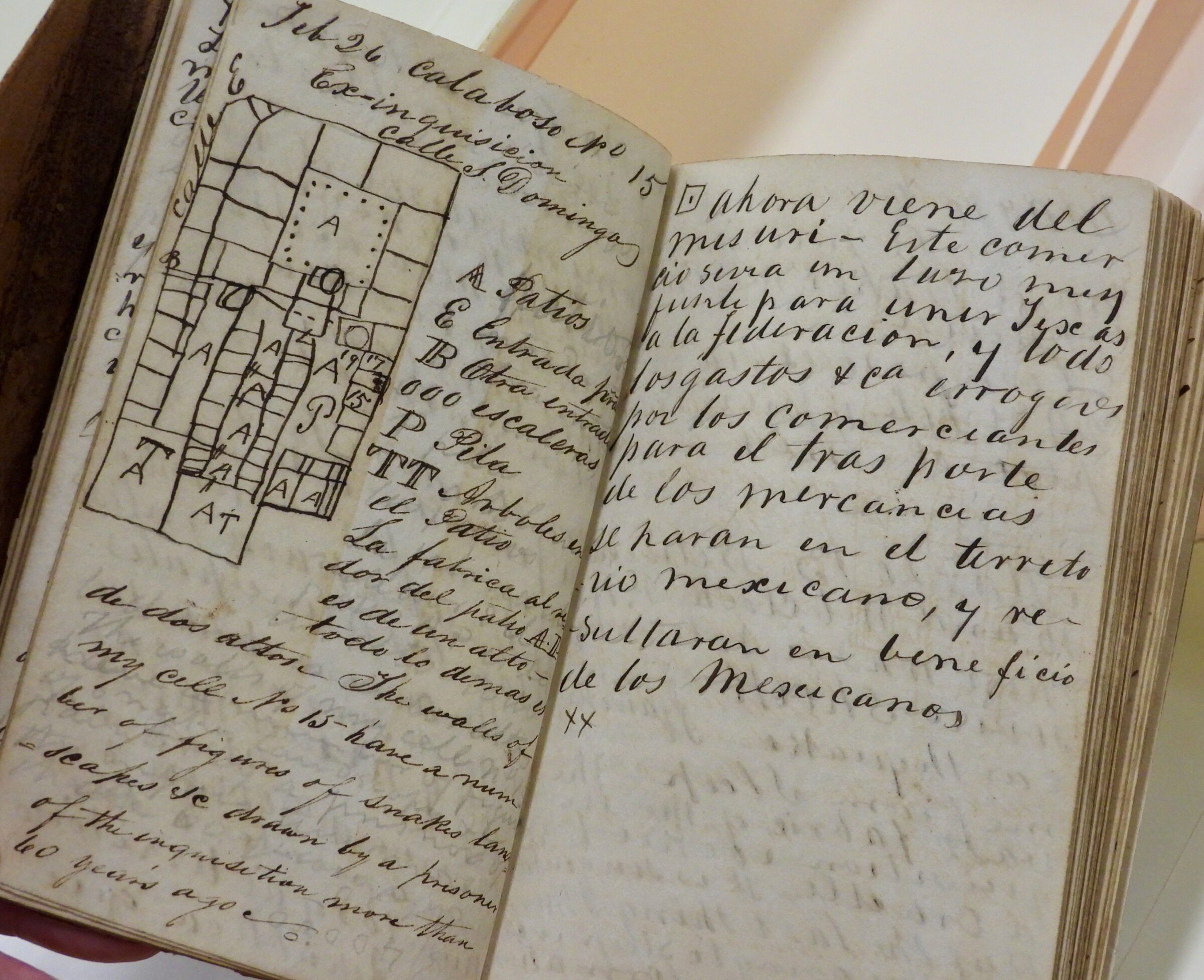
1834 – Austin’s Prison Diary
Mexican authorities arrested Austin on suspicion of sedition and imprisoned him for more than two years in Mexico City’s Palace of the Inquisition. Austin smuggled in a small diary in which he wrote in both Spanish and English. On Feb. 26, 1834, he drew a map of the prison and noted that the walls of his cell were decorated with snakes and landscapes painted by the prisoners of the Inquisition more than 60 years earlier.
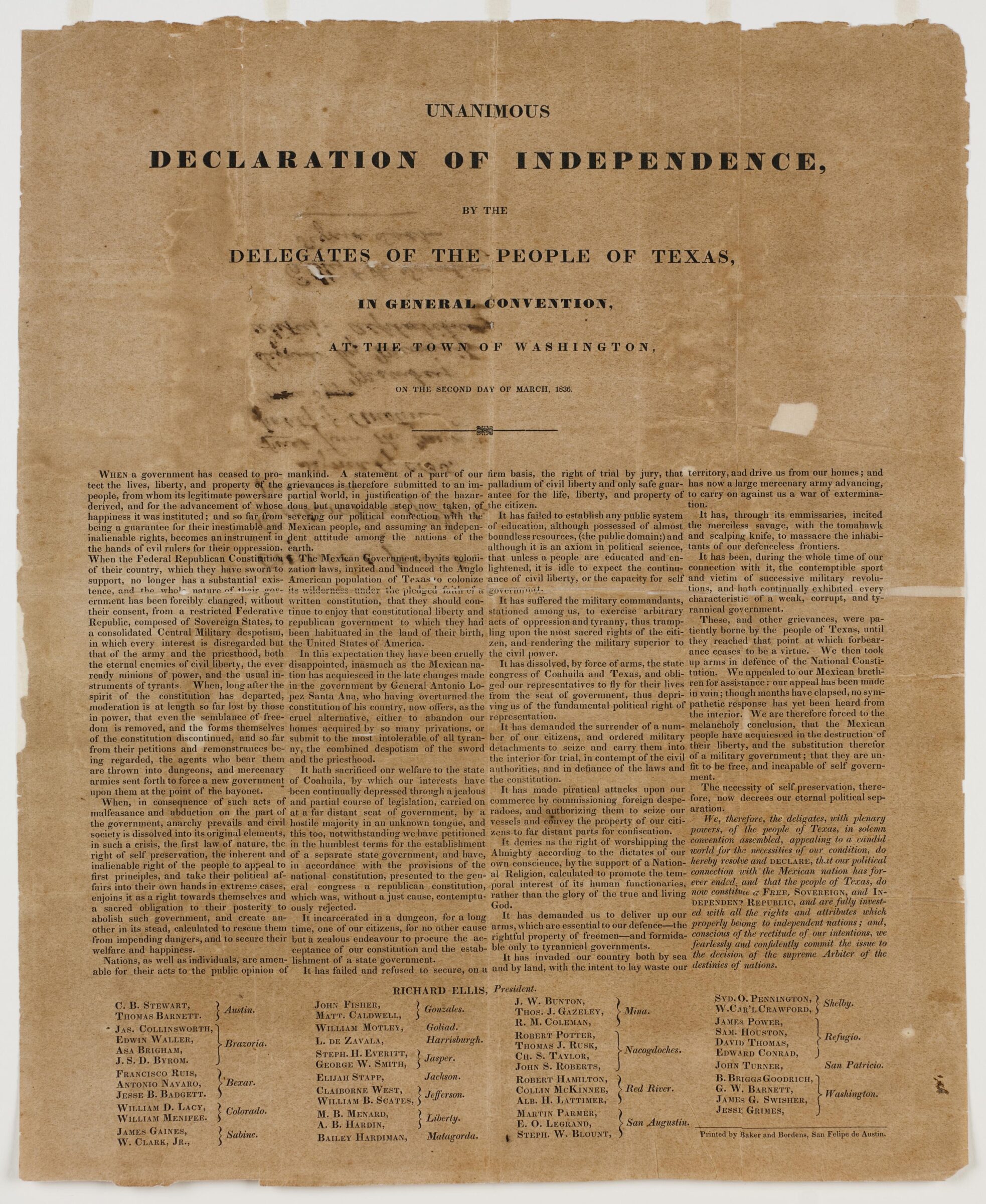
March 1836 – Texas Declaration of Independence
The Texas Declaration of Independence is “the outstanding state paper in Texas history,” according to the Briscoe Center. It was printed March 2, 1836, at San Felipe de Austin. At the foot of the broadside are the names of all the delegates present, with the exception of George C. Childress and Sterling C. Robertson of Milam. The printers, Gail and Thomas H. Borden, later apologized for the omissions, stating that the document was printed “in too much haste, and chiefly in the night.”
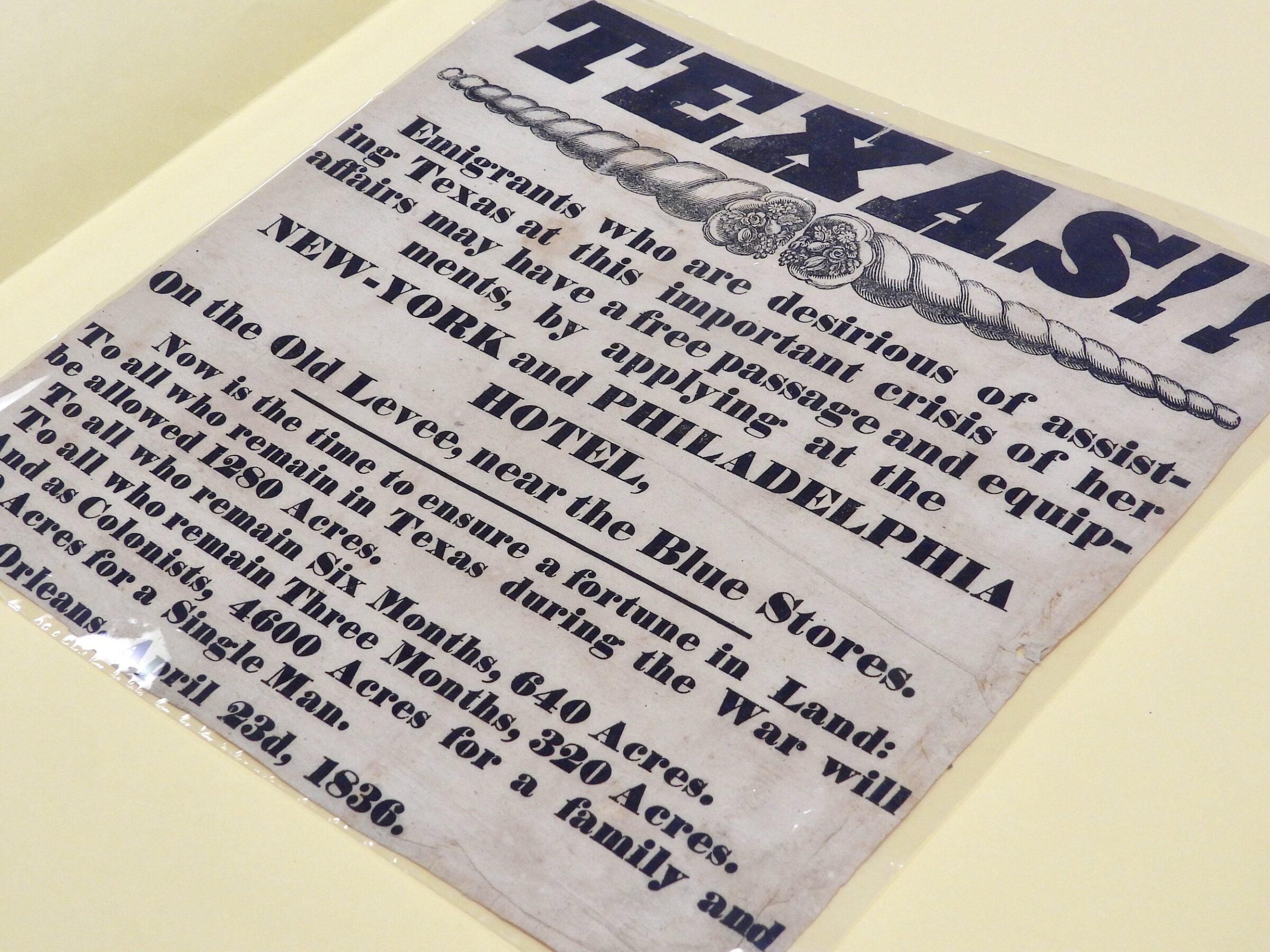
April 1836 – “Texas!!” Broadside
The Texas Revolution effectively ended with the Battle of San Jacinto on April 21, 1836. But it was not clear that the war was over, as this advertisement published two days later in New Orleans shows. It reads in part: “Now is the time to ensure a fortune in Land: To all who remain in Texas during the War will be allowed 1280 Acres …”
Those interested in immigrating were instructed to apply at the New-York and Philadelphia Hotel in New Orleans. Incidentally, Sam Houston arrived in New Orleans by ship about a month later to undergo surgery on his ankle, which was shattered at San Jacinto.
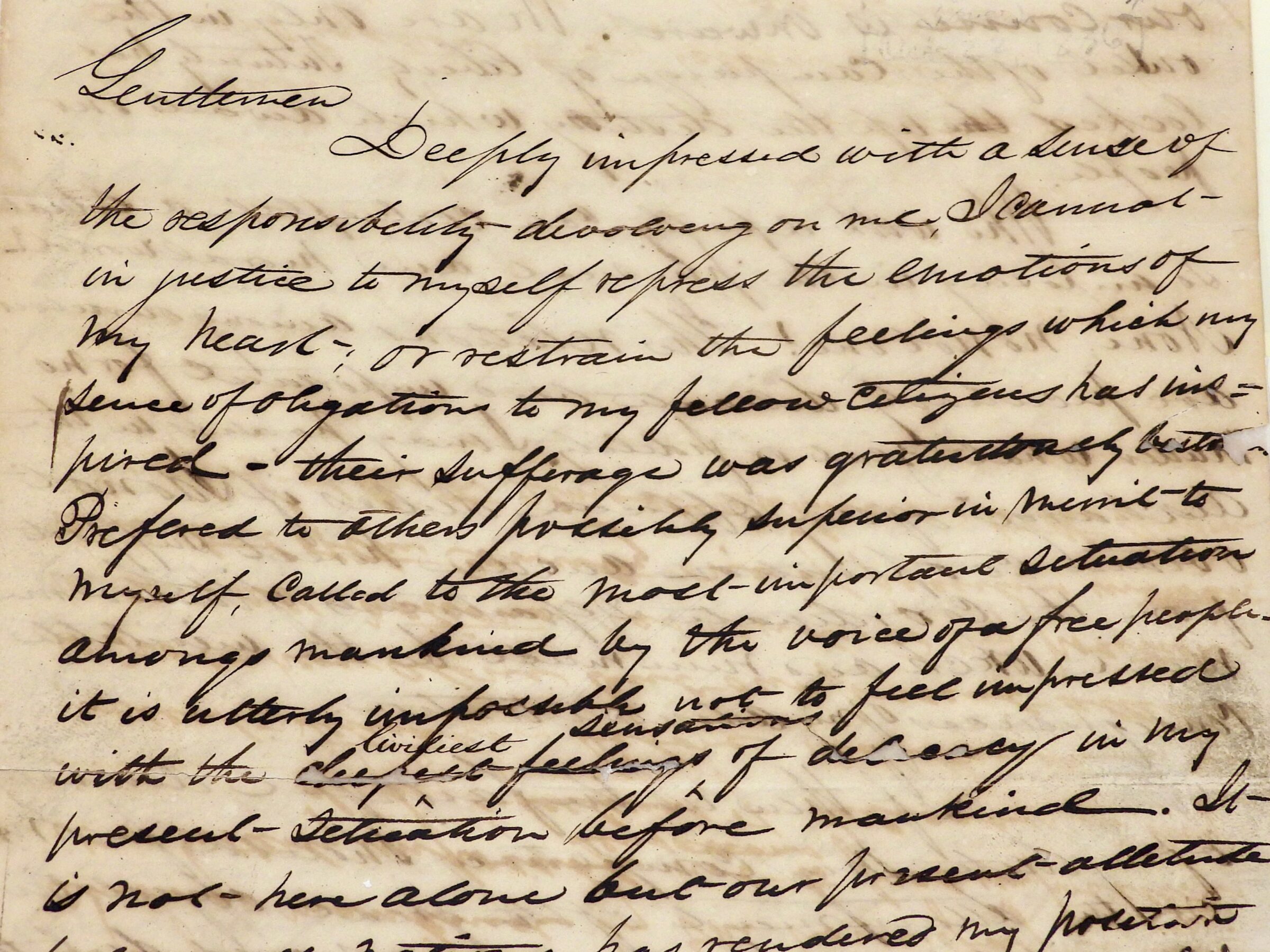
October 1836 – President Sam Houston’s handwritten inaugural speech
Although David Burnet served as interim president during and immediately after the Texas Revolution, Sam Houston served as the first elected president of the Republic of Texas. Houston lost reelection to Mirabeau Lamar but won a second term in 1841.
In this, Houston’s first inaugural address, he spoke of his “sense of obligation” to his fellow citizens and urged “treaties of peace and amity, and the maintenance of good faith” with Native American tribes, while maintaining an “army organized, disciplined, and increased agreeably to our present necessities.” You can even read his line-edits, such as his scratching out of “deepest feelings” in favor of “liveliest sensations” to better describe his “delicacy in my present situation before mankind.”
1842-43 – The Peña Memoirs
Lt. Col. José Enrique de la Peña served under Gen. Antonio López de Santa Anna during the Texas Revolution. Peña’s personal papers, consisting of a field diary and an extended memoir based upon the diary, provide an eyewitness account of the Mexican army’s campaign to suppress the Texian rebels.
Most famously, Peña’s narrative includes his account of the execution of David Crockett after the assault on the Alamo. Translated, it reads:
“Some seven men had survived the general carnage and, under the protection of General Castrillón, they were brought before Santa Anna. Among them was one of great stature, well proportioned, with regular features, in whose face there was the imprint of adversity, but in whom one also noticed a degree of resignation and nobility that did him honor. He was the naturalist David Crockett, well known in North America for his unusual adventures, who had undertaken to explore the country and who, finding himself in Bejar at the very moment of surprise, had taken refuge at the Alamo, fearing that his status as a foreigner might not be respected. Santa Anna answered Castrillón’s intervention in Crockett’s behalf with a gesture of indignation and, addressing himself to the sappers, the troops closest to him, ordered his execution … Though tortured before they were killed, these unfortunates died without complaining and without humiliating themselves before their torturers.”
In 1998, investment partners Charles Tate and Tom Hicks bought the manuscript at auction for $350,000 and donated it to the University.
![Loose leaf diary in Spanish in cursive with David Croket [sic] visible at the top](https://news.utexas.edu/wp-content/uploads/PenaPapers-2400x1800.jpeg)
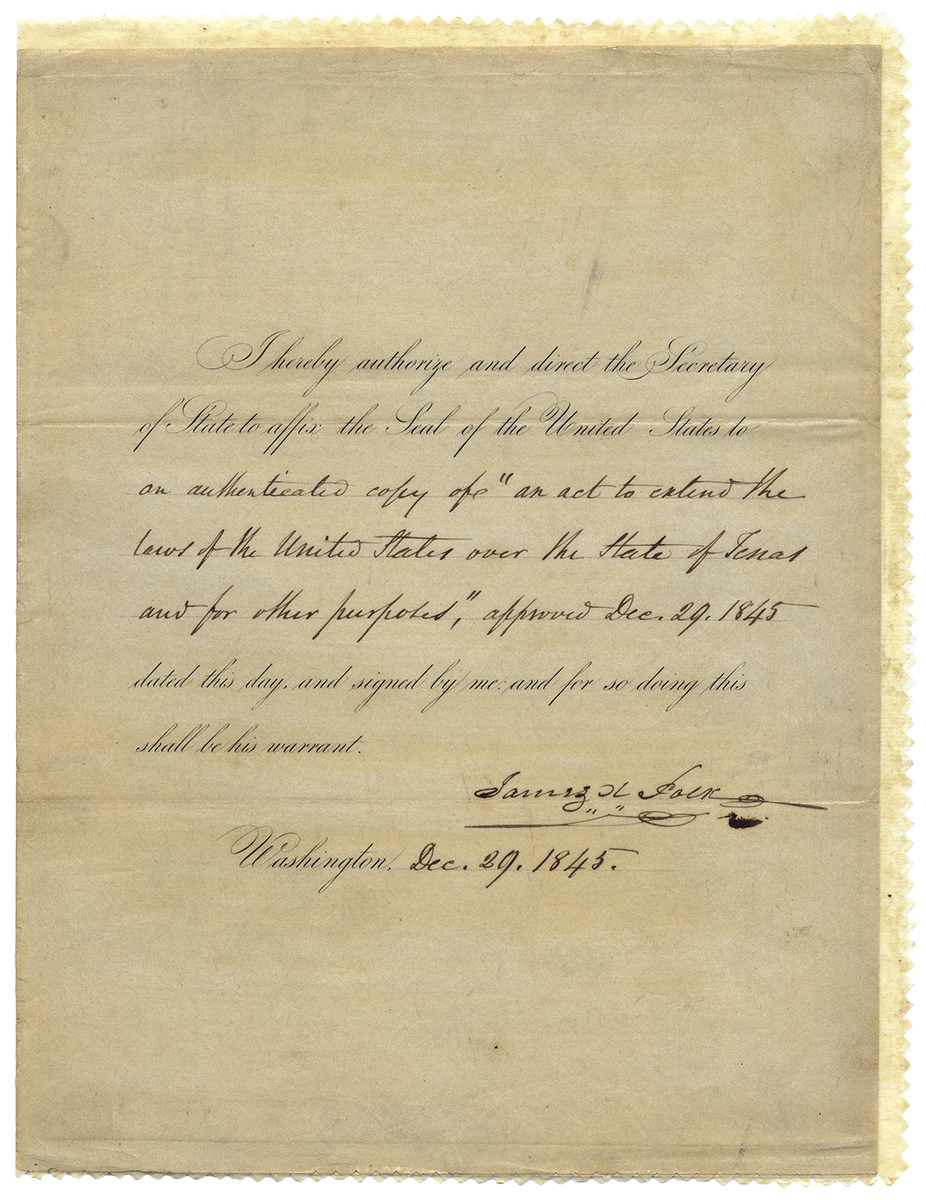
1845 – Annexation of Texas by the United States
In 1843, U.S. President John Tyler proposed the annexation of Texas, and the issue became part of the presidential election of 1844, during which citizens elected James K. Polk president on a pro-annexation platform. Polk recommended that the U.S. Congress and the Republic of Texas Congress jointly resolve to move forward with annexation. The U.S. Congress passed the annexation resolution in February 1845, and the Texas Congress accepted the resolution in June. On the final day of 1845, Texas legally entered the United States. By May 1846, the U.S. and Mexico were at war.
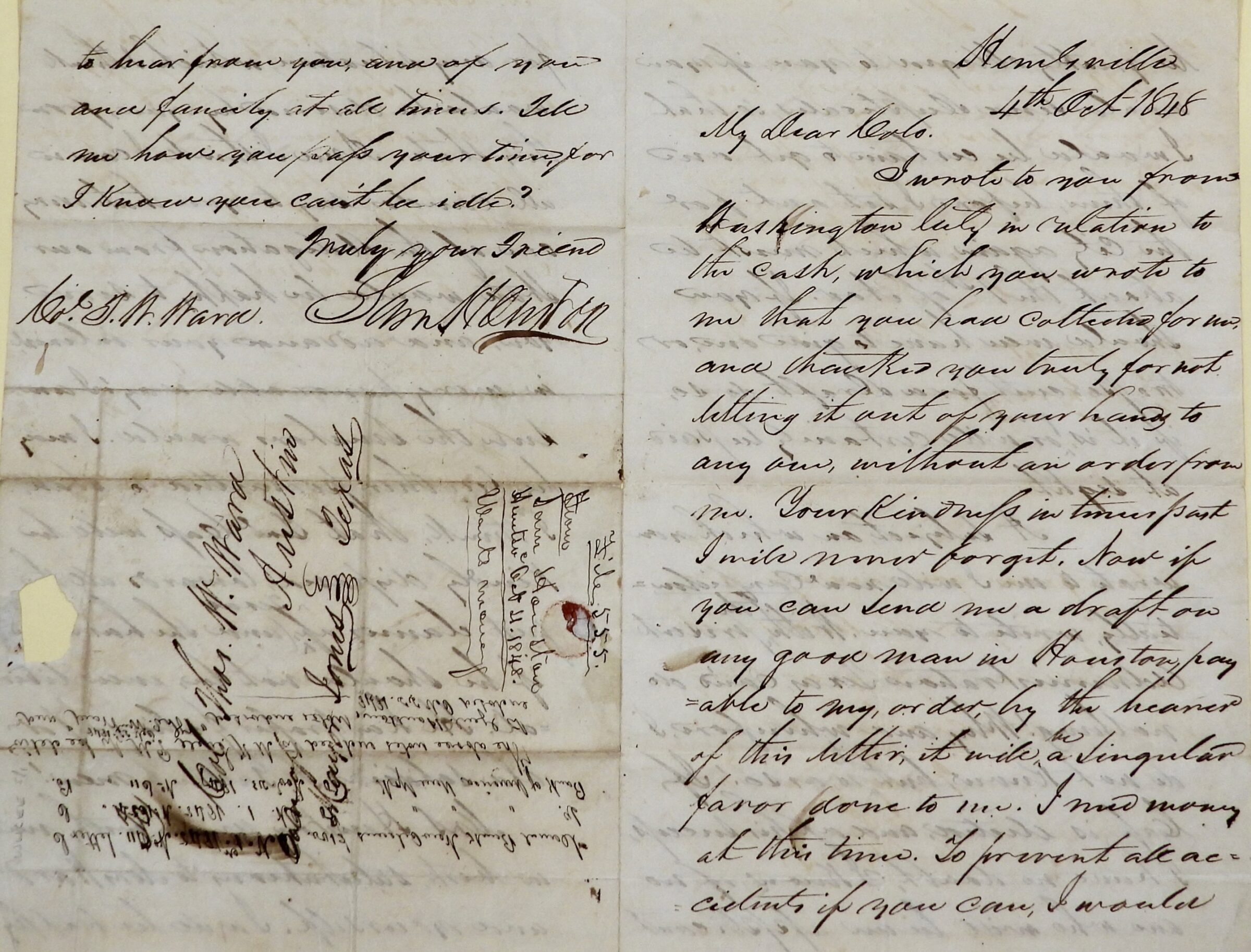
1848 – Sam Houston letter to Col. Thomas William “Peg Leg” Ward
After Texas became a state, Sam Houston represented Texas in the U.S. Senate from 1846 to 1859. He supported westward expansion but increasingly clashed with Southern Democrats over the spread of slavery. Houston wrote this friendly letter to Col. William Ward, requesting money transfers as well as a confidential reply concerning Gen. Lewis Cass’ nomination for the presidential ticket in the Democratic National Convention of 1848, a nomination that would split anti-slavery Democrats from the party and result in the election of the Whig Party candidate, Gen. Zachary Taylor.
Ward was born in Ireland and in 1835 responded to a call in New Orleans for volunteers to fight in the Texas independence movement, where he lost his leg to a cannon ball during the siege of Bexar. After healing from a risky field amputation, Ward got a primitive prosthetic that would become his namesake. He later served as mayor of Austin and as a commissioner of Texas’ General Land Office.
The letter was purchased and donated jointly by Gov. George W. Bush and Lt. Gov. Bob Bullock.
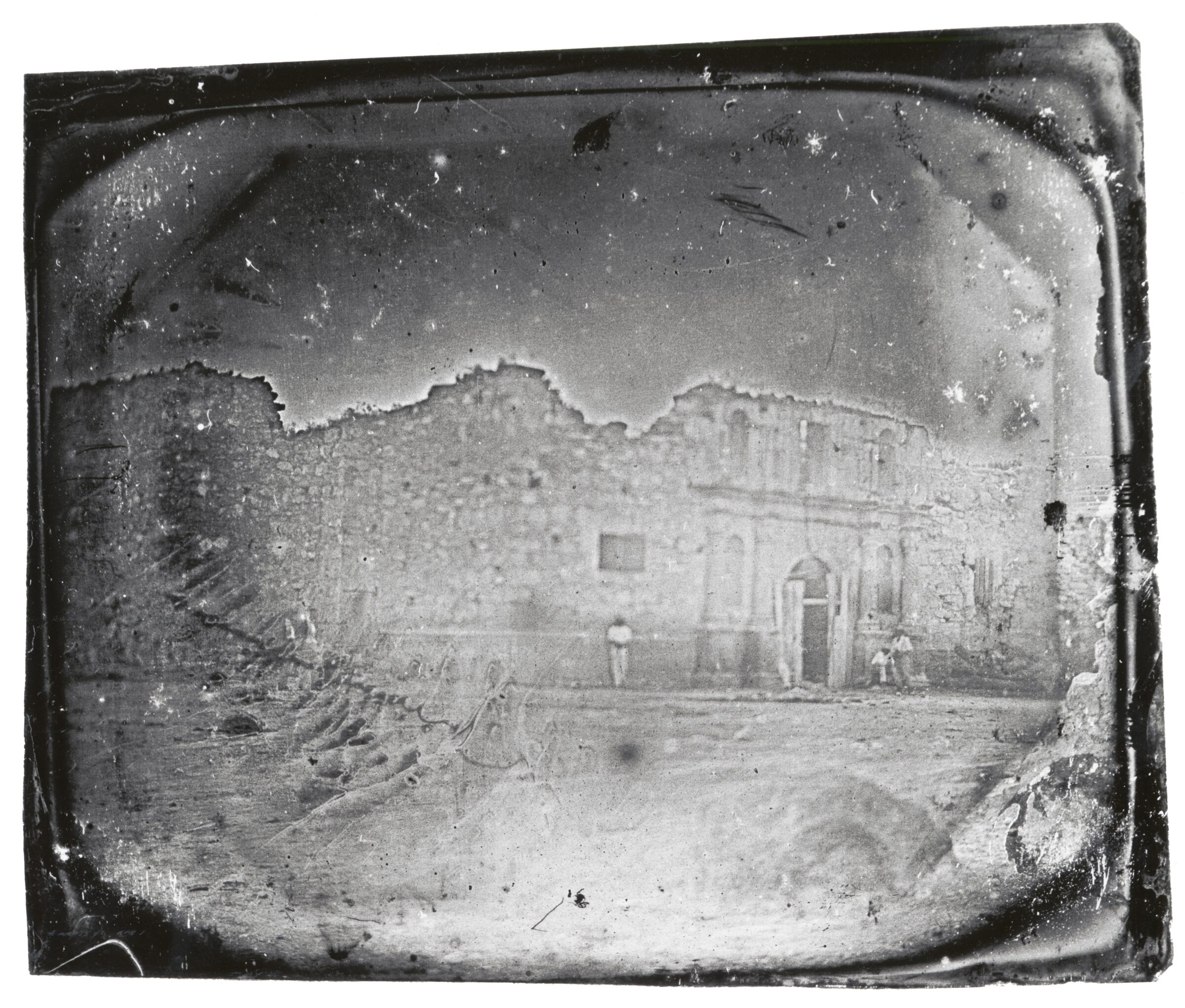
1849 – Earliest Photograph in Texas and of the Alamo
This is the earliest known photograph of the Alamo chapel at the San Antonio de Valero Mission and the earliest datable photo made in Texas. It shows the battle-scarred exterior of the chapel before its reconstruction in 1850.
The daguerreotype process fixes an image on a silver surface and was the dominant means of photography in America from 1840 to 1860. The original Alamo daguerreotype measures less than 3.5 inches wide. The accompanying scale reproduction shows the daguerreotype inside its case, kept closed to preserve the fragile and light-sensitive image.
This image was the gift of Gov. Dolph Briscoe and Mrs. Janey Briscoe.
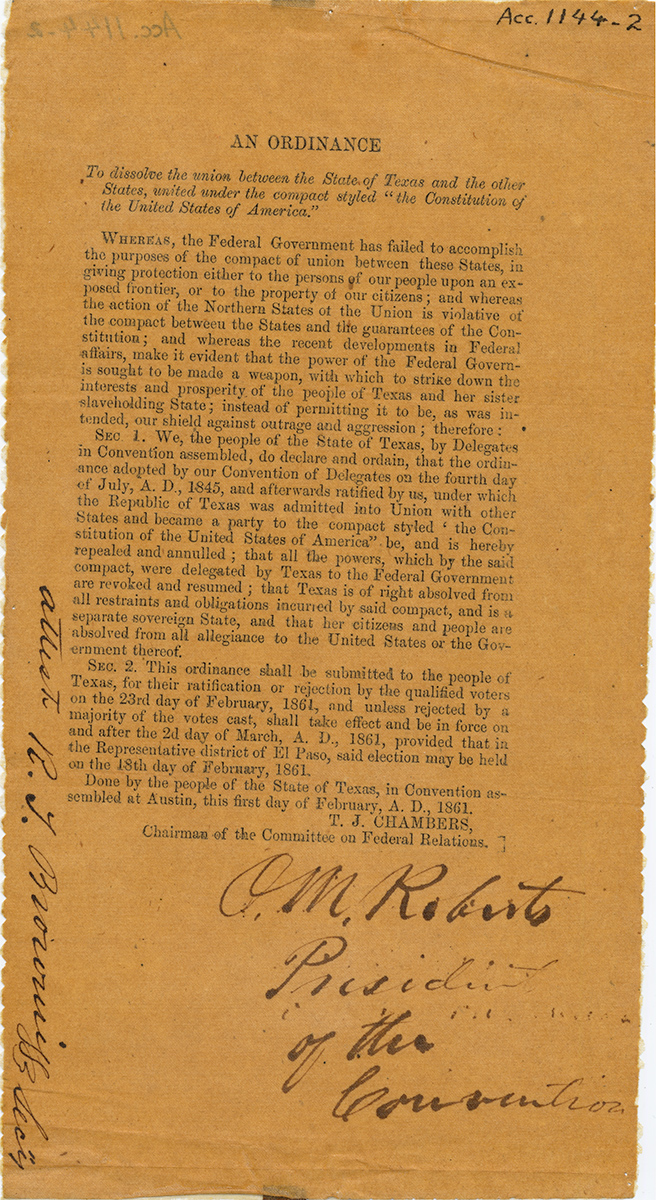
1861 – Ordinance of Secession
The adoption of the Texas Ordinance of Secession officially separated Texas from the United States on Feb. 2, 1861. The ordinance was passed in a special convention by a vote of 166 to 8 and then was ratified by a statewide referendum. Although many Texans, including Gov. Sam Houston, opposed secession, the overwhelming majority supported it. The document reads in part:
“And whereas the recent development in Federal affairs make it evident that the power of the Federal Government is sought to be made a weapon, with which to strike down the interests and prosperity of the people of Texas and her sister slaveholding State [sic]; instead of permitting it to be, as intended, a shield against outrage and aggression; therefore … We the people of the State of Texas do hereby declare and ordain that the ordinance adopted … under which the Republic of Texas was admitted into Union with other States and became a party to the compact styled “the Constitution of the United States of America” be, and is hereby repealed and annulled …”
The document was signed by O.M. Roberts, president of the convention and later the governor who signed The University of Texas into existence in the Texas Constitution of 1876.
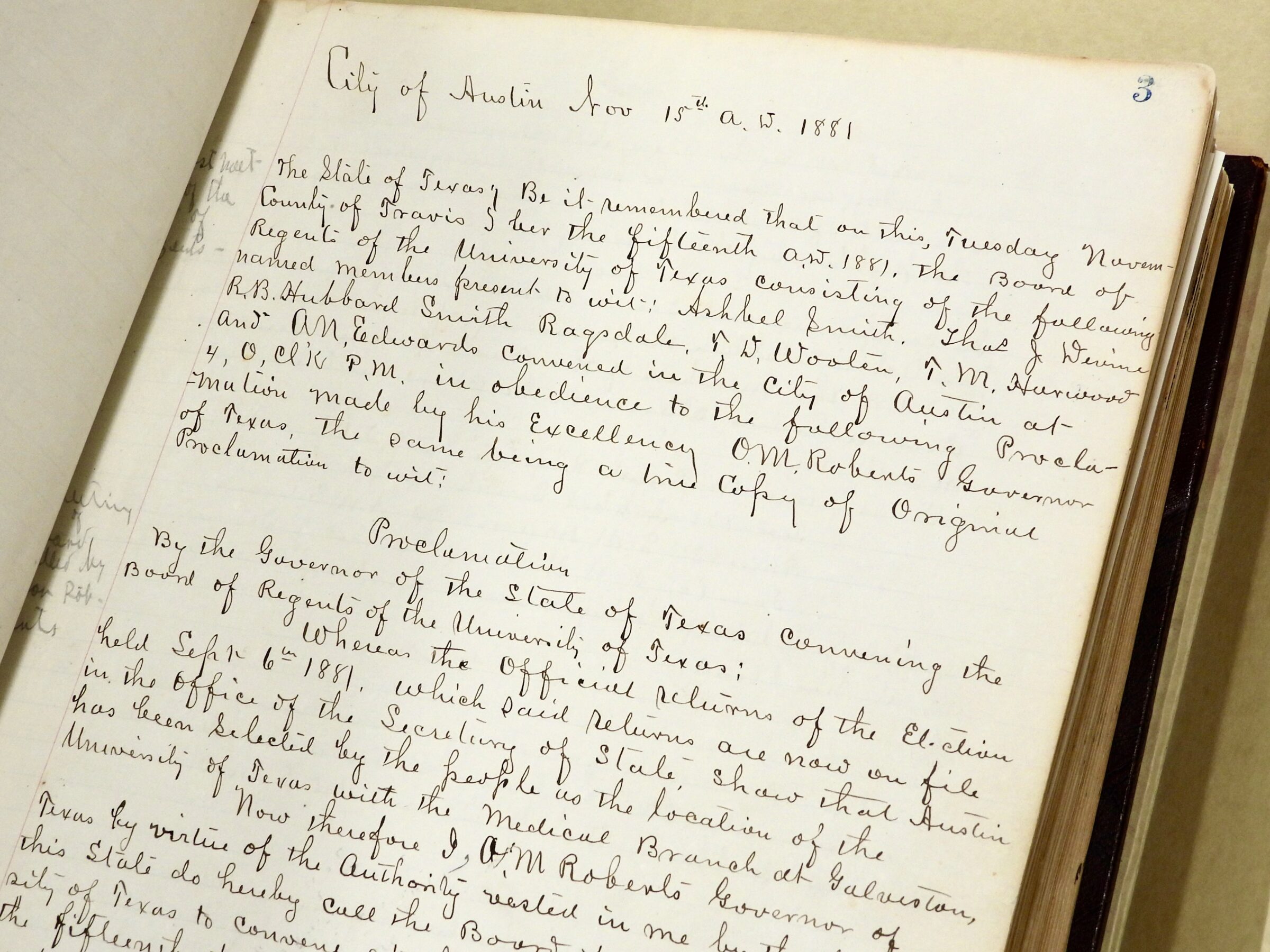
1881 – First Board of Regents Minutes
Moving closer to home, the exhibit features a bound volume containing the first 13 years’ worth of UT Board of Regents minutes, starting in 1881. The first entry reads:
“State of Texas, County of Travis — Be it known that on this, Tuesday November the fifteenth A.D. 1881, the Board of Regents of the University of Texas … convened in the City of Austin at 4 o’clock P.M. in obedience to the following Proclamation made by his Excellency O.M. Roberts, Governor of Texas …
“Whereas the official returns of the election held September 6th 1881 … show that Austin has been selected by the people as the location of the University of Texas with the Medical Branch at Galveston, now therefore I, O.M. Roberts Governor of Texas by virtue of the Authority vested in me by the laws of this State do hereby call the Board of Regents of the University of Texas to convene at the City of Austin … to effect the permanent organization of the Board and to take such action as the law requires for the establishment and organization of the University.”
1919 – Jane McCallum Diary
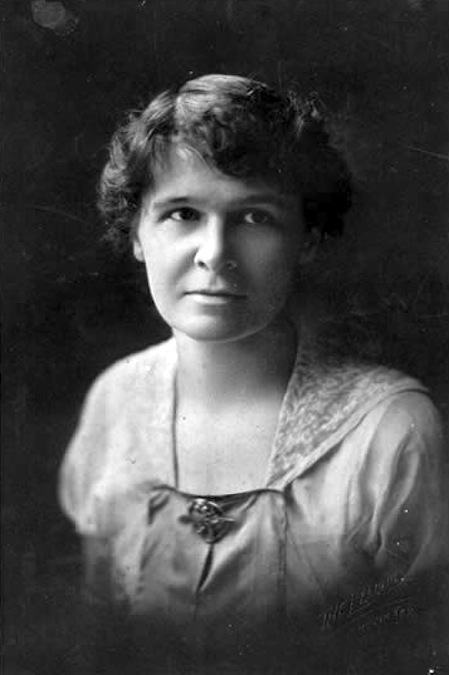
The Briscoe Center archives contain many documents relating to the suffrage movement in Texas. Jane McCallum (1877-1957) was a UT alumna (one of the first mothers to attend the University), a tireless suffrage activist, columnist for the Austin American and Texas secretary of state under two governors.
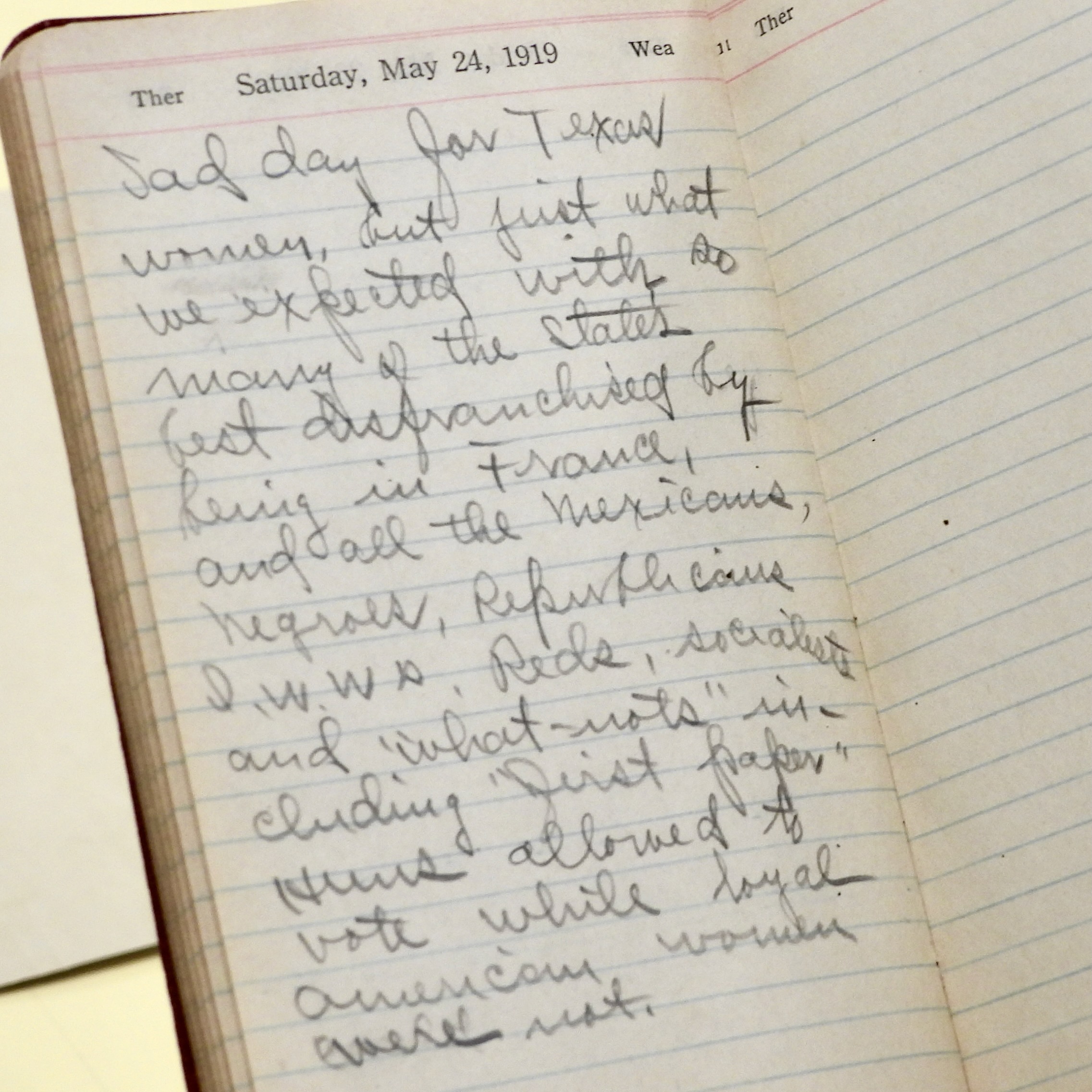
Her 1919 diary records her work as a suffrage campaigner, including the progress and setbacks of the movement within Texas. Full suffrage was put to a popular vote in Texas on May 24, 1919. The referendum was rejected by a margin of about 25,000 votes, largely because women couldn’t vote in support of their own cause.
However, when the Legislature convened a month later, it sailed through both chambers, and on June 28, 1919, Texas became the first state in the South to ratify the 19th Amendment.
1940 – Franklin Roosevelt Letter to Sam Rayburn
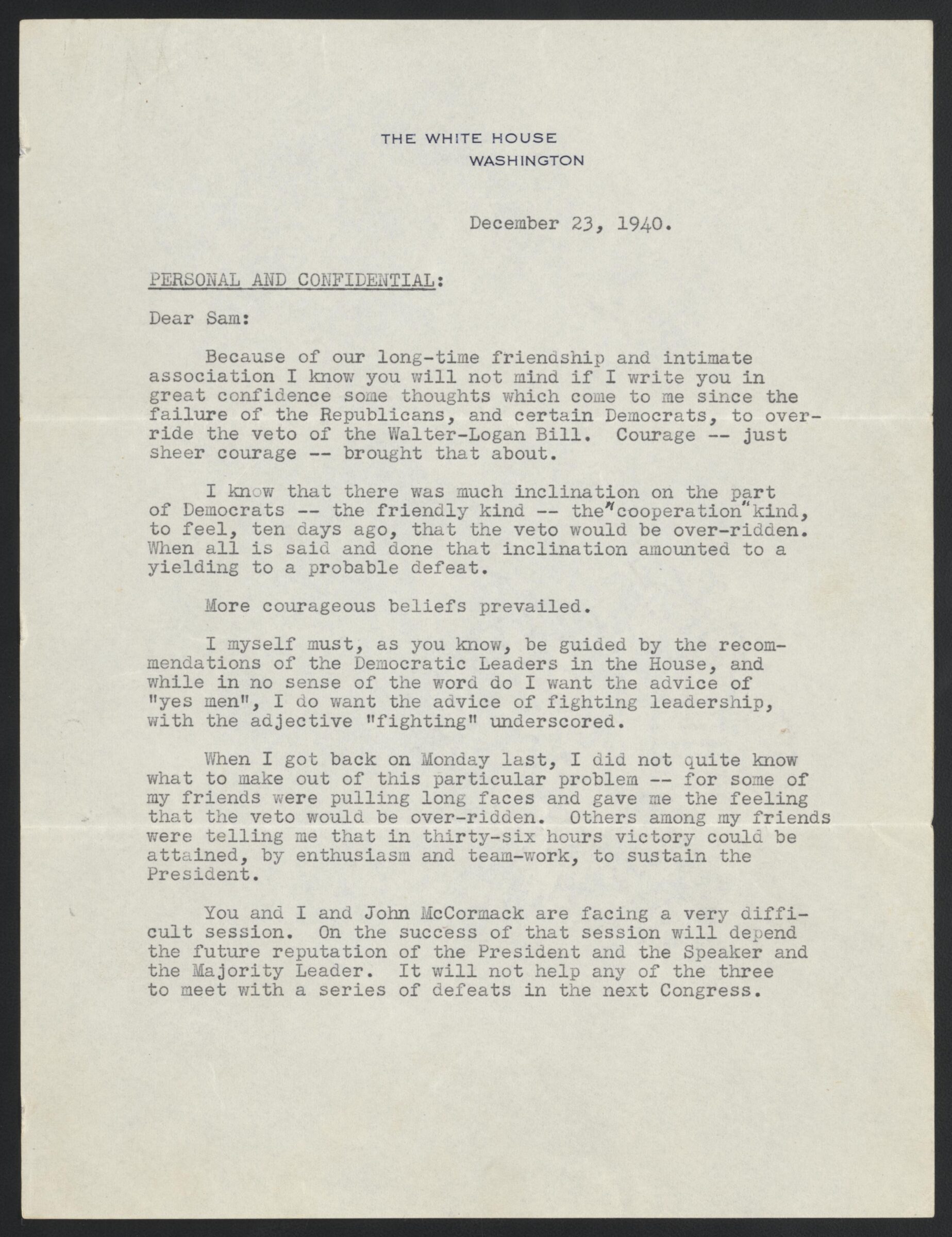
As federal agencies increased their authority and power during the New Deal, there were no comprehensive standards to govern agency actions. The Walter-Logan Bill was a controversial attempt to restrict the power of federal agencies that President Franklin Roosevelt vetoed. In this letter to Speaker of the House Sam Rayburn, Roosevelt encourages Rayburn to continue the fight.
Rayburn was a Distinguished Alumnus of UT (attending UT law school in 1908) and was the longest-serving House speaker in U.S. history, beginning in 1940.
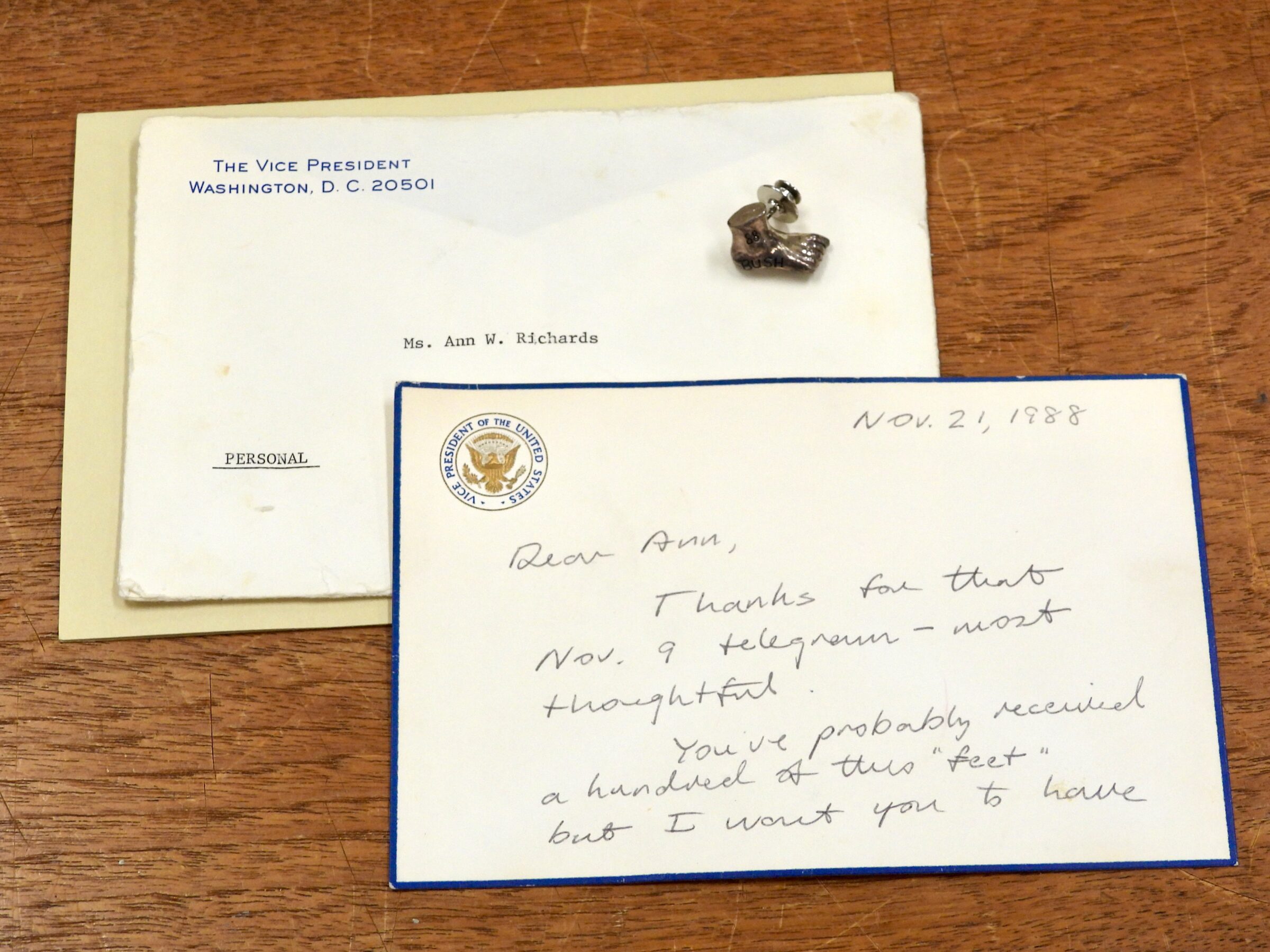
1988 – Notecard from Vice President and President-elect George Bush to Texas Treasurer Ann Richards, with silver-foot lapel pin
When the Democratic National Convention was held in 1988, the DNC recruited a rising star and entertaining speaker, the Texas treasurer, to deliver a keynote address critiquing the GOP nominee, Vice President George Bush.
The most famous line of many in the career of Ann Richards was one that intentionally conflated two sayings: “born with a silver spoon in his mouth” (denoting a life of privilege; Bush’s father, Prescott, was a U.S. senator from Connecticut) and putting one’s “foot in his mouth,” as the vice president was somewhat prone to gaffs and verbal awkwardness.
“Poor George! He can’t help it,” Richards beamed. “He was born with a silver foot in his mouth.”
The line brought the house down, but Richards’ speech did not matter in the short term, as Bush handily defeated Michael Dukakis, 426-111 in the Electoral College. Richards sent a congratulatory telegram to Bush after his election. Bush replied with this note of thanks, along with a charm in reference to her jab.
Although the speech did not move the electorate, it did elevate Richards’ profile, and she went on to be elected governor two years later. The Bush/Richards rivalry was not over, however, as the president’s son George W. Bush unseated Richards after one term.
***
Once again, this installment of “The American Experiment: Pursuing Our Promise” opens Aug. 15 on the 10th floor of the LBJ Presidential Library and runs to Oct. 18.