The Art of Exploring Campus
Over the course of a year, one staff member got to know The University of Texas campus through its public art.
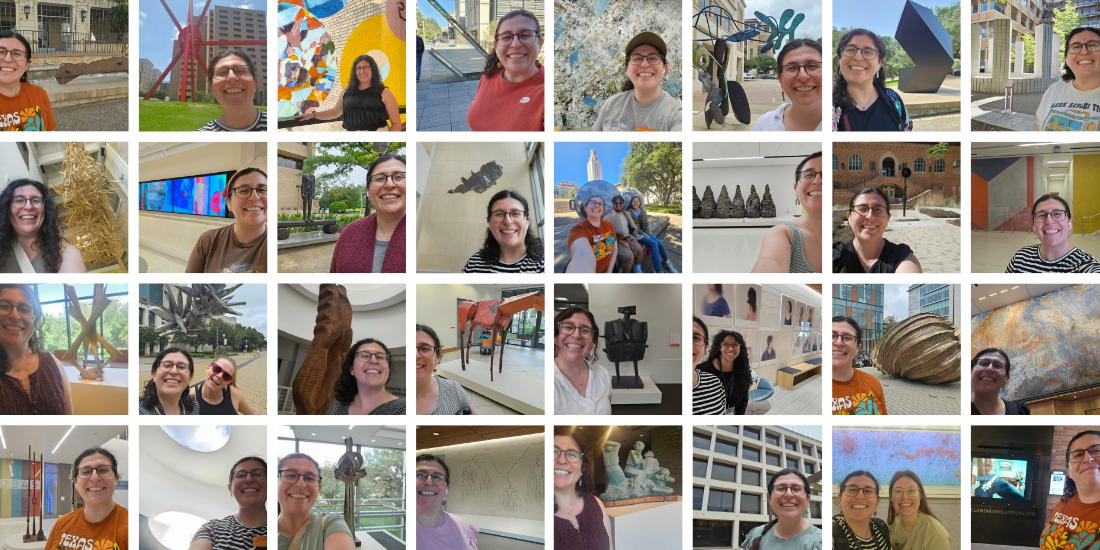
Staff member Morgan Laner documented, via selfie, her yearlong journey to visit every Landmarks work on campus.
A walk across The University of Texas at Austin campus can change the way you see a familiar place. A quiet courtyard becomes a place to linger. A rooftop opening frames a patch of sky awash with color. And a familiar route between meetings can suddenly reveal something that has been there all along — something you simply hadn’t noticed before.
Those moments are part of everyday life with Landmarks, the University’s award-winning public art program in the College of Fine Arts. Some 50 works of modern and contemporary art are spread across UT’s 441-acre main campus, embedded in the places where students, faculty and staff work, study and move throughout their days. The collection features some of the most admired and promising artists of our time and is always free and accessible to all.
For staff member Morgan Laner, experiencing the collection became something more deliberate: a challenge to visit every Landmarks work on campus.
When Laner began working at UT in January 2021, she was a zero-waste coordinator in Facilities Services, supporting recycling and composting initiatives. Based east of Interstate 35, she was often farther from the heart of campus and traveled by golf cart, experiencing the University through a very particular lens. When she later moved to the College of Fine Arts, she saw an opportunity to rediscover her surroundings on foot and with fresh eyes.
“I wanted to be able to explore and learn about campus from a different angle than what I had known,” Laner said. “And from a personal perspective, I was really craving a goal.”
And thus, a self-challenge was born: Laner committed to visiting every work in the Landmarks collection, aiming to see one installation each week. Rather than organizing her route geographically, she worked through the collection chronologically, using Landmarks’ online map to find each destination. She took a selfie at every stop to track and document her progress.
The challenge became a weekly “side quest,” as Laner described it, and a reason to leave her usual routine behind. Summer heat, busy workweeks and unfamiliar corners of campus occasionally complicated the plan. During some weeks, she skipped a visit and doubled up during the next. Gradually, though, she discovered not only where the works were, but how she wanted to experience them.
Laner developed a ritual: arrive, walk around and look first, then listen to an audio guide or watch a video about the work. These and other resources are easily accessed by scanning the QR codes embedded within the signage for each work.
“Art can be very intimidating,” Laner said. “So, if you can build that practice of interpreting it yourself first, I think that’s really important when you’re exploring different pieces.”
The Stops That Stuck
Some experiences lasted much longer than the walk it took to get there.
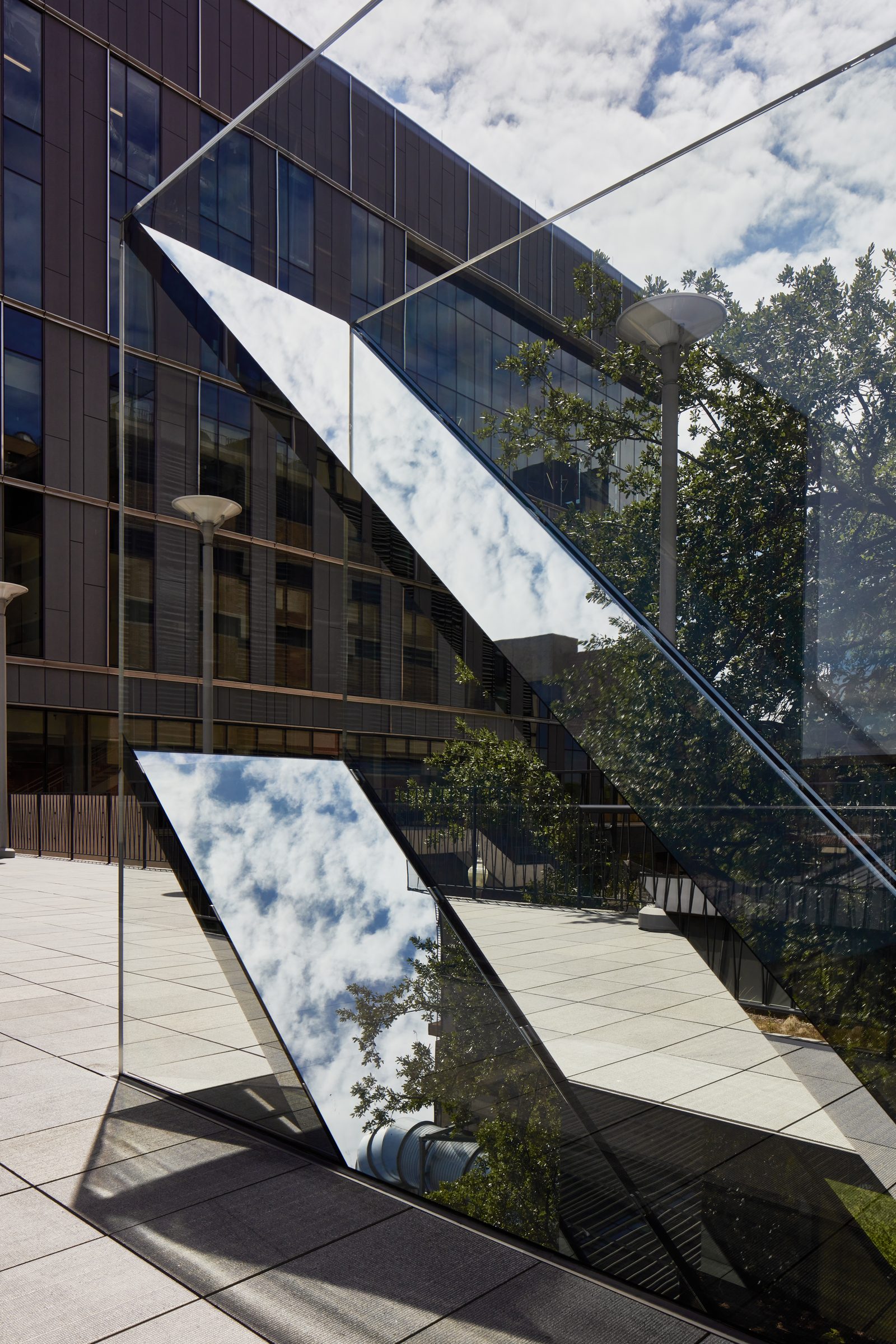
Sarah Oppenheimer’s “C-010106” prompted a pause. Integrated into the pedestrian bridge at the Cockrell School of Engineering, the work uses diagonal reflective glass to create unexpected views between people above and below the bridge.
Laner initially followed the map onto the bridge before realizing she could also experience the installation from underneath. She circled back, changing her vantage point and taking time to consider the work from a new perspective.
Trying to understand how the shifting reflections worked was, she said, “almost a trippy experience.” The stop lasted longer than most. Laner first examined the installation on her own, then sat down with Landmarks’ educational materials before returning to the work with new information.
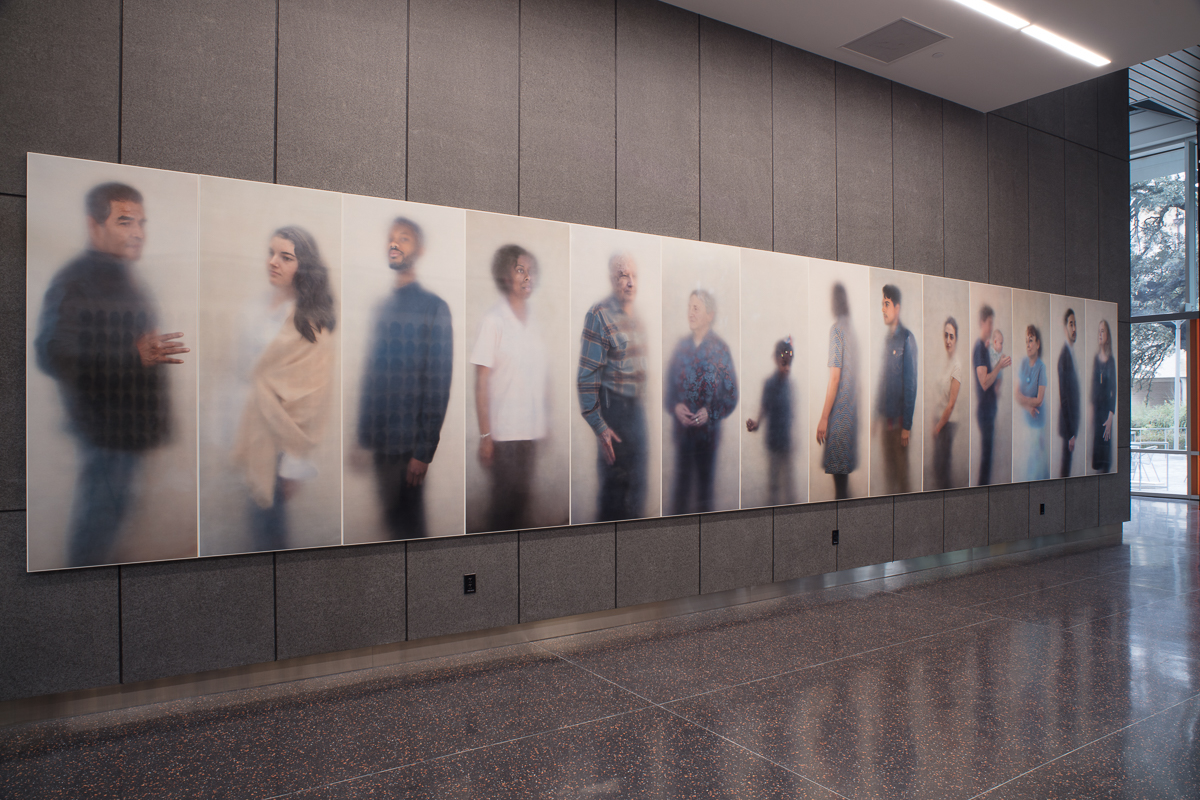
Dell Medical School offered one of the biggest surprises of Laner’s challenge. She had spent little time in that part of campus and hadn’t expected to encounter works of art throughout its buildings. Among them was Ann Hamilton’s “O N E E V E R Y O N E,” a series of photographic portraits commissioned by Landmarks for Dell Medical School that explores touch as a gesture of contact and care.
As part of her commission for Landmarks, Hamilton photographed more than 500 members of the Austin community. She placed her subjects behind a translucent material that brings whatever touches its surface into sharp focus while allowing the rest of the figure to recede.
For Laner, encountering the portraits within a medical school made the relationship between the work and its surroundings especially resonant. What initially felt like an unexpected place to find art soon seemed inseparable from the experience of the building.
“It was really one of the most unexpected spaces to see the work, but it made so much sense for that building,” she said.
That sense of discovery began changing the way Laner moved through the rest of campus, too. Places that once seemed difficult to navigate became familiar. Her visits began connecting the sculpture, the architecture and the people who had occupied the space before her. On walks after lunch, she started recognizing works she had visited months earlier.
One More Landmark
For a personal challenge that began as an effort to see campus differently, Laner’s final encounter with the Landmarks collection offered a fitting conclusion: a familiar University building had been transformed by the arrival of something new.
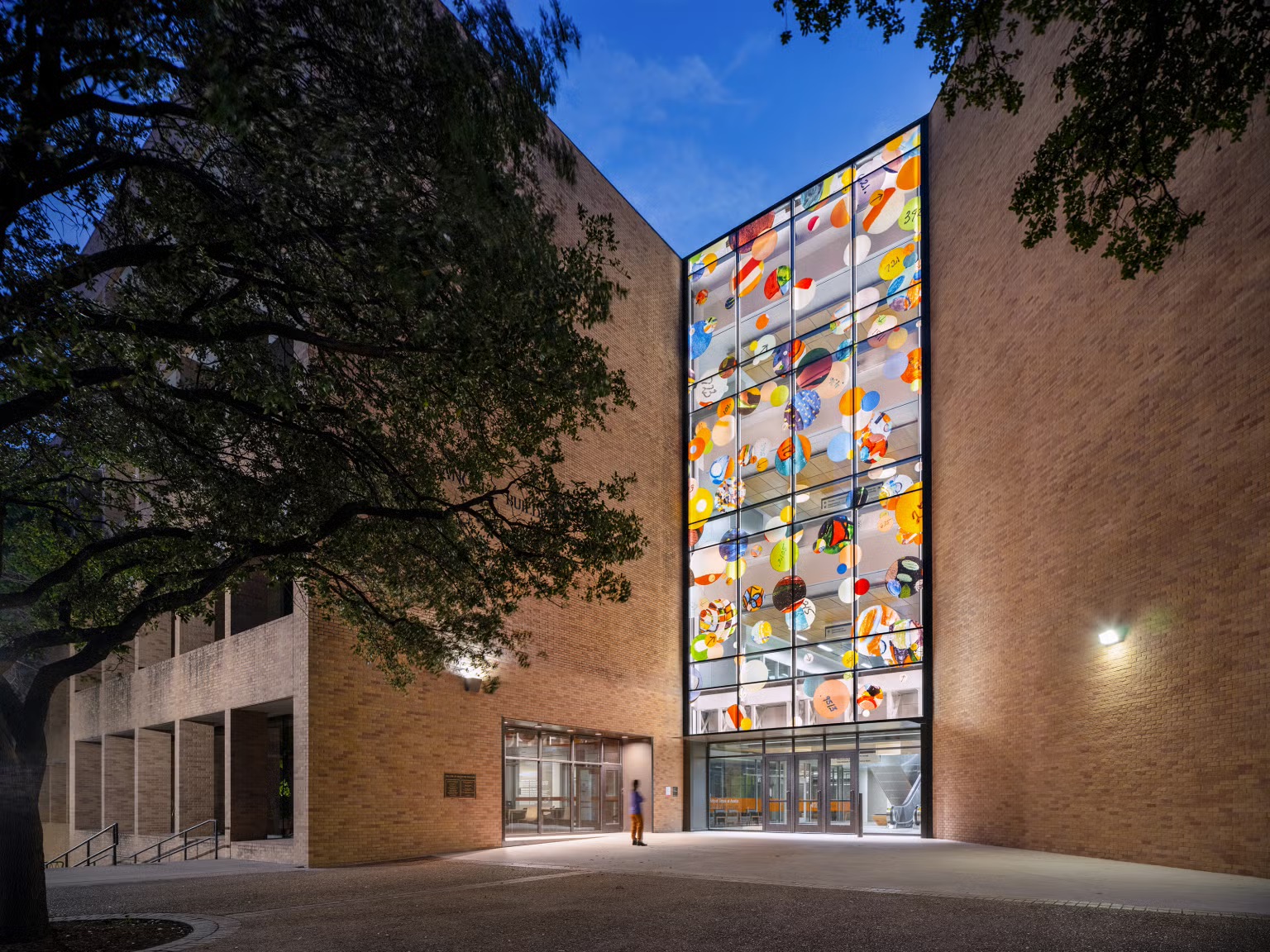
The facade of the College of Education’s George I. Sánchez Building was newly renovated and activated by “Autobiography: Circles,” a multistory installation by artist Howardena Pindell.
Fused into the glass facade of the building, the four-story composition brings together circles, numbers and arrows — visual motifs that have appeared throughout Pindell’s career. The 2026 commission represents Pindell’s first exterior public work and her first commission in Texas. As daylight passes through its ceramic frit glass, the entrance is filled with shifting fields of color and pattern.
Completing her challenge brought Laner “a feeling of accomplishment,” she said, but also a new sense of confidence, both in navigating campus and engaging with the art sited throughout it. After more than a year of seeking out unfamiliar places, interpreting works on her own and then learning about the artists behind them, spaces that had once felt unfamiliar had become more approachable — and so had the art itself.
For those looking to take on a similar challenge, Laner’s advice is simple: Pace yourself, figure out what motivates you, and make room for discovery when day-to-day responsibilities leave you feeling stuck.
There is no single way to explore the Landmarks collection. Start chronologically, as Laner did, or pick a different corner of campus to visit each week. Bring a co-worker. Listen to the audio guides. Or simply stop at a work you’ve walked past a hundred times but never taken the time to explore.
The real challenge is to see what happens when you start looking.