Social consequences and social media
Social media Web sites like Facebook have invaded everyday life. A new study by Associate Professor S. Craig Watkins digs deeper into the nuances of social media behavior.
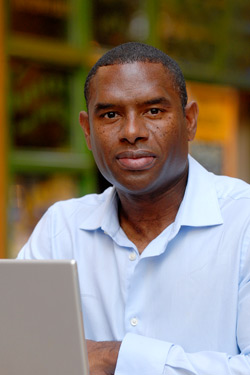
S. Craig Watkins Photo: Marsha Miller S. Craig Watkins, associate professor of Radio-TV-Film in the College of Communication, has been researching young people’s media behaviors for more than 10 years. In November, Watkins released a study showing that social media, contrary to popular opinion, actually makes us more social.
In the coming months, he will be part of an international research network funded by the MacArthur Foundation to study how young people are living and learning with social and mobile media technologies.
Watkins’ most recent book, “The Young and the Digital: What the Migration to Social Network Sites, Games, and Anytime, Anywhere Media Means for Our Future” (Beacon 2009), explores young people’s dynamic engagement with social media, online games, mobile phones and communities like Facebook and MySpace.
Seven years ago I pieced together a research team and started studying young people’s historic migration to the digital world. We were on the ground just as social media was beginning to spread beyond early adopters and technology geeks. We were deeply immersed in what I like to call “the digital trenches” and had a close up view of the future as young technology users began spending as much time online and with their mobile phones as they did with television, the dominant media technology in our society for more than 50 years.
One of the first research interviews that I did was a true eye opener. Speaking with a young woman in her early 20s she explained her emphatic embrace of Facebook this way: “It’s a big part of our lives in this day and age,” she said candidly. “And if you’re not a part of that, then you’re missing a huge part of your friends’ lives also.” She elaborated. “It’s hard to relate to the people that you are friends with, if they have this big force in the their lives and you are not a part of it it’s the impact that it has on real life.”
Understanding that impact or, more precisely, the social consequences of social media is a key part of my research.
According to Facebook each month the world spends about 7 billion minutes a month on the Web site and shares about 30 billion pieces of content — pictures, videos, links, etc. That is a lot of time and a lot of stuff. But what are we doing and sharing during those 7 billion minutes? Our new study, “Got Facebook?” emphatically confirms what we suspected: social media is a pervasive force in our everyday lives. But the study also digs deeper to understand the nuances of social media behavior.
Among other things, “Got Facebook?” studies how social media behaviors change in the transition from college to life after college. While most young people continue to use Facebook after college, the demands of work or family, for example, influence the degree of engagement. Among the 900 people we surveyed in a national cross-section of young users:
- Recent college graduates (50 percent) are much less likely than current college students (43 percent) to share their religious views on Facebook. This holds true for political views, too, as 37 percent of graduates compared to 43 percent of college students report sharing this information.
- In the networked media world we are “always on,” that is, always connected to our social networks usually through a mobile device.
- Whereas more than half of college students (55 percent) log in to Facebook three or more times a day only 43 percent of college graduates do. One recent college graduate told us, “there was a time when I would be on Facebook anytime I could, even if there was nothing on Facebook.” Now that she works and has less leisure time her engagement with social media has changed.
It turns out that men and women use Facebook in different ways.
- Women, for example, are much more likely to post photos whereas men are much more likely to share videos.
- Women are also less likely than men to share their political and religious views online.
Social media is a common part of our daily lives. Understanding what that means for the quality of our lives will continue to be a source of widespread debate.
Read more about Watkins’ study on The Young and the Digital Web site.