In Annual State of the University Address, President Davis Highlights Position of Strength and Future Plans in Healthcare, Research and Undergraduate Education
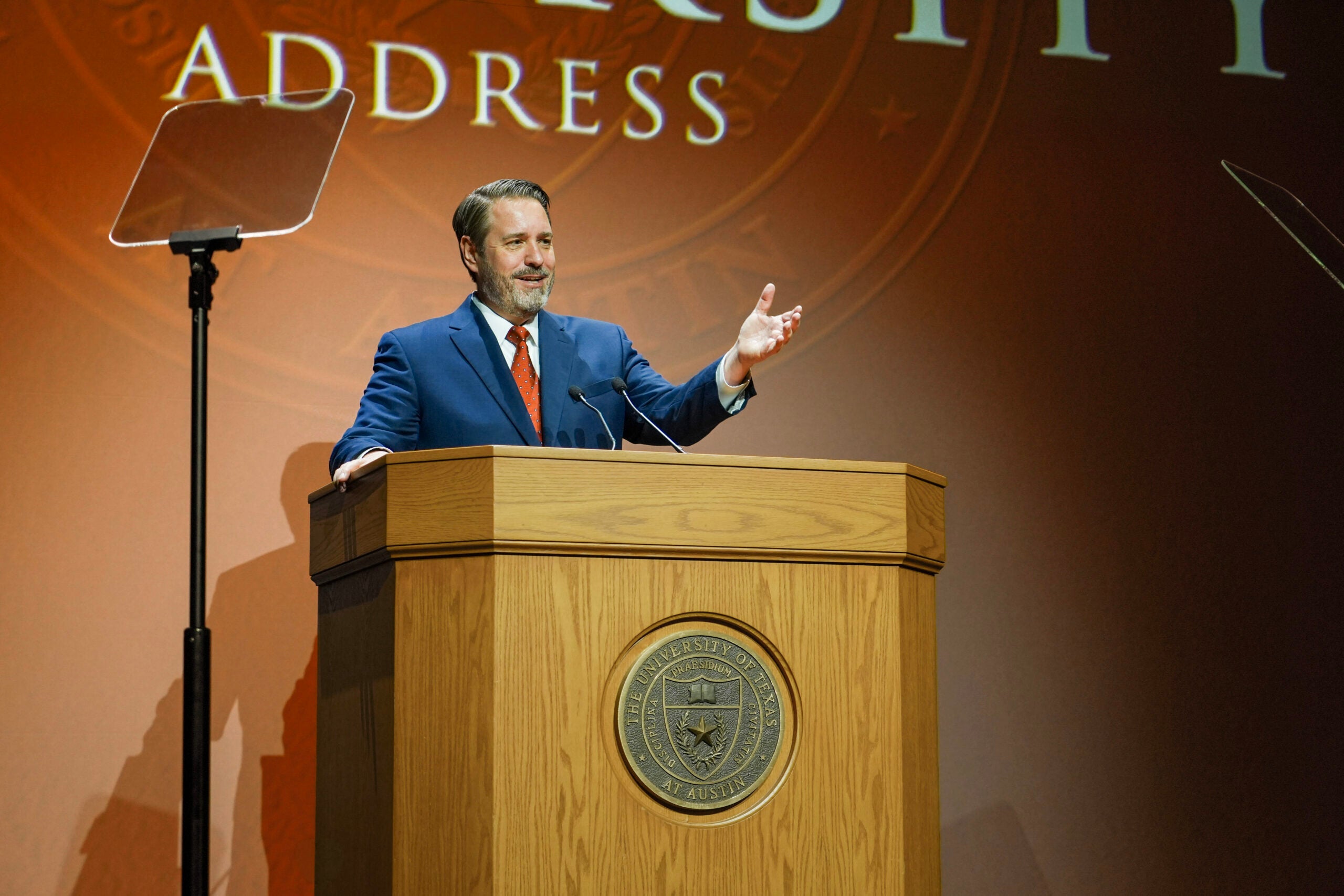
President Jim Davis shared a bold and confident vision for the future of The University of Texas at Austin during his annual State of the University address, highlighting the institution’s growing strength and outlining major efforts to advance health care, research and undergraduate education.
Pointing to record-high applications and enrollment, historic growth in research funding, unprecedented philanthropic support, and continued success in attracting top faculty talent, Davis demonstrated how the University is operating from a position of strength and is poised to expand its impact.
“The state of the University is clear,” Davis said. “Texas is on the rise. We are stable. We are flourishing. And we are ready for what’s next.”
Davis emphasized a culture of mission, decision and action as the foundation for the University’s continued success. He focused on three areas that will shape UT’s future: building an integrated academic health enterprise, accelerating interdisciplinary research, and strengthening undergraduate education.
His first priority focused on the future of healthcare. Davis praised the leadership of Executive Vice President Claudia Lucchinetti and highlighted the launch of UT Dell Medicine, a new integrated health system that puts patients at the center. The effort represents a significant expansion of UT’s mission, creating an academic health enterprise that brings together clinical care, research and the training of future health professionals.
“We have been an academic and research enterprise for 143 years. We are now adding a health institution into our organization,” Davis said. “We will treat patients in a cutting-edge academic medical center and conduct medical and health-related research at a whole new level.”
Davis said the initiative will place patients at the center of care while integrating expertise from across the University, including medicine, engineering, natural sciences, nursing, social work and more. He also highlighted the development of the UT Dell Medical Center, launched through a historic investment from Susan and Michael Dell as an AI-native medical center that combines advanced computing, research and clinical care that will deliver more personalized treatment and better health outcomes.
Davis also outlined a vision for research that brings together scholars from across disciplines to pursue discoveries and solve problems that no single field can address alone.
“Generations of investment and talent have put us in a position where we are world-class,” he said. “We have strengths across all the fields we all know about. And we are poised to be the leaders of the next thing, and the next thing, and the next. And while we continue to invest in our strengths and grow new ones, this is the time to bring our strengths together to solve problems bigger than any one discipline.”
As part of that effort, Davis announced plans for a new Frontiers of Science Building, a Universitywide research facility designed to foster collaboration and support emerging areas such as artificial intelligence, robotics, automation and quantum science while helping attract more top faculty members to UT. The building is envisioned to be different from those that currently exist — one that is not owned by any college or school but instead brings campuswide teams together to solve big challenges.
In undergraduate education, Davis praised the leadership of Executive Vice President and Provost William Inboden and highlighted the University’s recent Core Curriculum redesign, describing it as a renewed commitment to providing all students with a strong educational foundation while preparing them for citizenship, leadership and success in a rapidly changing world. To support implementation of the new curriculum, Davis announced the establishment of the University College and named Devin Stauffer, professor of government and chair of the Core Curriculum Task Force, as its inaugural dean. The college will serve as the steward of the Core Curriculum and help guide its continued development.
“The charge was simple: We will produce 100,000 citizens over the next 10 years; what do you want them to know?” Davis said. ” The new core is clear, focused, and rigorous — a foundational education. It gives every Longhorn a common learning experience and builds judgment and character.”
Davis ended with an eye toward the 150th anniversary of the University’s founding, declaring that during the next six years, the University will advance the efforts he highlighted while continuing to grow, modernize, come together and build upon UT’s foundation.