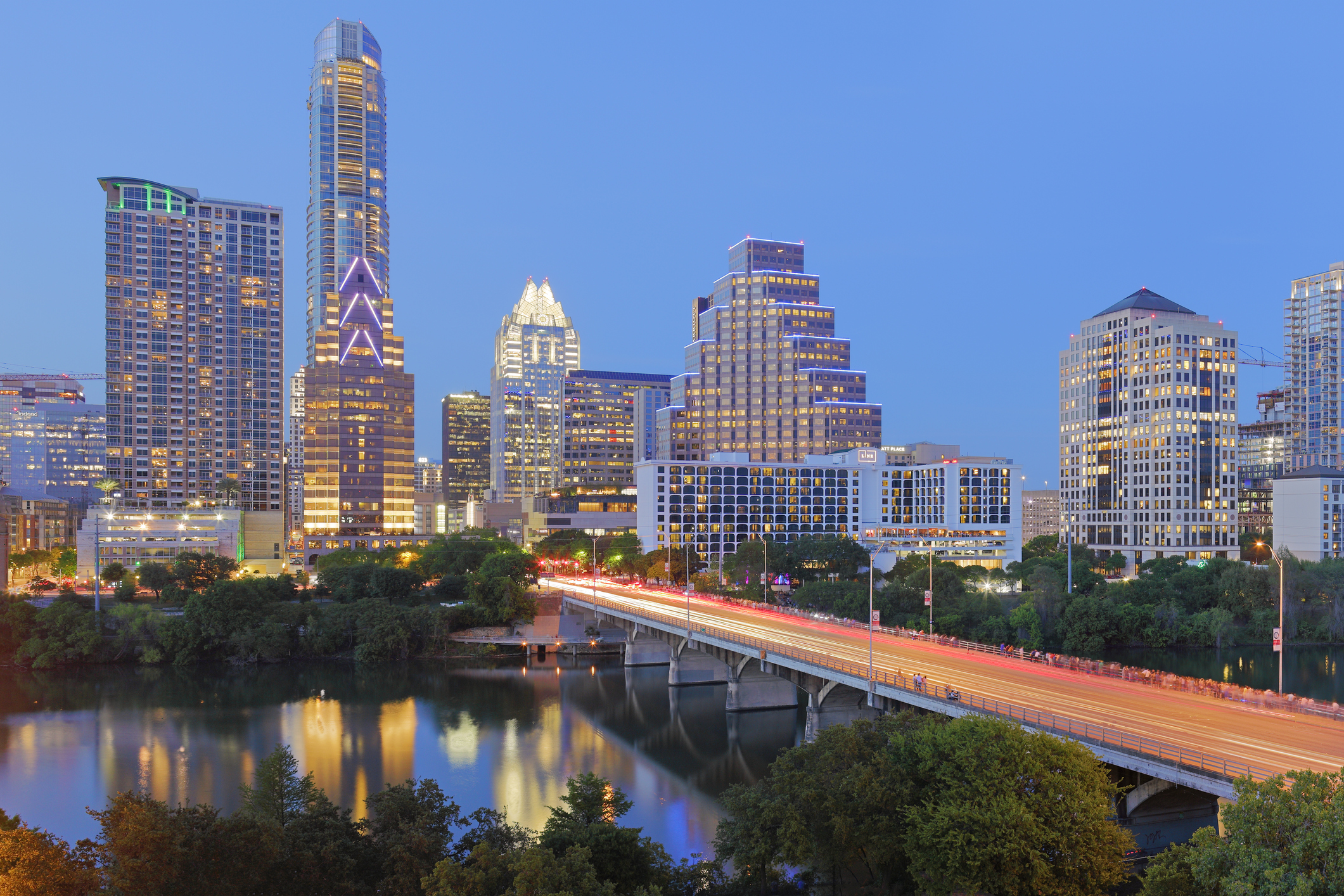
Night time panoramic view of the Austin (Texas) skyline and the Congress Avenue bridge crossing the Colorado river.
AUSTIN, Texas — As immigrants move to Austin, they may face several challenges. A new analysis from public policy researchers at The University of Texas at Austin shows that although measures of legal support, government leadership and community put Austin at 43 out of the 100 largest cities in 2020 for immigrant incorporation, the city falls below average on measures of civic participation, livability and job opportunities. Additionally, Austin’s naturalization rate is one of the lowest among its peers.
Researchers analyzed data from the New American Economy (NAE) Cities Index and used census tract data to find that most affordable housing units, hospitals, fire stations, public libraries and child care facilities are along the heavily populated central corridor of Austin, bending toward wealthier west Austin. Most of Austin’s noncitizen communities live in central and southeast Austin while naturalized people live in west Austin.
Austin’s subpar score of 2 on job opportunities also was troubling, researchers said, especially given the city’s overall record of prosperity and economic growth. Median annual wages in the construction sector in Austin ($32,960), for example, fall below state ($34,980) and national ($43,000) levels. The analysis found that immigrants in Austin experience rent burden at a rate 4.8 times higher than native-born residents.
“As foreign-born and native-born Austinites face many of the same challenges, policies needed to alleviate these problems would benefit both native- and foreign-born residents,” said Ruth Wasem, the study’s lead author and a migration policy expert at the LBJ School of Public Affairs. “The location of hospitals, fire stations, child care and public libraries mirrors the longstanding racial and economic divides in the city of Austin.”
Austin is one of the fastest growing cities in the United States and is identified as an emerging gateway for immigrants. The city’s immigrant residents are increasingly diverse. The single largest source country for immigrants to Austin continues to be Mexico, but immigrants from Asia are increasing in numbers and relative proportion. Immigrants from Africa have doubled during the past decade and make up 4% of the immigrant population.
“Our various immigrant communities deserve to experience a high quality of life, and the recommendations from this report will help us work toward making Austin a truly livable city for all of our residents,” said Rocío Villalobos, the immigrant affairs manager for the City of Austin.
Researchers recommend that the city:
- Formally establish and staff an office charged with immigrant affairs and incorporation.
- Explore policy options to remedy its comparative low wages in key sectors of the economy.
- Develop and preserve affordable housing.
- Continue to collaborate with public universities and colleges and other nongovernmental organizations to deliver workforce development programs.
- Ensure information about requirements for starting businesses are accessible in immigrant communities.
- Support naturalization with additional resources and available coursework aimed at the English language proficiency and civics education required to qualify for naturalization.
- Establish community hubs that bring agencies and neighborhood groups together to provide specialized services as needs ebb and flow.
- Develop initiatives to encourage civic participation across all communities.
The study, funded by the City of Austin, is the culmination of several phases of research and analysis. The initial phase drew on the New American Economy Cities Index and identified a subset of U.S. cities similar to Austin on key economic and demographic factors. The study then explored the immigrant incorporation policies of successful peer cities. Another critical phase of the research was socioeconomic analysis of the foreign-born population in Austin, using the 2019 American Community Survey Five-Year Estimates to identify census tracts with concentrations of foreign-born residents and analyze key traits.