
Newly Discovered View of Brain Blood Flow During Surgery Could Prevent Debilitation, Save Lives
UT researchers develop new camera technology that overcomes a longstanding hardware barrier.
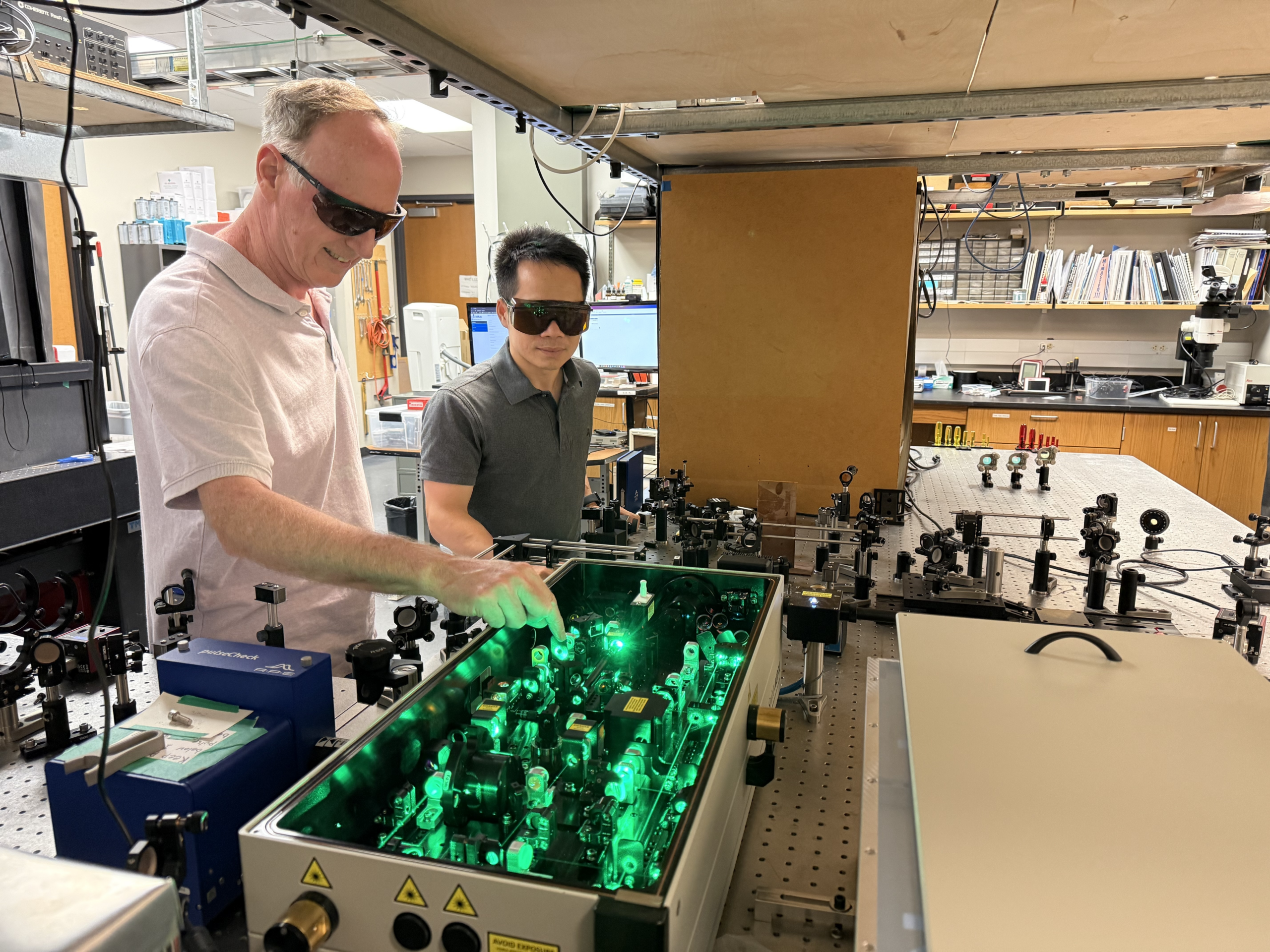
Biomedical engineering professor Andrew Dunn and Hengfa Lu, a postdoctoral student in the lab where they developed brain blood flow monitoring technology.
Tracking the brain’s blood flow during neurosurgery represents one of the most critical and challenging parts of the operation. A brief interruption can mean the difference between permanent damage and full recovery, but it’s difficult to track blood flow across the surgical field.
Researchers at The University of Texas at Austin have developed a new way to monitor blood flow with standard camera hardware. The method, called sinusoidal intensity modulation speckle imaging, or SIMSI, uses the physics of dynamic light scattering to image blood flow noninvasively, across a wide field of view and without high-speed cameras.
“This has been a fundamental challenge in the field for a long time,” said Andrew Dunn, a professor in the Cockrell School of Engineering’s Department of Biomedical Engineering whose lab published the finding in the Proceedings of the National Academy of Sciences. “SIMSI gives us a way to get quantitative, physically meaningful numbers from a technique that is already fast and practical enough to use in the clinic.”
In addition to neurosurgery, this technology could improve monitoring during cardiac surgery, help assess tissue viability in reconstructive procedures, guide treatment decisions in stroke care, and support research into conditions ranging from dementia to traumatic brain injury.
This research builds on a technique called laser speckle contrast imaging, or LSCI, which has been widely used in biomedical research to image blood flow. When laser light illuminates tissue, the movement of red blood cells causes the resulting laser speckle pattern, a granular, shimmering image, to blur in proportion to how fast the cells are moving. By analyzing that blur, researchers can map blood flow across an entire field of view simultaneously, without touching the tissue or injecting dyes.
However, conventional LSCI provides only relative measurements. It can tell that flow increased or decreased, but not by exactly how much, or what the absolute blood flow is.
SIMSI solves this problem by adding precise modulation to the laser illumination, varying light intensity in a sinusoidal pattern at a controlled frequency within each camera exposure. This seemingly simple addition, combined with a new imaging model, encodes information about fast blood flow dynamics into the speckle images, allowing researchers to make more quantitative, physically meaningful measurements without relying on high-speed cameras.
The result is a camera-based system that produces quantitative maps of rapid blood flow dynamics across a wide field of view without contacting the tissue.
“Blood flow can change over many timescales, but the optical fluctuations that reveal how fast blood is moving are often too fast for standard cameras to sample directly,” said Hengfa Lu, a postdoctoral fellow in Dunn’s Functional Optical Imaging Laboratory who led the development of the SIMSI framework. “By intentionally modulating the illumination during the exposure and using a newly derived imaging model, we can recover fast blood flow dynamics that would otherwise be averaged out. That gives researchers a more quantitative way to study how tissue is functioning, from stroke recovery in the lab to, eventually, surgical decision-making.”
Dunn has been working on this research for 25 years, dating back to documenting the first use of laser speckle to image brain blood flow in 2001. He translated this technology to the operating room for the first time in 2010. In 2024, Dunn worked with UT’s Discovery to Impact commercialization hub to license his SpeckleView surgical imaging platform to Austin-based medical device startup Dynamic Light.
Looking ahead, the team sees SIMSI as part of a broader effort to make fast, quantitative blood flow imaging more accessible. By pairing engineered illumination with a physics-based imaging model, the approach enables standard cameras to capture rapid dynamics while maintaining long, light-efficient exposures. That could open new opportunities in stroke research, brain injury, surgery and other areas where blood flow is an early signal of tissue health.
The project was funded by the UT Austin Portugal Program and the National Institutes of Health. Other team members are Qingwei Fang of the Department of Biomedical Engineering; Jewel A. Ashbrook of the departments of Biomedical Engineering and Physics; Victoria Nemchek and Theresa A. Jones of the Department of Psychology; and Michela Fracassi of the Department of Neuroscience.