It is perhaps the grandest space on the campus, a place that says, now you are at a real university. And that is precisely what the builders intended.
There was a time when the heart and soul of a university — the truest expression of its commitment to learning — was its library. Naturally, this feeling has waned in the internet age, but not so long ago, a university was considered exactly as good as its library. And, true to the Texas ethos, bigger was better. A 27-story library was a play for academic world dominance.
Starting in 1934, this was the University of Texas Library. This was The University of Texas.
Almost 90 years on, any VIP or recruitment tour of UT Austin must include what now is known as the Life Science Library on the second floor of the Main Building.
The cavernous library with high, ornate ceilings, large windows and rich woodwork was the central part of the first section of the Main Building and Tower to be completed. It was opened as the Library Extension.
Where the grand central staircase ends at second floor, a complex of three rooms served as the heart of the Library Building. The majestic Hall of the Six Coats of Arms greets visitors, who can pass through it to the Hall of Noble Words on the east or the Hall of Texas on the west. Directly north of this center room are the stacks, constructed to hold the library’s thousands of books. In the beginning, these stacks would form the 10 lowest levels of the Tower, those that don’t protrude above the Main Building.
Largely unchanged since it was opened in 1934, the architecture bespeaks the great ambition of the University, and the details reveal the intellectual milieu of the faculty of the time.
Changes have been made — as when fluorescent light fixtures were destructively added to the ornate ceilings of the reading rooms, and when giant partitions were erected in the Hall of Texas to create the Plant Resources Center — but those modifications have since been reversed, recognizing that the original vision for this grand space could not be much improved regardless of whatever seemed necessary at a given time.
The Hall of the Six Coats of Arms
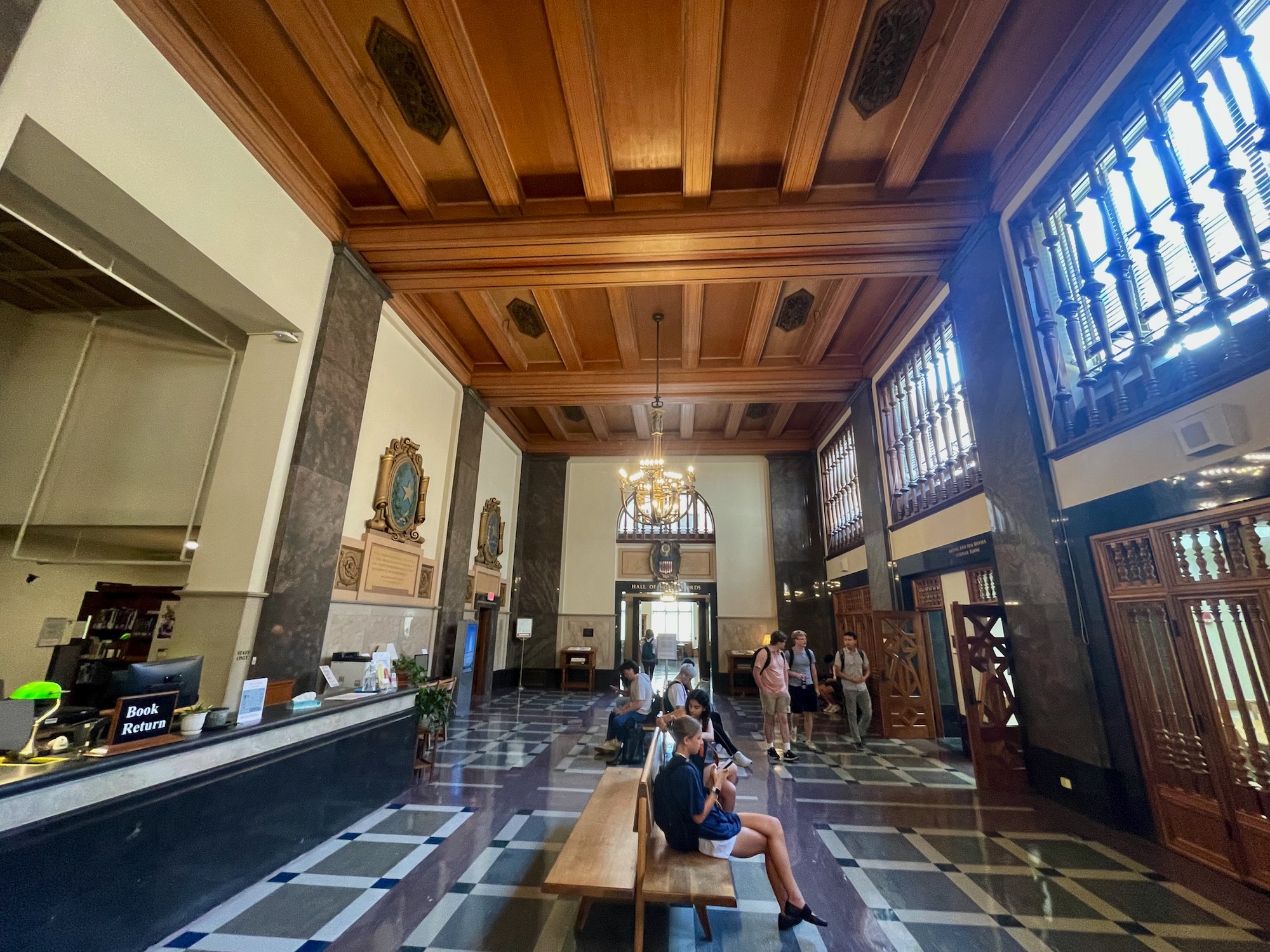
In his detailed description of the Main Building, William Battle, longtime chairman of the Faculty Building Committee (and namesake of Battle Hall, UT’s first purpose-built library building), explains that the Loan and Catalog Room is also called the Hall of the Six Coats of Arms. “Texas has made much of the fact that it has lived under six nations. … The six flags of these nations have often been brought together for decorative purposes, but here for the first time have their heraldic arms been so used.”
The coats of arms are arranged chronologically from left to right as one enters the library, with Spain on the west wall, France, Mexico, the Republic of Texas and the Confederacy on the north wall, and the United States on the east wall. Battle gives interesting commentary on each:
- The insignia of Spain’s Charles I was chosen because he was on the throne when the Spanish first explored Texas in 1519.
- Likewise, the arms of France’s Louis XIV were chosen because he ruled during La Salle’s short-lived attempt to settle parts of the future state.
- Mexico’s national arms (seen below), the eagle, snake and cactus familiar from Mexico’s flag, were adopted in 1823, and the branches of the cactus represent the states.
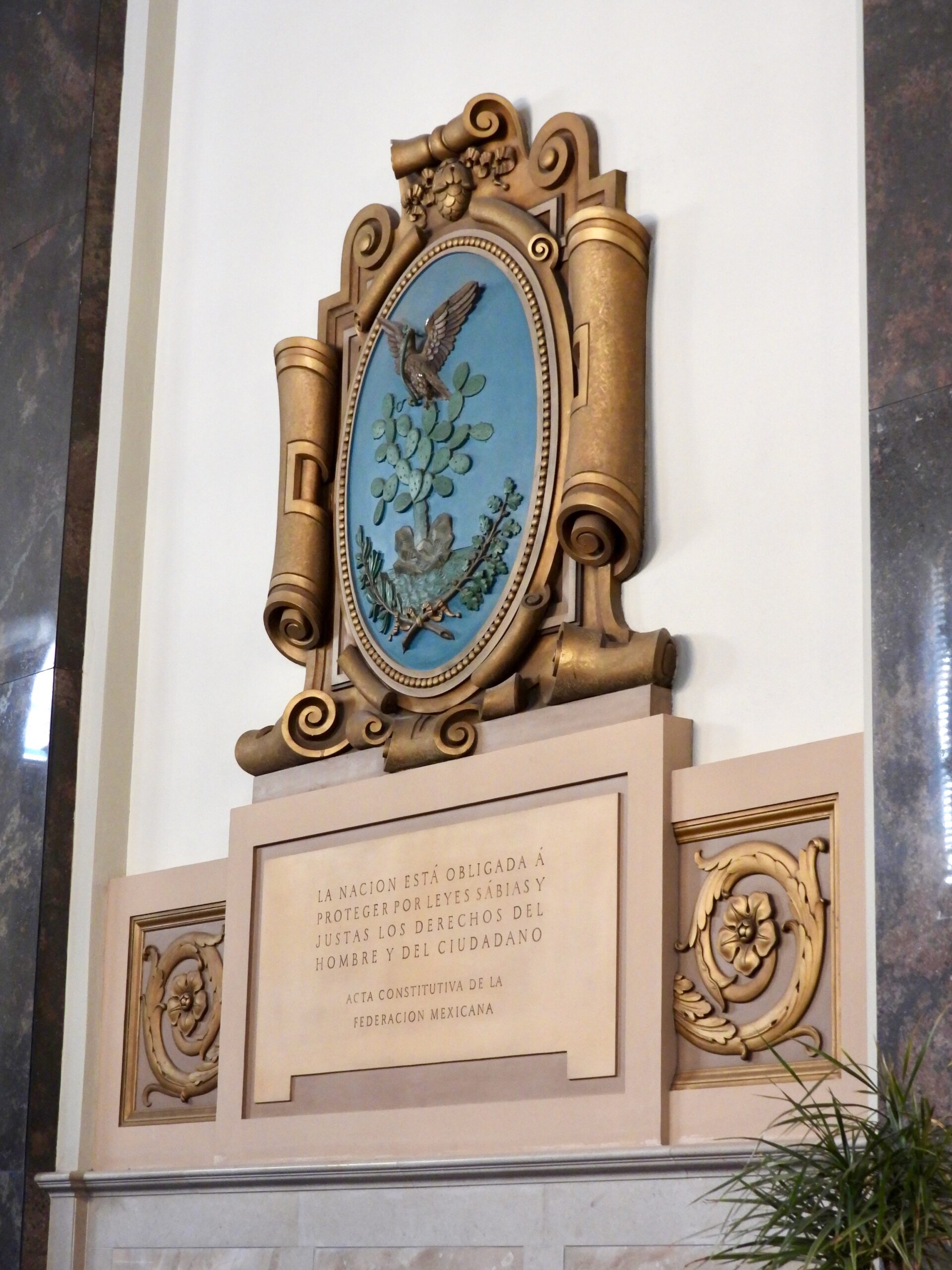
- Battle points out that per the constitution of the Republic of Texas, the wreath made of live oak and olive “is correctly represented here. In the Texas seal as usually seen, the Wreath is post oak and palm branches,” subtly correcting the state’s symbolic grammar. Each coat of arms is paired with an inscription below it, and the inscription for the republic, especially relevant for a university, is excerpted from the Texas Declaration of Independence: “It is an axiom in political science that, unless a people are educated and enlightened, it is idle to expect the continuance of civil liberty or the capacity for self-governance.”
- The arms of the Confederate States, adopted but never used, Battle explains, show George Washington on horseback (trading on his Virginia roots) within a wreath made of Southern products: tobacco, rice, corn, cotton, wheat and sugar cane.
- Finally, we see the arms of the United States, with the motto “E Pluribus Unum” “left off for lack of space,” Battle writes. It is paired with the preamble to the Constitution.
On the south side of this hall once sat the card catalogs. In 2008, this space was divided into seminar rooms for undergraduate studies. Each received a large elliptical table based on one designed and built by the founding dean of undergraduate studies, Paul Woodruff, elliptical so that everyone at the table could see everyone else. The star-themed doors to the rooms were inspired by early plans for doors that would connect the circulation area to the stacks but that were never built.
On the room’s north side sits the original, enormous circulation desk. In 2005, a small end section of the counter was removed to comply with the Americans With Disabilities Act, but not much else has changed. It still bears the signage of when this operated as a closed-stack library: “WAIT FOR BOOKS AT THE LEFT.”
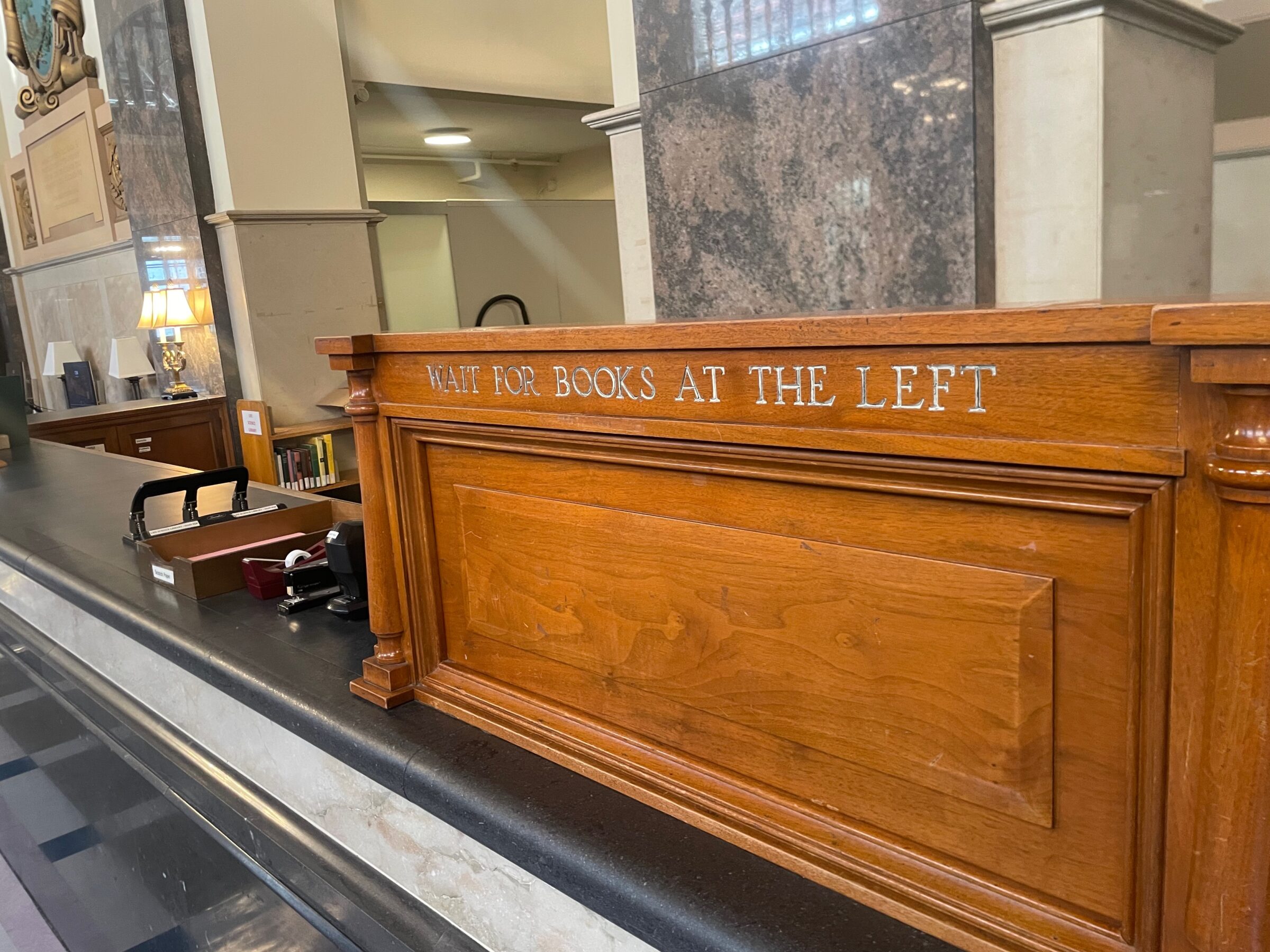
The sign is a perfect reminder of why this is no longer the University’s main library. By the 1960s, waiting for one’s books to be delivered — the hallmark of closed-stacks libraries — was on its way out. A new open-stack library for undergraduates was being planned for next door.
The walls are clad in marble, the ceiling paneled in walnut. The transom windows still have their wood grilles, and original bronze chandeliers still light the space.
A final note on this room: The Hall of Noble Words and the Hall of Texas, described below, were not officially known by those names but had long been referred to as such. During a 2019 renovation, the names were emblazoned over each room’s vestibule, at last making the monikers permanent. Bill Gannon, manager of facilities and AV for UT Libraries, created and installed the signs.
[The library’s book stacks, north of this room, are discussed in Part 2.]
The Hall of Noble Words
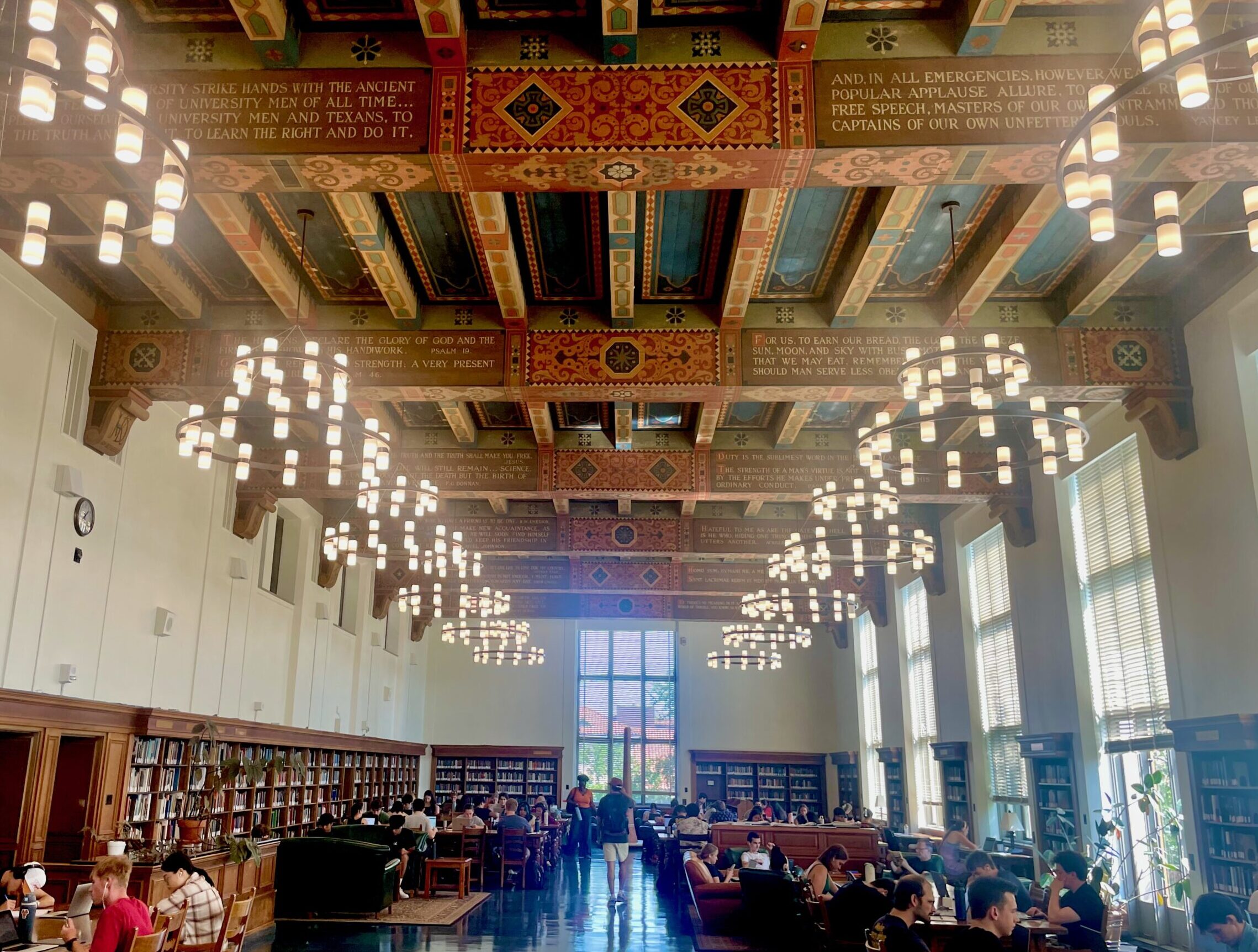
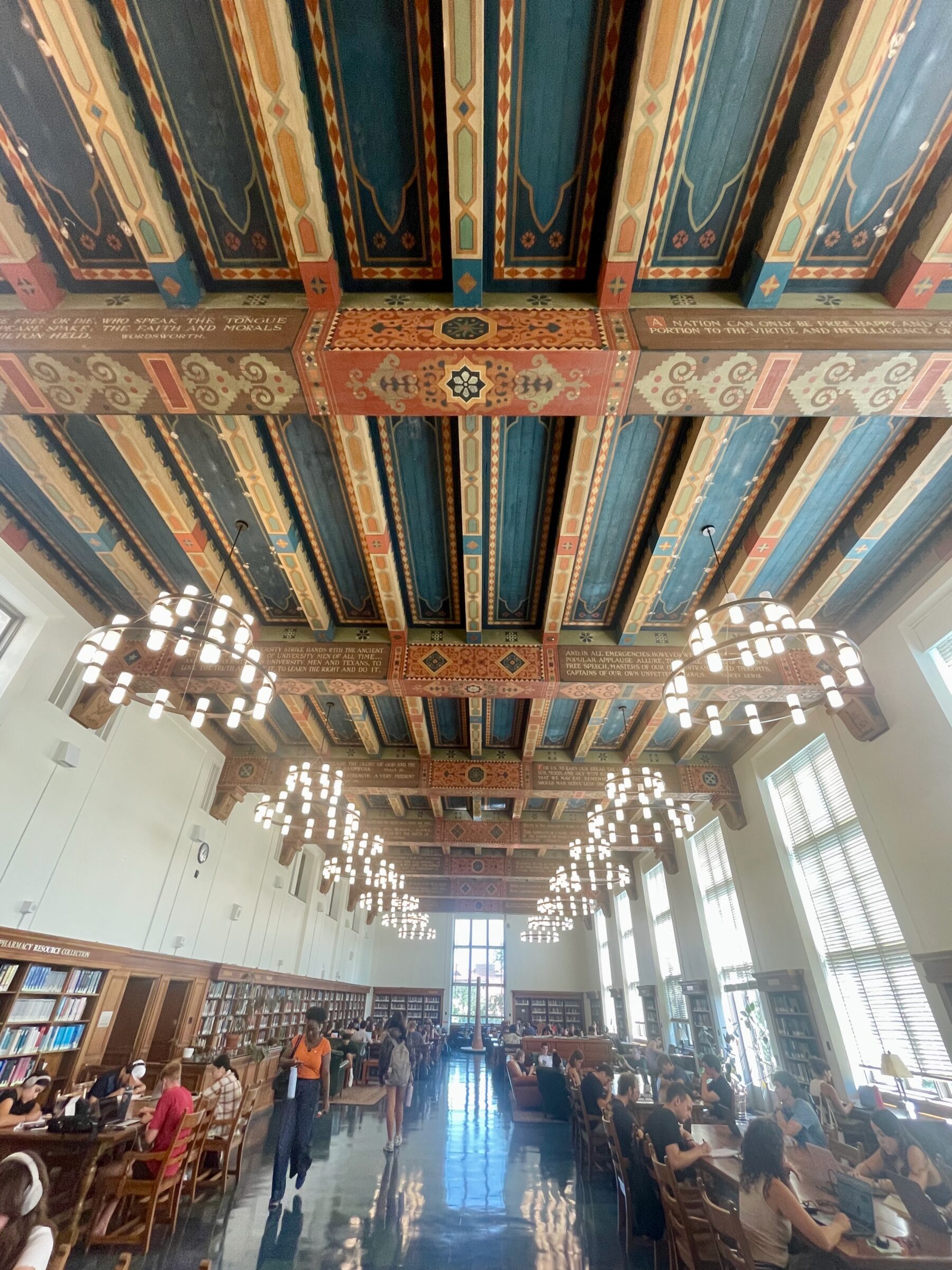
To the east, or right as you enter the Life Science Library, sits the Hall of Noble Words. It was conceived as the Undergraduate Reading Room, then served as the Humanities Reading Room before becoming part of the Science Library, then Life Science Library.
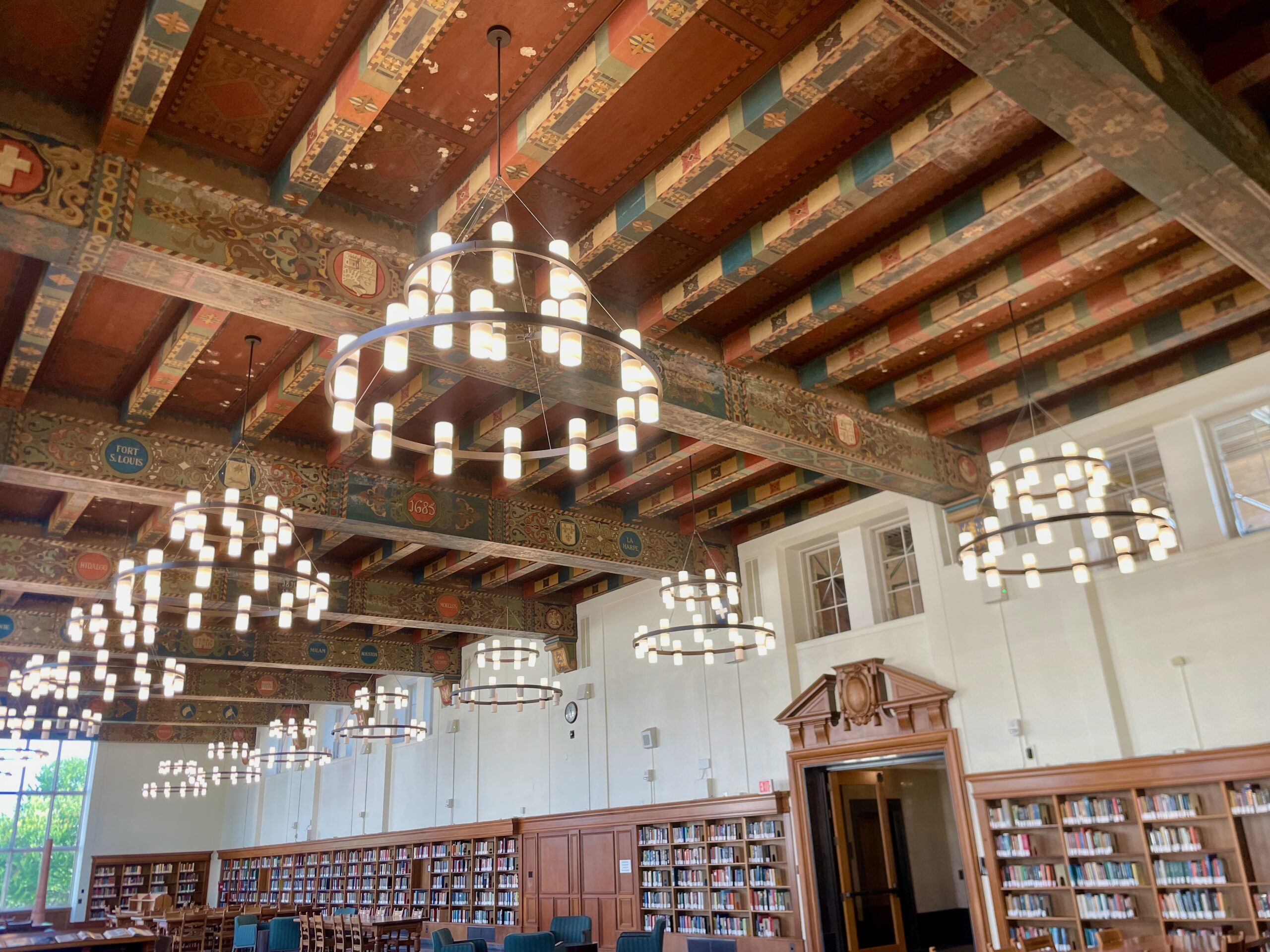
The noble words in question — 31 inspirational quotations — are painted on both sides of the eight concrete beams.
According to UT historian Jim Nicar, in June 1933, Battle sent mimeographed copies of a letter to select members of the faculty and staff:
“As a part of the decoration of the ceiling of the east reading room of the new library, the Building Committee contemplates the use of noble and inspiring utterances appropriate to the function of the room as an educational agency. The concrete beams offer long, broad surfaces well adapted for such a purpose … We might, with propriety, call the reading room The Hall of Noble Words. The Committee would be greatly pleased if you would suggest utterances that seem to you appropriate … Perhaps the thoughts expressed may occasionally find lodgment in the minds of users of the reading room.”
Submissions arrived from all parts of the campus, Nicar writes. “I am much pleased by your suggestion for the use of noble utterances,” wrote accounting and management professor Chester Lay. “I like the idea of using inspiring inscriptions,” responded home economics professor Lucy Rathbone. “The thing that impressed me most in the Library of Congress was the quotations carved on the columns,” she wrote, then submitted:
“The strength of a man’s virtue is not to be measured by the efforts he makes under pressure but by his ordinary conduct.” —Blaise Pascal
Nicar relays that history professor Ed Barker submitted Martin Luther’s “Hier stehe ich. Ich kann nicht anders.” (Here I stand. I cannot do otherwise.) Anthropology professor James Pearce suggested Isaac Barrow’s: “He that loveth a book will never want a faithful friend, a wholesome counselor, a cheerful companion, an effectual comforter.” And Mattie Hatcher, an archivist in the University Library, submitted Stephen F. Austin’s: “A nation can only be free, happy, and great in proportion to the virtue and intelligence of the people.”
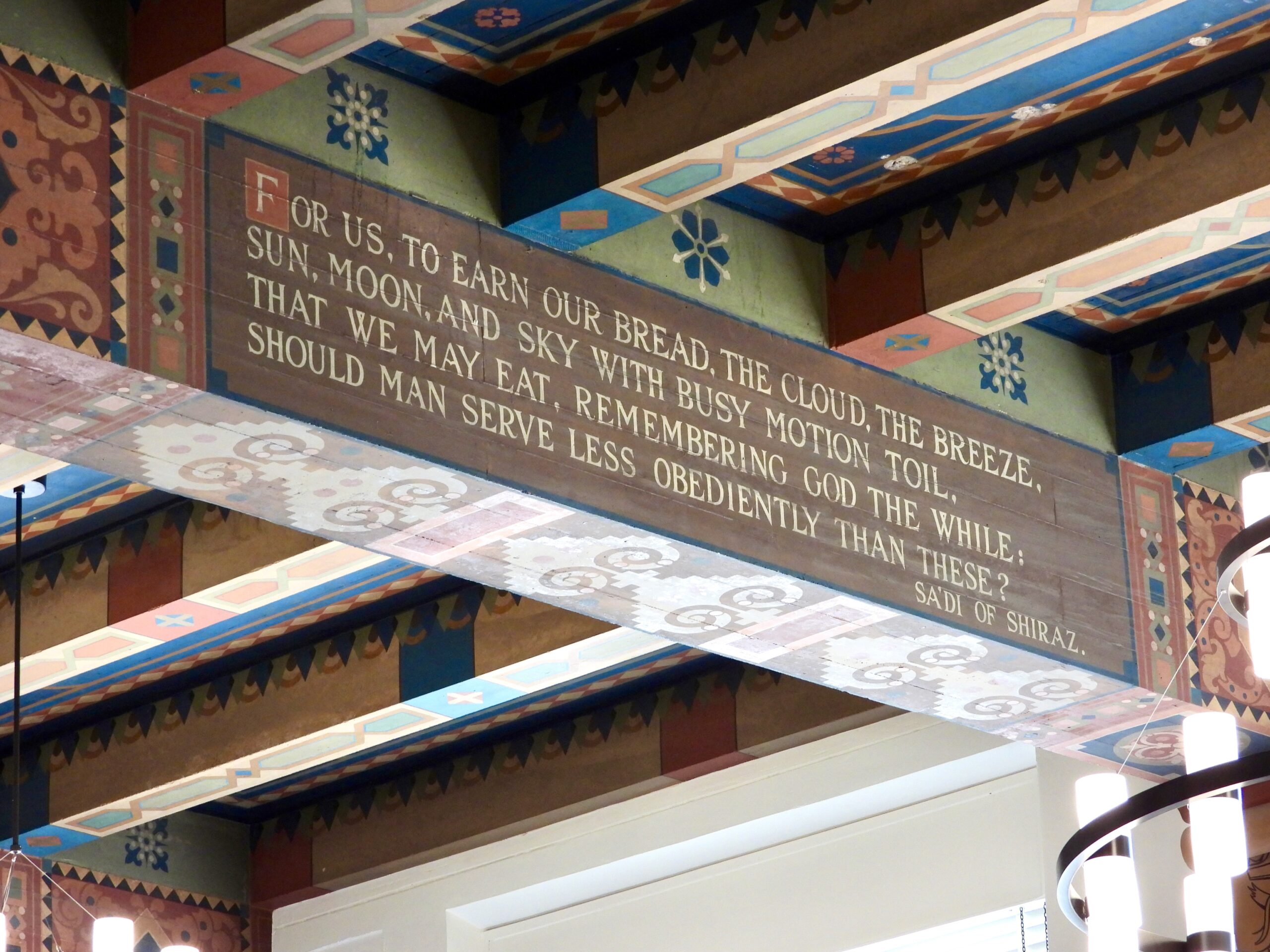
Architect Paul Cret supported the idea, writing: “The idea of inscriptions on the beams of the east room is excellent … Do not be afraid of having the color scheme too high in key at first,” adding wryly, “It will become subdued with age — like all of us.”
He was right. The colors have faded, but not merely due to time; they had much help from decades of cigarette smoke and would no doubt be much more vibrant with a skillful but expensive cleaning.
Eugene Gilboe, a Norwegian-born Dallas painter and interior designer known for theater murals throughout Texas, was hired to paint the ceiling. Gilboe used stencils for the letters and freehanded the surrounding designs. Gilboe also painted the beams in the Texas Union Presidential Lobby and the ceiling of Hogg Memorial Auditorium.
The beam supports carry 16 famous printers’ marks from the past four centuries, from Fust and Schoeffer of Mainz to Houghton, Mifflin and Company of New York to Southwest Press of Dallas.
And over the hall’s door is “A representation of the top of the central tower of the old Main Building, carved in walnut…,” according to Battle. The Hall of Texas sports a similar feature, and this walnut is thought to have been salvaged from Old Main itself.
The Hall of Texas
To the west is the Hall of Texas, which has been the Graduate Reading Room, the Business and Social Science Reading Room, and the Plant Resources Center. Each side of this room’s eight beams, also painted by Gilboe, is devoted to a period of Texas culture, starting at the south side. Familiarizing oneself with the story of each name and symbol on these beams would make for a fine course on Texas history up until 1933. Listed below are the themes and a sample of the 96 images and names used, with quotation marks indicating Battle’s descriptions:
- Aztec (south side) — corn, rattlesnake, tiger-man, head of god Huitzilopochtli, maguey plant. (Although areas of modern Texas were never under Aztec rule, the empire’s trade networks did extend into the American Southwest.)
“Indian” (north side) — antelope, stone ax, Indian chief, arrowheads, buffalo. - Period of Discovery (s) — Cross, arms of Columbus, date of European contact.
Spanish conquest (n) — Spanish cannon, arms of Cortez and date of Cortez’s conquest, 1519. - French Attempt at Colonization (s) — French ship, La Salle’s settlement Fort St. Louis, names of Louisiana traders La Harpe and S. Denis.
Spanish Settlement (n) — bull’s head, St. Francis of Assisi, chapel window of San Antonio mission San José. - Mexican Independence (s) — Our Lady of Guadalupe, patriot priest Miguel Hidalgo, elements of the Mexican arms.
American Settlement (n) — covered wagon, Father of Texas Stephen F. Austin, “name of brave and resourceful pioneer-woman Jane Long.” - Texas Revolution (s) — names of fallen patriots Bowie, Travis and Milam, Goliad, the Alamo and San Jacinto.
Republic of Texas (n) — map of the republic, “father of public education in Texas” Mirabeau B. Lamar, Texas Ranger Jack Hays, six-shooter. - Public Life in the First Period of State (s) — bounding dates 1845-1861, first governor J. Pinckney Henderson, Governor’s Mansion.
Private Life in the First Period as a State (n) — preacher who founded Austin College: Daniel Baker, name of historian Henderson Yoakum. - In the Confederacy (s) — Governor Lubbock, Confederate flag and battle flag.
More Confederate and Southern Symbolism (n) — cotton boll, magnolia blossom, five Confederate generals killed in action. - Rebuilding of Texas (s) — locomotive, governors Coke and Roberts, wire fence.
First Half-Century of The University of Texas (n) — 1883-1933, airplane, regent chairmen Ashbel Smith and Thomas Wooten, Capitol dome.
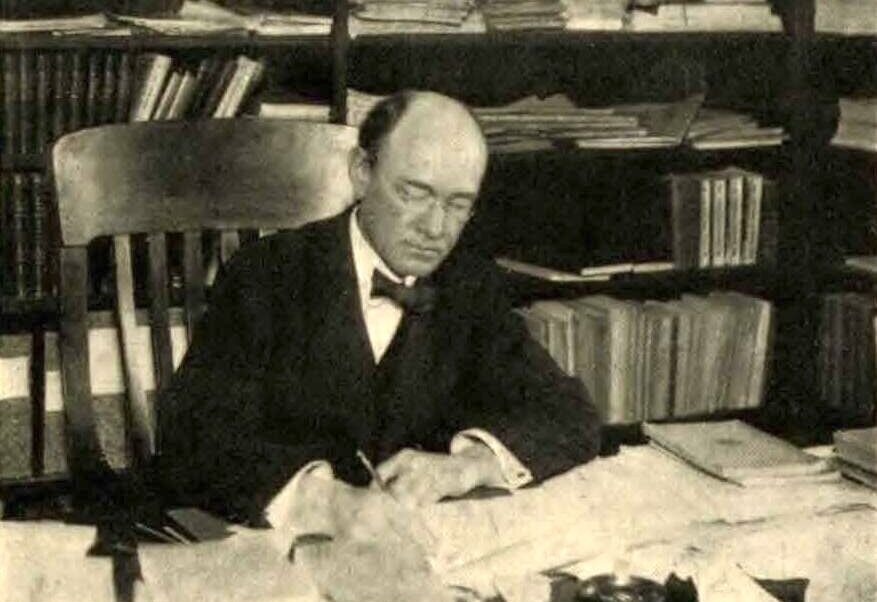
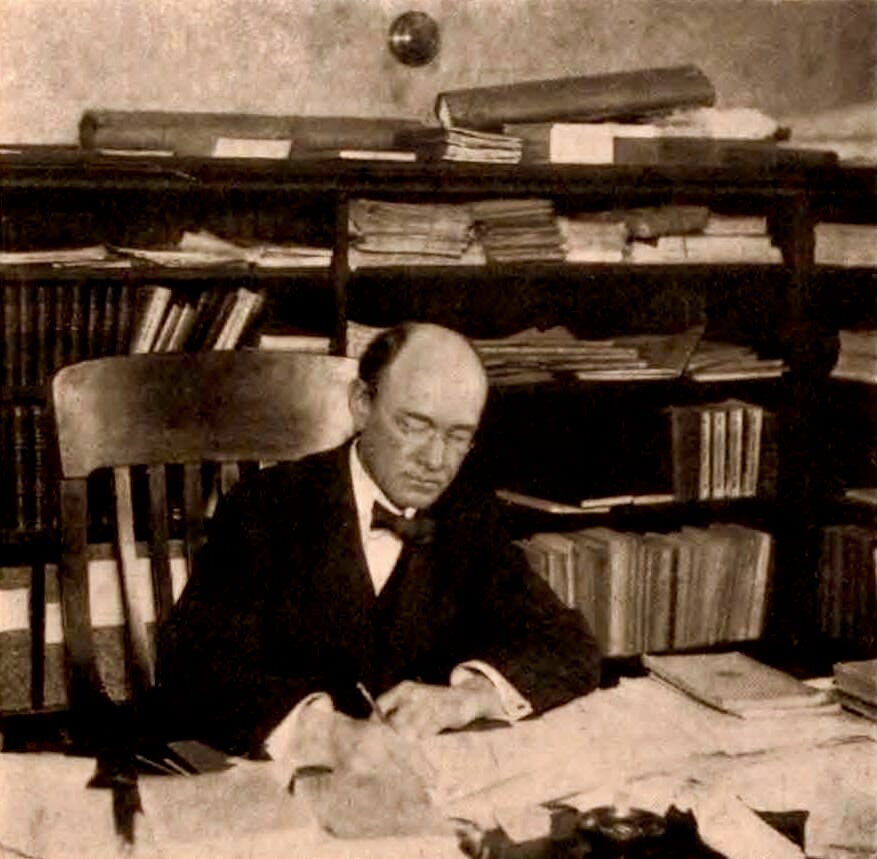 William Battle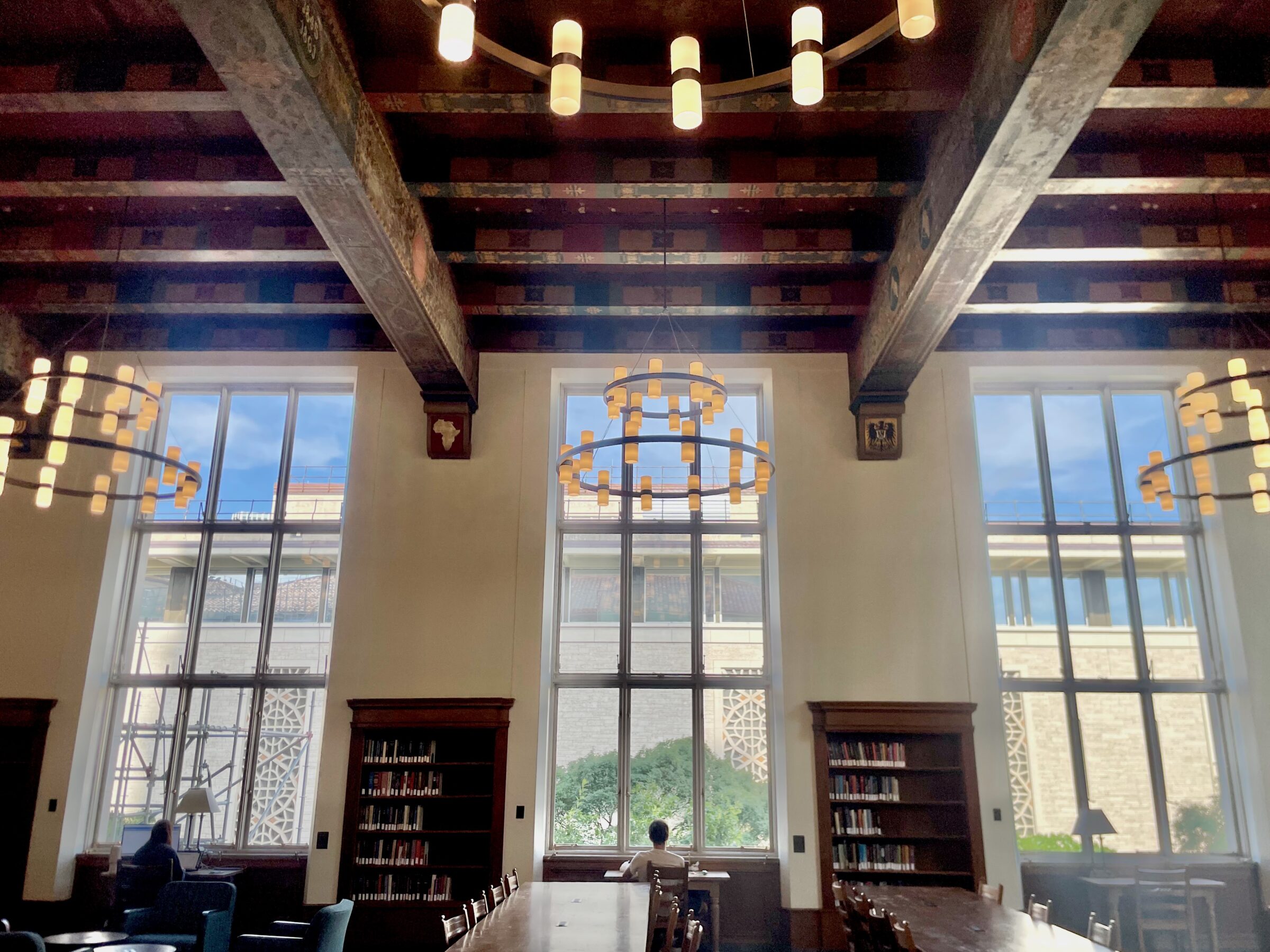
But we’re not finished. Battle explains that on the brackets supporting each beam are “The national arms of the chief stocks that make up the population of Texas today with the exception of those which appear in the Loan and Catalog Room.” Those “stocks,” what we would term ethnicities, were represented by the arms of England, Wales, Scotland, Ireland, Germany, Sweden, Norway, Bohemia, Italy, Poland, Denmark, Greece, Holland and Switzerland. For Jewish Texans, they chose a menorah, and for Black Texans, the African continent.
According to Geoff Bahre, head of in-person user experience for the six libraries within UT Libraries purview, a new wood plane had to be fabricated so that they could replicate the exact molding that had been used in the rest of the Hall of Texas.
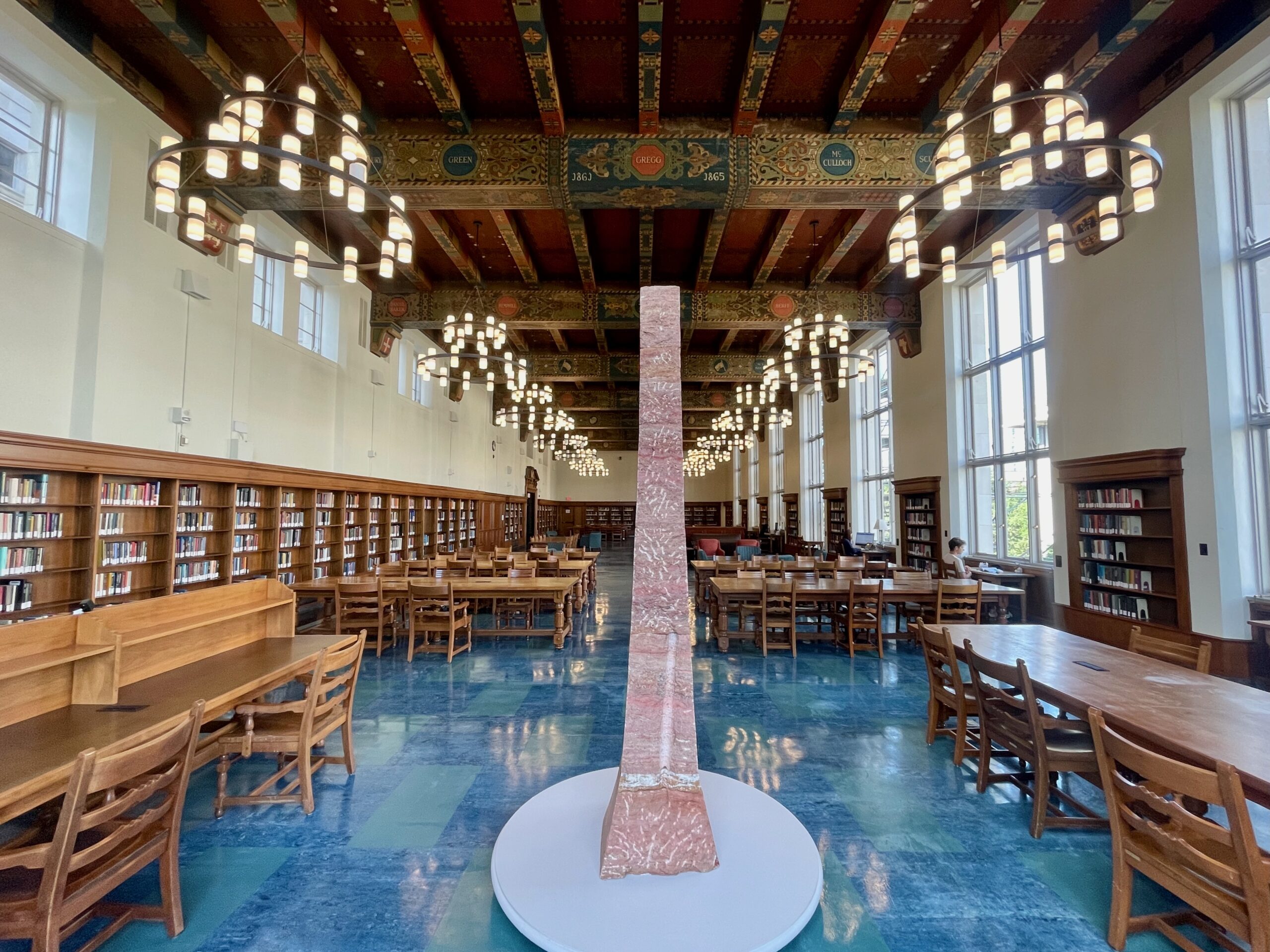
Those fluorescent lights have been removed, and new chandeliers appropriate to the room have been installed, style: reading room regal.
Additionally, a 1977 travertine marble sculpture by Walter Dusenbery called “Pedogna,” part of UT’s Landmarks program to promote public art, sits at the north end of the reading room.
In Part 2 of this series, learn more about the building of the library during the 1930s and operation of its stacks during its heyday, from 1934 to 1977.
Our Tower. Our Time.
We are embarking on a venture to restore, revitalize and reimagine the most iconic, most beloved landmark on our campus: the UT Tower.
Visit tower.utexas.edu to learn more and to support this once-in-a-lifetime effort.