The American Experiment
The LBJ Presidential Library teams up with UT’s Briscoe Center for American History to exhibit national treasures for America’s 250th birthday.
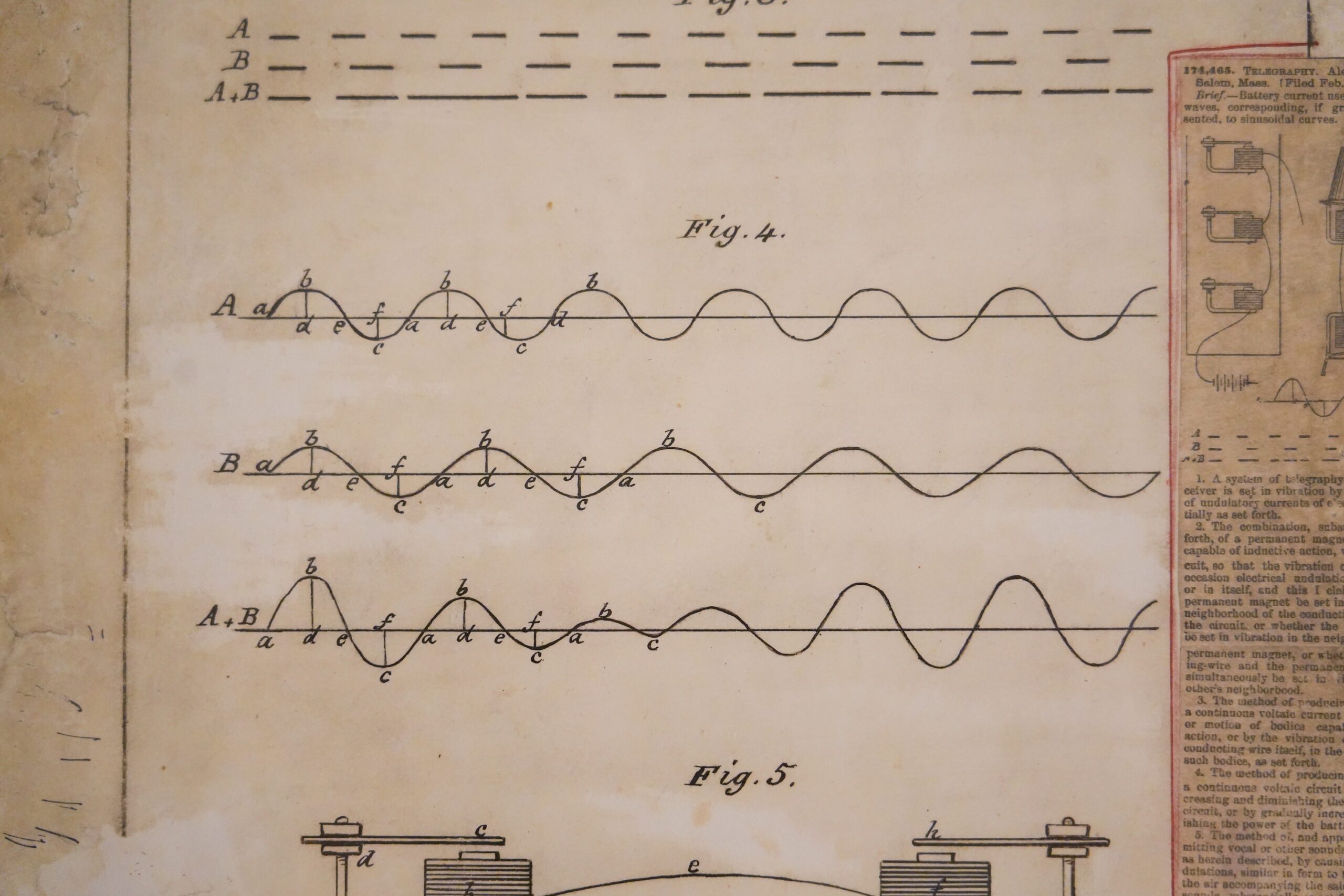
Bell’s patent drawing for the telephone
When trying to convey a sense of the United States in the quarter millennium since its founding, it is difficult to know where to start. But curators at The University of Texas at Austin at both the LBJ Presidential Library and Briscoe Center for American history have done an admirable job of this daunting task. The two entities have partnered to create a series of four exhibits that will rotate over the next six months. The first installment of “The American Experiment: Pursuing Our Promise” opened June 2 and will remain up until July 9.
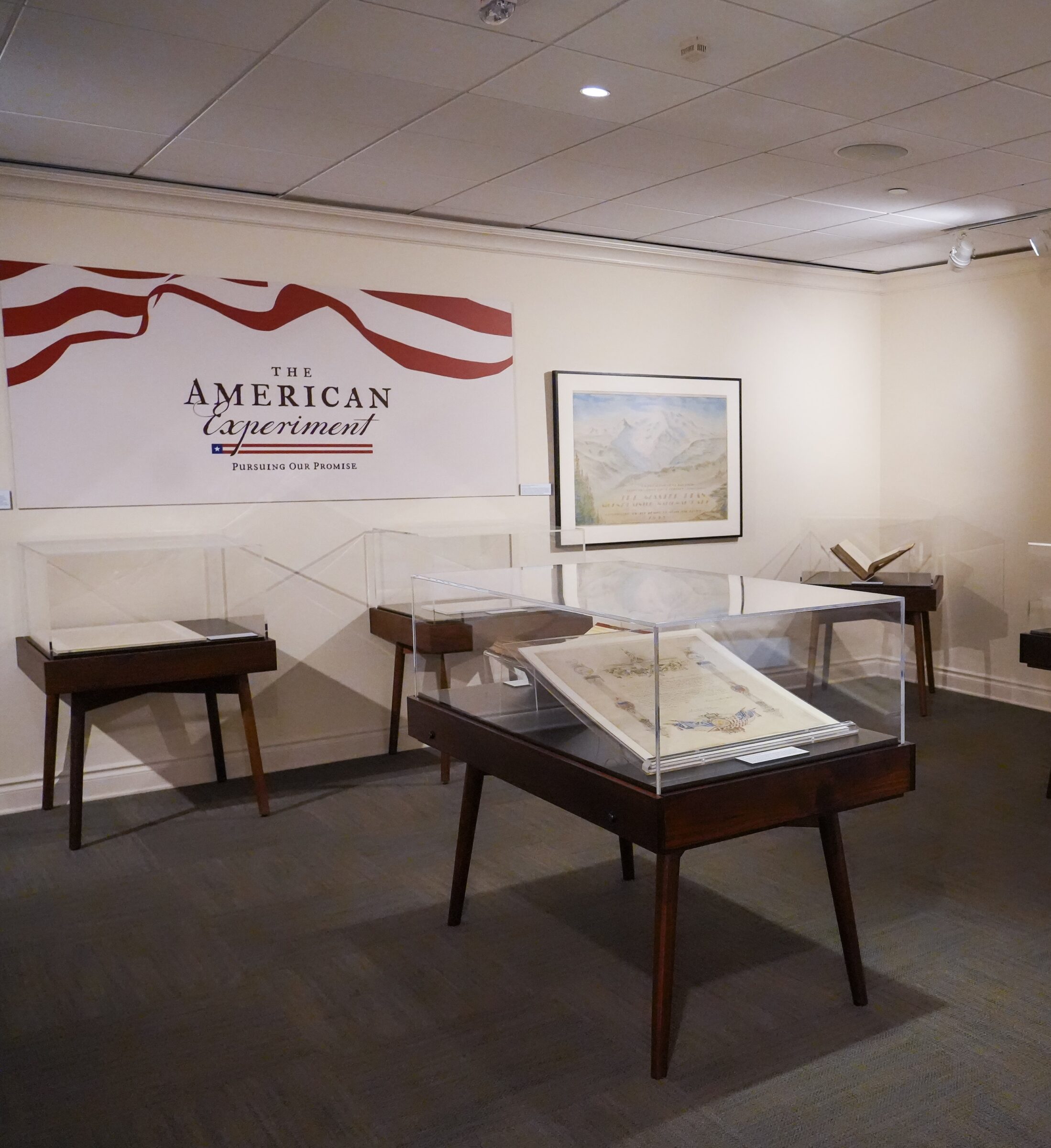
On the 10th floor of the LBJ Presidential Library, near the replica of the Oval Office, “The American Experiment” occupies a single, modest room. But its 10 glass cases hold documents of huge importance. These are on loan from both the National Archives and the Briscoe Center for American History next door. The exhibit series is called “an ongoing effort to define, challenge, and expand the meaning of democracy.”
What is America? It is a place, of course, and the first document to greet visitors is the 1848 Treaty of Guadalupe Hidalgo, which not only ended the Mexican-American War but established the modern border with Mexico and added more than a half million square miles of territory to the U.S. all the way to the Pacific. A few feet away is the 1868 treasury note with which the U.S. bought Alaska from Russia for $7.2 million just 20 years later.
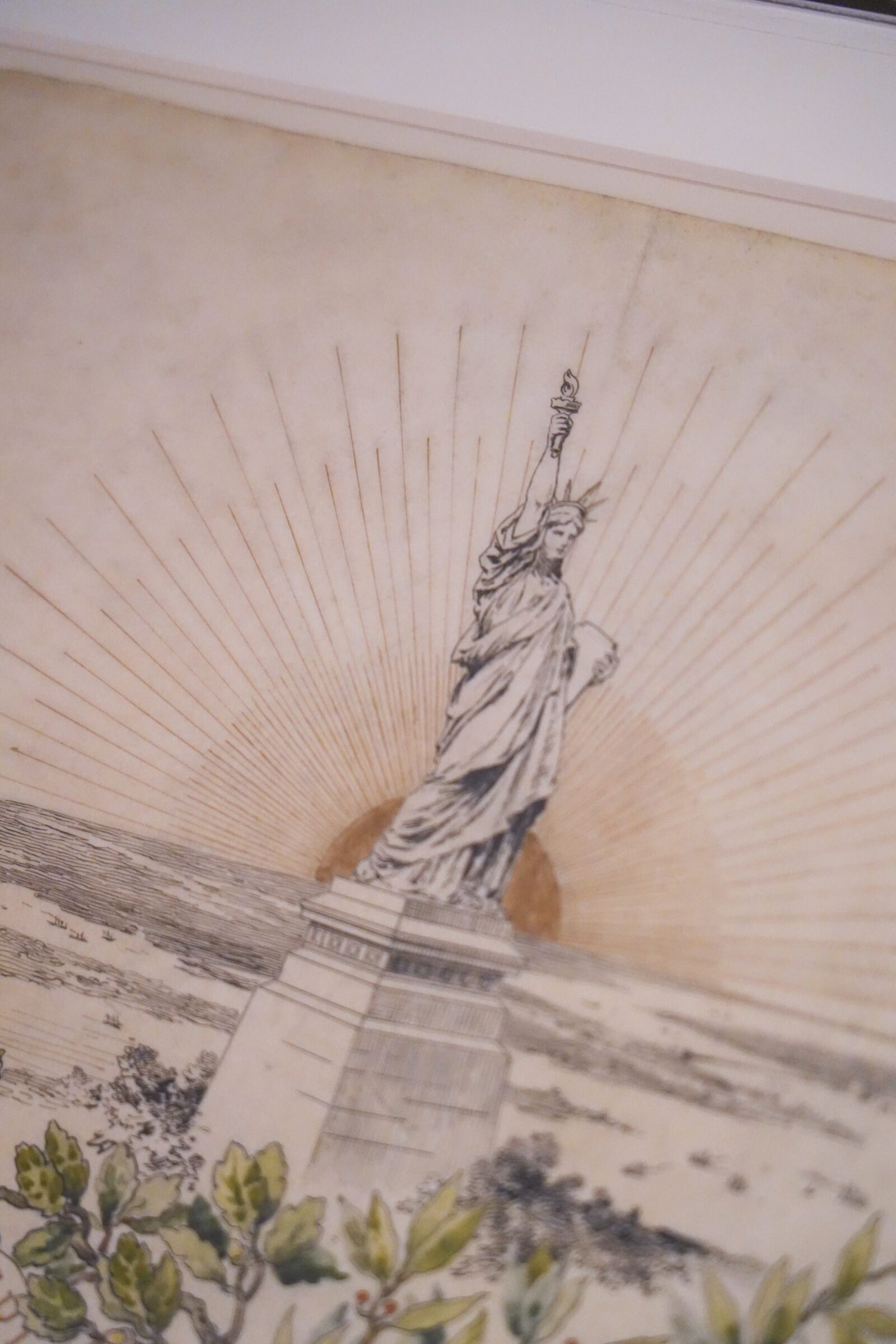
America is also a set of rights and ideals. The 15th Amendment to the Constitution, passed in 1869, granted African American men the right to vote. The library’s interpretive plaque says, “In retrospect, the 15th Amendment was in reality only another step in the struggle for equality that would continue for more than a century before African Americans could begin to participate fully in American public and civic life.” As for ideals, we are also treated to the colorful and ornate deed to the Statue of Liberty.
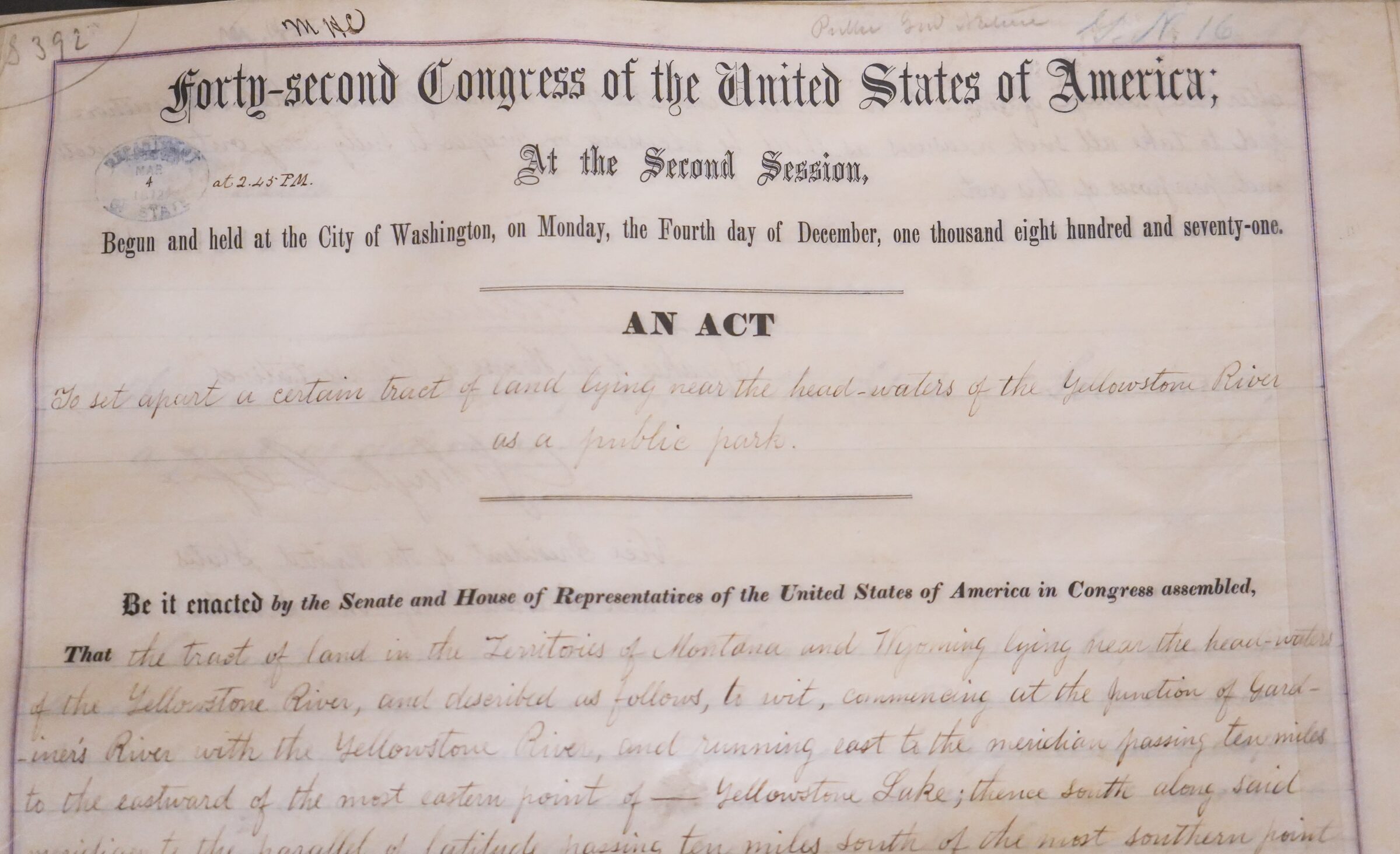
America has always been a land of innovation and invention. In another large book, we find the 1872 act establishing Yellowstone as the nation’s — and the world’s — first national park. Nearby, we see the 1916 act establishing the National Park Service and specifying the director’s annual salary of $4,500.
Several of the documents attest to America’s enormous contribution to technological progress, and these three are doozies: a patent drawing for the Wright brothers’ first airplane, Thomas Edison’s patent drawing for an electric lamp, and Alexander Graham Bell’s patent drawing for the telephone, simply called “improvement to telegraphy.” We also find, in the innovation category, the 1861 act authorizing the construction of the transcontinental railroad.
As a center of power, America has also been a place of conflict. On this front we find an original copy of the Alien Enemies Act from 1798, when Congress was still meeting in Philadelphia.
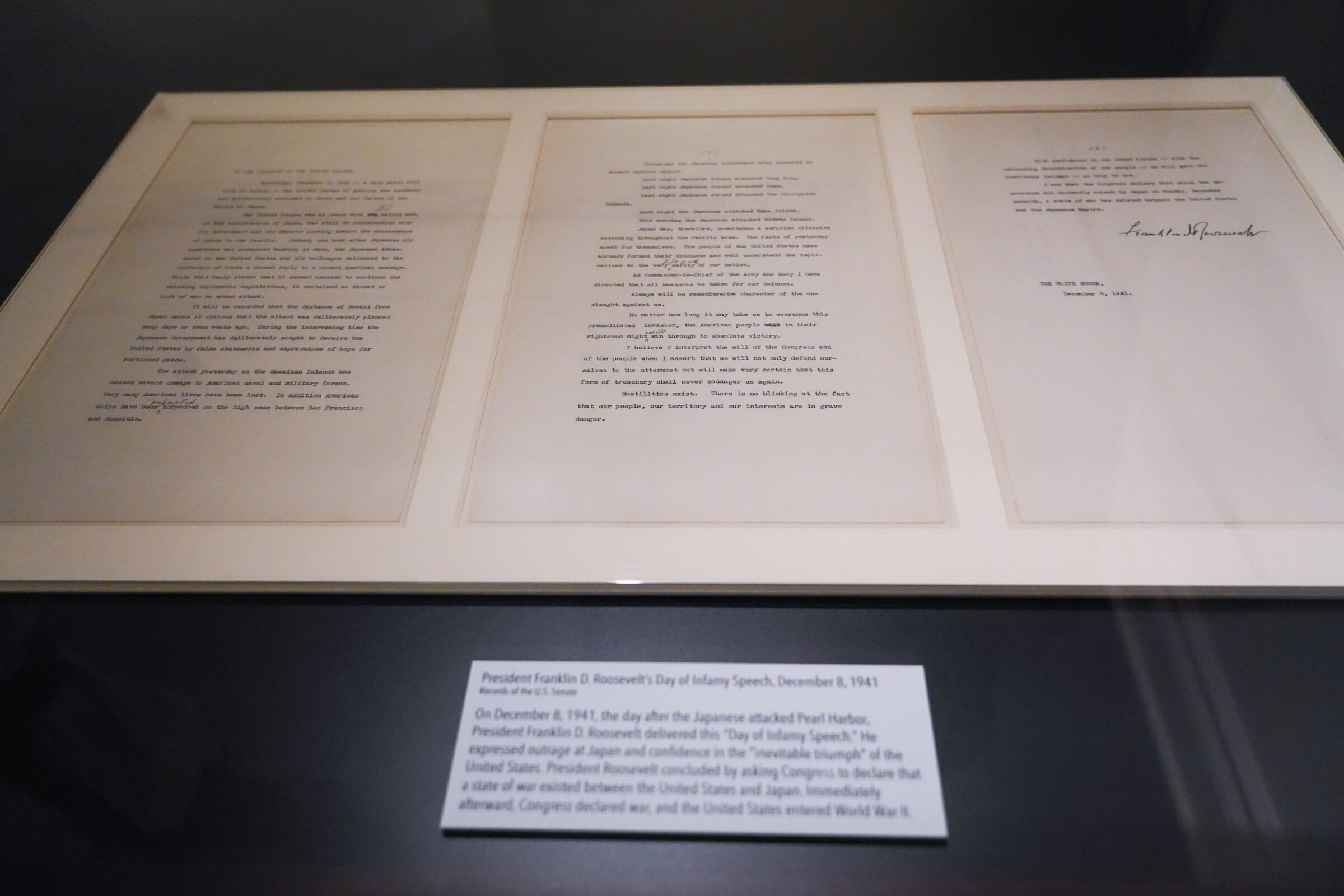
Among the exhibit’s many “wow moments” is a typescript of President Franklin Roosevelt’s “a date which will live in infamy” speech to Congress the day after the bombing of Pearl Harbor. It is fascinating not only because it is so familiar but because it contains his handwritten edits in pencil. FDR changed one reference to Japan from “the nation” to “that nation.” He inserted the word “reported” before “torpedoed.” He also changed “… the American people will in their righteous might win through to absolute victory” to “… the American people in their righteous might will win through to absolute victory,” choosing not to split the verb.
What would an exhibit about American life be without entertainment? And Elvis Presley’s fingerprints are all over this one, or at least his thumb print. The exhibit features a document of his much-celebrated induction into the U.S. Army in 1958 at Fort Chaffee, Arkansas, doing his duty like all other able-bodied men of his age. Five black thumbprints of the king’s adorn the bottom of the form.
The second installment of “The American Experiment” goes on display July 11 until Aug. 2.
Photos by Bailey Evertson