
Startup Founded at UT Pinpoints Solution to Common Landscape Challenges
MBA graduate Stephen Herrera and his childhood friend, Kevin Hartzog, are making a splash in the world of irrigation systems.
MBA graduate Stephen Herrera is no stranger to running a business. In high school, he ran a lawn company with his childhood friend, Kevin Hartzog. Now, the two are taking on a new venture –– Pinpoint Irrigation. Current irrigation systems are often expensive to install, hard to maintain, and can waste large amounts of water. Herrera and Hartzog believe Pinpoint Irrigation can solve these problems and save consumers money in the process.
During the months before he began his MBA studies, Herrera was living in Atlanta and planning an irrigation system for his own house. Hartzog was about to move to California for a job but called Herrera to see if he needed help.
“Kevin said, ‘Hey, I’ll come hang out and help you trench out some lines like the good old days,’” Herrera said. “Tells you what kind of a friend he is. It’s not fun trenching out lines.”
This planted the idea for an irrigation company in their minds, but it wasn’t until Herrera began his first semester at UT’s McCombs School of Business that the idea seemed like something they could really pursue.
“It wasn’t until midway through the fall semester of 2024 that I just saw all the resources that UT had,” Herrera said. “I saw all these opportunities and I was like, ‘Hey, I’m going to write a grant for this.’”
Their application was successful, providing them their first few hundred dollars. With a background in propulsion and turbomachinery engineering at an aerospace company, Hartzog led the effort to design their idea for the robotic sprinkler on computer-aided design (CAD).
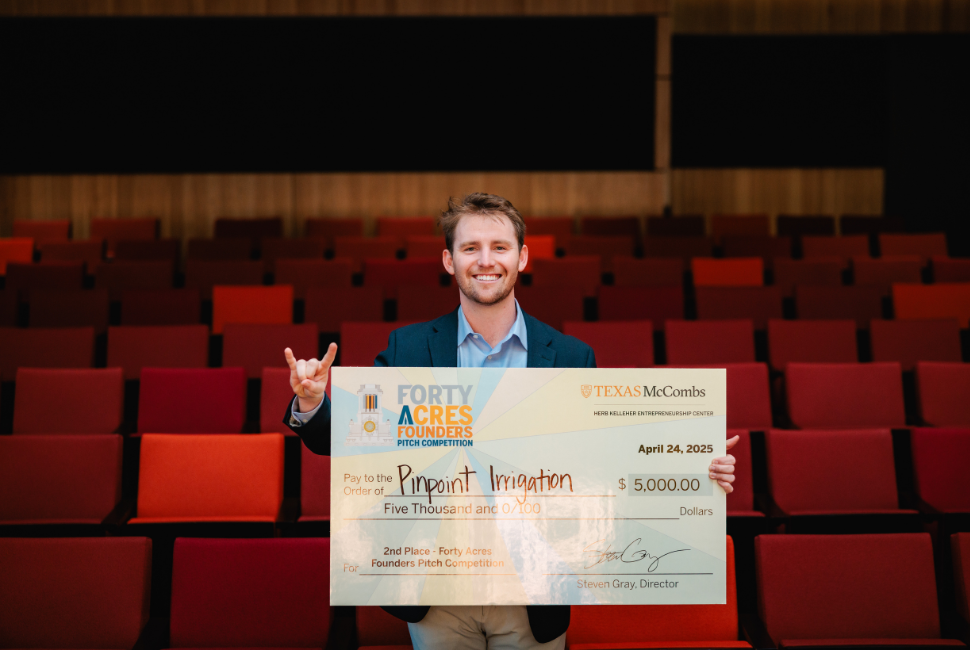
After winning a few smaller pitch competitions, the pair was accepted into Forty Acres Founders with the Herb Kelleher Entrepreneurship Center, a pre-accelerator program that allowed Herrera to dedicate an entire class during his spring semester to figuring out how to make Pinpoint Irrigation a reality.
That summer, he was also awarded a startup fellowship through the Brumley Institute for Graduate Entrepreneurship — which paid almost $10,000 to pursue the company as a summer internship — while Hartzog began working on the prototype.
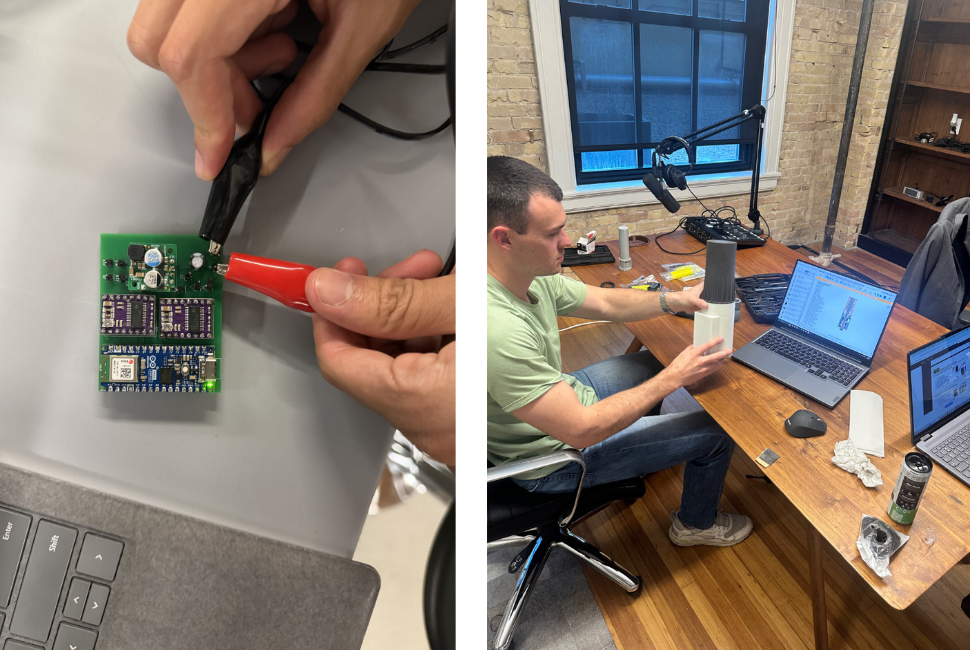
“We saw products that were out there that were kind of doing the same thing we were wanting to do, sort of like a robotic sprinkler head, and they were just really expensive,” Hartzog said. “The engineer in me gets annoyed when I see sort of a luxury technology that’s prohibitively expensive when there’s got to be a low-cost way to do it. So, it was kind of a chip-on-the-shoulder motivation to see if it was feasible or not.”
Irrigation technology is often outdated, and the industry hasn’t seen many advancements in recent years. Herrera and Hartzog’s idea for Pinpoint Irrigation looked to reimagine a system that was long overdue for innovations.
Rather than a traditional irrigation system, which has sprinklers spray in a circular pattern that often overlaps, Pinpoint works with a robotic sprinkler head that traces out an area’s boundaries and changes its spray distance as it rotates, spraying water only where it’s needed. A technologically advanced sprinkler head like theirs also allows for the introduction of sensors that can measure data, such as hyperlocal climate data about the environment they’re placed in. The sensors will also help users track issues in real time.
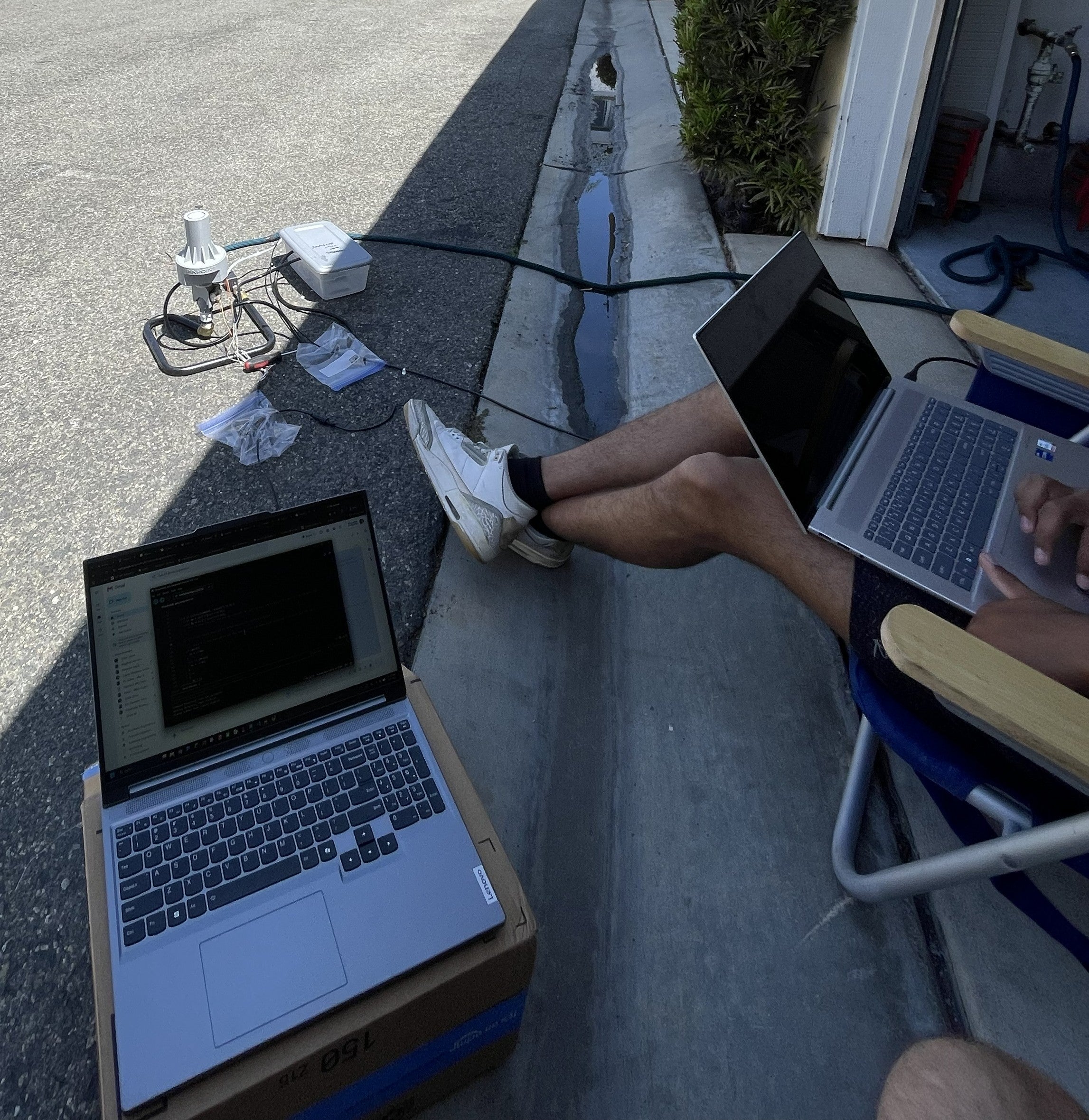
“At the commercial level, if something goes wrong –– which, with thousands of sprinklers something goes wrong once a week –– companies usually only retroactively find it,” said Herrera. “What if there’s a leak between the sprinklers? They retroactively find it while it’s just losing water. Our idea is with the sensor fusion and our sprinkler, you get precision and you get infrastructure protection.”
The two are hoping to use solutions they’ve found for irrigation to help improve larger water infrastructure issues, such as large-scale leaks. One solution is a new technology being developed at UT in the Cockrell School of Engineering. Current doctoral student Yuanjun Fan has been working in professor Michael Cullinan’s lab on a project using mechanical sound waves to transmit data –– something that would be a low-cost, durable solution for communicating underground. The technology could communicate crucial data instantaneously, like the size and location of leaks, something that’s not currently available.
“The status quo of technology cannot penetrate through solid surfaces at all,” explained Hartzog. “What’s innovative about this is that it’s using acoustic signals. Like whale cries that can travel for miles and miles –– this is a similar thing. You’re essentially screaming through a really solid, dense medium where traditional light waves can’t get through.”
The device is about the size of an AirTag and can measure metrics such as soil moisture to ensure plants and grass are getting enough water without overdoing it. The product is currently still in laboratory testing, but both Herrera and Hartzog know that’s what it means to be at the forefront of innovation.
They are currently working with UT’s research commercialization unit, Discovery to Impact to bring this exciting subsurface technology to market by developing the intellectual property behind it so that it can be licensed and further advanced with industry partners.
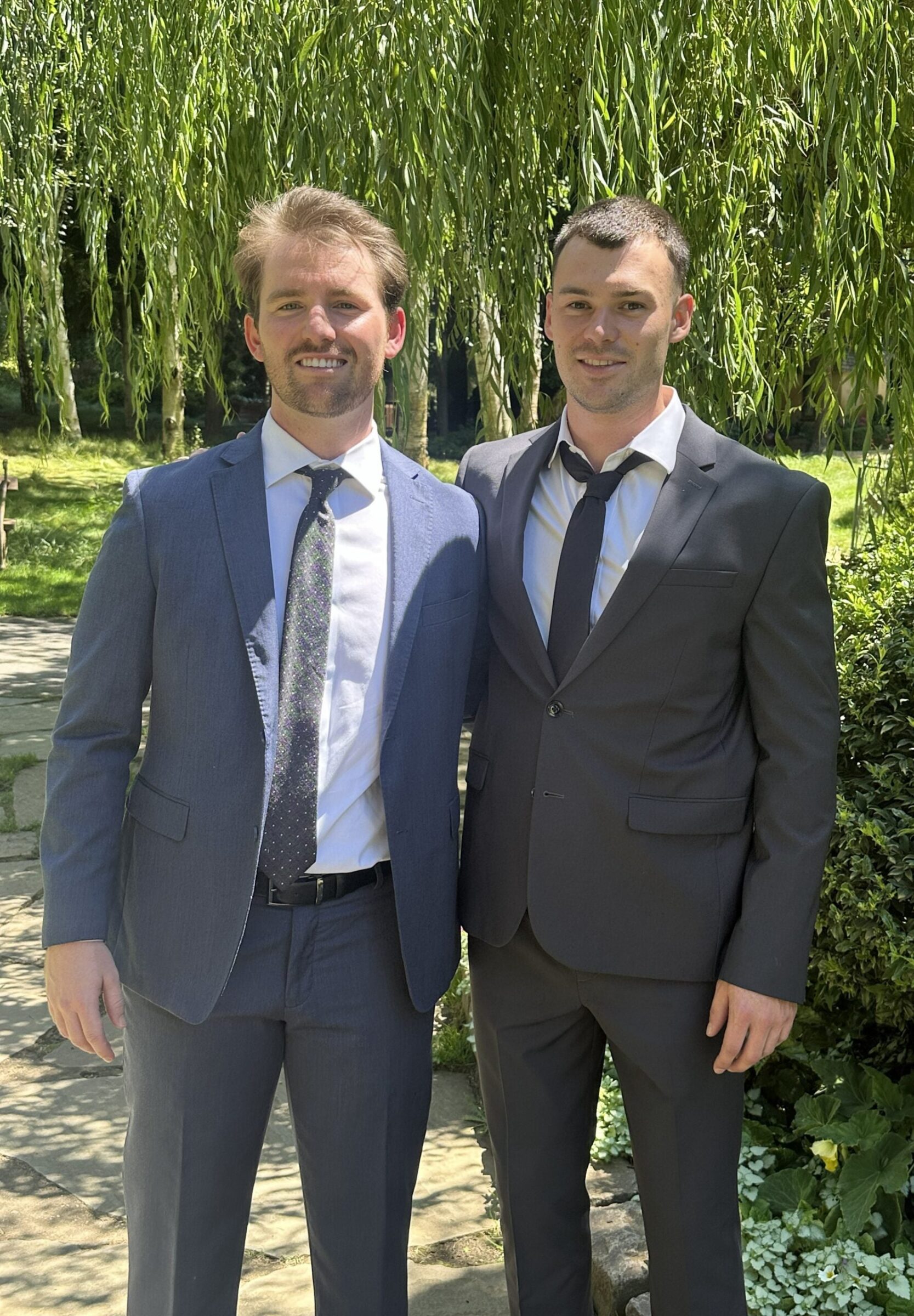
Through all of Pinpoint Irrigation’s growth during the past three years, Herrera credits the support system at UT with not just helping them feel confident enough to pursue their idea, but also for resources to get it done.
“We were, honestly, looking for reasons not to do the idea in the spring semester,” said Herrera. “We did a handful of other accelerators while at UT, always gathering more talent, really looking for any relevant resource –– all of these things were our momentum to start really building.”
As of this summer, the team has secured over 10 signed pilot commitments across Texas, including regional water authorities such as Austin Water and the San Antonio Water System (SAWS), as well as local properties including Pease Park and Waterloo Greenway.