Summer at CERN
A group of undergraduate students spent their summer at the world’s largest particle physics laboratory.
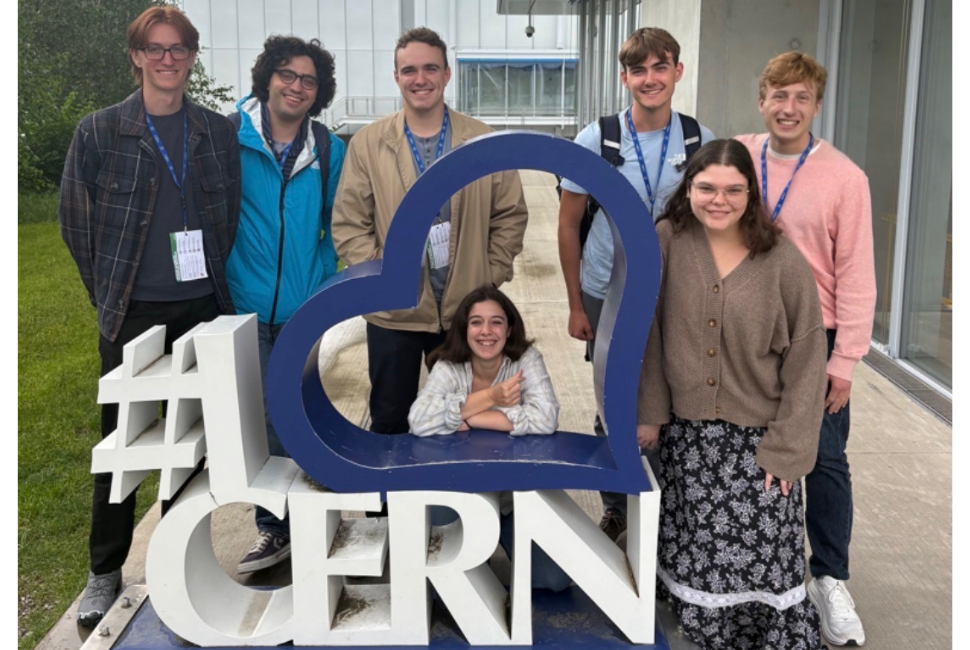
This May, students from The University of Texas at Austin made their way to Geneva, Switzerland, to study modern particle and nuclear physics at CERN and other nearby labs. CERN is the European Organization for Nuclear Research. It operates the largest particle physics laboratory in the world, which includes the Large Hadron Collider, a 17-mile ring buried underground along the Switzerland-France border that accelerates subatomic particles close to the speed of light.
Led by nuclear engineering professor Will Flanagan and physics professor Karol Lang, students were enrolled in a course with an emphasis in detector technologies that provided a survey of many of the modern particle detection techniques. The group also visited the Paul Scherrer Institut, Institut Laue-Langevin and Laboratoire Souterrain de Modane to see physics being studied firsthand.
The students had the opportunity to visit the Jungfraujoch cosmic ray observatory, which sits at almost 12,000 feet above sea level in the Swiss Alps. Although the observatory is open to the public and is a popular tourist destination, the students were able to spend the night in the same room as Nobel Prize-winning physicists, including Irène Joliot-Curie, who discovered artificial radioactivity. Before the night at the observatory, students proposed research projects using the MiniPIX detector on-site, and they conducted the experiments during the night of the visit.
“My group focused on the effects of lead shielding on the count of cosmic ray particles, which was really fun to do,” said Kushaal Singh, a rising senior and triple major in mechanical engineering, math and Plan II. “Staying up in the mountains in the observatory was quite magical and beautiful and gave us room for hands-on experimentation.”

“The visit to Jungfraujoch cosmic ray observatory was nothing less than spectacular,” said Andrew Rosen, a rising junior physics major. “Being able to spend the night on top of one of the highest points in Europe while taking data was incredible. It was a good exercise in experimental design in trying to measure cosmic rays. The view and the hike we went on with our professors are hard to describe in words.”
The course provided undergraduate students with hands-on learning and research opportunities that are usually reserved for graduate students. Many on the trip are rising sophomores or juniors who may have had little or no experience working in particle physics facilities before going on the trip.
“This is the first year that I, as an undergrad, can do something with particle physics,” said Lauren Miller, a physics major entering her third year at UT. “It’s kind of a graduate-level class, but it really gets you into the practical side of what the different parts of a particle detector look like. It’s very practical and accessible for undergrads. I can tell people like, ‘Oh, I know what a scintillator is.’ I can get the concepts.”
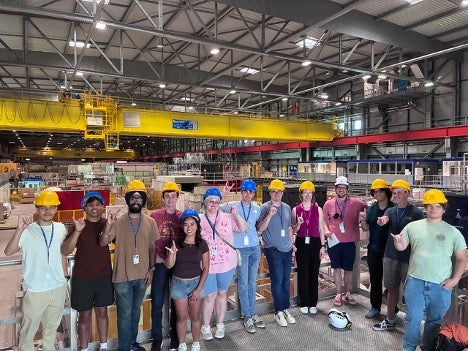
Officially titled “Modern Particle and Nuclear Physics at CERN and Nearby Labs,” the Maymester program taught both the how and why of the physics being studied at detectors and data acquisition facilities, and it provided a pathway for Longhorns early in their careers to experience firsthand the research opportunities available to them. Many participated in other internships related to particle physics at the conclusion of the program, including Rosen, who is staying in Europe to work with Flanagan at Institut Laue-Langevin.
“Simply being aware of the many different types of ongoing research is an undervalued thing to have, as it provides the starting point for collaboration and eventually new experiments,” said Rosen.