UT and UT MD Anderson Collaborate To Improve Breast Cancer Patient Outcomes
Through the TRIUMPH-IBC initiative, researchers are bringing together different disciplines to develop new treatments for patients dealing with aggressive forms of breast cancer.
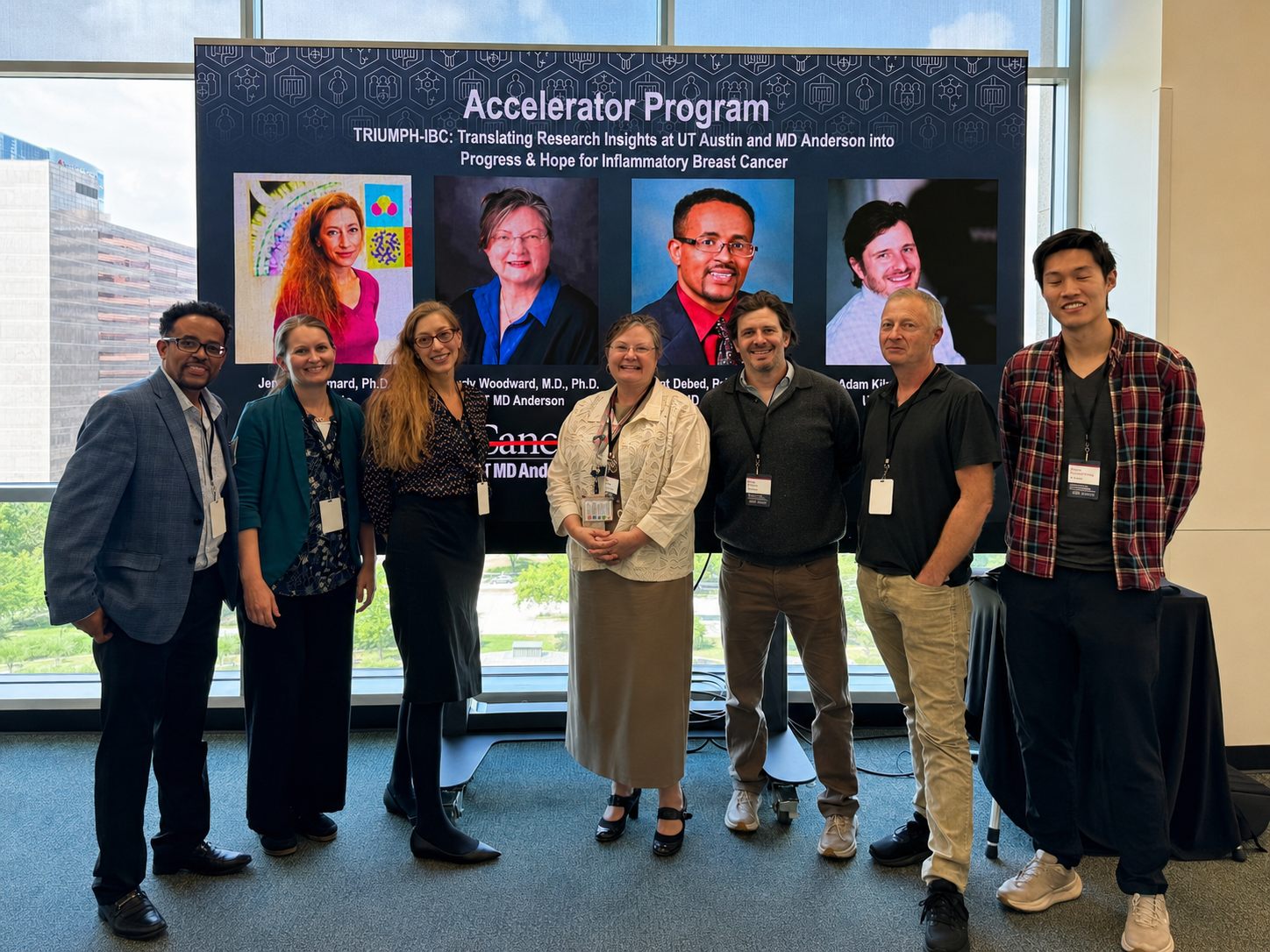
Photo courtesy of UT MD Anderson
With the support of The University of Texas at Austin and UT MD Anderson Cancer Center’s joint initiative, the Collaborative Accelerator for Transformative Research Endeavors, researchers are setting their sights on innovative cancer treatments.
One team, TRIUMPH-IBC — Translating Research Insights at UT Austin and UT MD Anderson into Progress and Hope for Inflammatory Breast Cancer — is targeting a particularly aggressive form of breast cancer that often goes undetected in many patients. Unlike other types, inflammatory breast cancer currently has no specific therapies for treatment.
About 1 in 8 women will develop breast cancer during their lives, and according to UT MD Anderson associate professor Bisrat Debeb, early detection is paramount to increasing treatment outcomes. But the problem with screening for inflammatory breast cancer, which accounts for about 1%-5% of cases, is that it often occurs without the typical breast lumps associated with the disease.
Often mistaken for mastitis, the inflammation of breast tissue that commonly occurs with breastfeeding, inflammatory breast cancer can fly under the radar before metastasizing and drastically reducing treatment options at the start. Through a collaborative, multidisciplinary approach spanning the engineering, biology and computational science fields, the team at TRIUMPH-IBC is working to improve these odds.
“Cancer is far too complex for anyone to solve alone,” Debeb said. “That is one of the strengths of TRIUMPH-IBC: Each team contributes a different piece of the therapeutic-development process.”
Researchers from the UT MD Anderson side of the collaboration include Debeb and breast radiation oncologist Wendy Woodward, who also directs the first inflammatory breast cancer-specific clinic in the world: the Morgan Welch IBC Clinic. Together, the pair work to identify targets, or specific proteins and molecules that could enable the spread or growth of cancer cells, before passing their findings to their colleagues at the University.
From there, the team at UT, which boasts experts from the Cockrell School of Engineering and the College of Natural Sciences, looks for ways to bioengineer targeted therapies that can improve patient outcomes more efficiently.
“Each part of the collaboration informs the next,” Debeb said. “The goal is not simply to make an interesting discovery and publish it, but to move the most promising discoveries toward something that could eventually make a difference for patients.”
Treating the cancer alone is not the sole focus for the TRIUMPH-IBC team. Annalee Nguyen, research assistant professor in the McKetta Department of Chemical Engineering, has seen firsthand the toll that cancer treatments such as chemotherapy can have on the body in addition to the disease itself. With her research, Nguyen said she is working toward therapies that control the spread and scope of the cancer while ensuring the patient’s quality of life as well.
“It can be hard to watch people that you love when they’re suffering, whether from disease or from the treatment,” Nguyen said. “Figuring out ways to help people stay on their therapies by making therapeutics more tolerable is one goal.”
In order to evaluate which treatments are the most promising for patients, the team has a threefold approach within their broader collaboration. As the researchers — including Nguyen, McKetta department chair Jennifer Maynard and molecular biologist Everett Stone — develop targeted solutions using proteins, UT’s Institute for Foundations of Machine Learning tests their efficacy.
Machine learning is the act of training a computer to analyze large amounts of data and make informed selections based on its pattern recognition abilities. Adam Klivans, the director of the IFML and co-director of the UT Center for Generative AI, and his team are utilizing tools in machine learning and AI to streamline the selection of therapies that ultimately make it to the clinical trial stage in research.
“Our role in this project is to use and develop the latest custom AI tools that could potentially come up with protein binders for the researchers to test out,” Klivans said. “That could eventually lead to new therapeutics for inflammatory breast cancer.”
In what many of the TRIUMPH-IBC researchers describe as an exciting time in the fields of medicine and technology with the increased presence of AI, Klivans said the application of his work in improving patient outcomes is his main motivator in the research process.
“What holds the most promise and impact is in the biological domain, where we could generate new vaccines, new therapeutics, and accelerate scientific discovery,” Klivans said. “If we can make any progress at all, it will be very rewarding.”
Studies within Debeb’s lab at UT MD Anderson have already begun identifying specific biomarkers relevant to brain metastasis including miR-141 and NDRG1, which both have the potential to either act as suppressors or players in the spread of aggressive cancers.
The foundations of TRIUMPH-IBC’s research, while focused on the treatment of inflammatory breast cancer, have broader implications in the understanding of why metastasis occurs in the brain and how cancer cells survive there. While the answers may not be immediately ready in research, Nguyen said she finds motivation in the idea that her work will one day be a part of discoveries that could make all the difference in cancer survival.
“As a person who exists in the world and has people that I love, whether they’re friends, family or colleagues, I feel like having this impact on this disease that touches so many lives is motivating in itself,” Nguyen said. “Even if I can’t quite say, ‘I personally saved all of these lives,’ I am adding to this knowledge.”
At TRIUMPH-IBC, cancer care isn’t restricted to the lab, and during Breast Cancer Awareness Month, Debeb finds that the ability to communicate scientific knowledge is an important aspect of prevention. Identifying the signs to look for in the various forms of breast cancer, he said, is just one step to increasing awareness around the disease and opening the pathways for their research work to be its most impactful.
“The progress we make belongs to this entire community,” Debeb said. “Our responsibility as researchers is to turn that collective investment and trust into discoveries that improve patients’ lives.”