
UT Establishes ‘University College’ To Anchor New Core Curriculum, Names Founding Dean
University College will guide the common learning experience for every undergraduate and maintain standards across the Core
Supporting a shared educational foundation for all undergraduate students, The University of Texas at Austin is establishing University College, which will be dedicated to stewarding and guiding the University’s new Core Curriculum.
University College will provide faculty support and institutional continuity as the new Core Curriculum is phased in, while safeguarding its standards over the long term. Built on rigorous foundational coursework, the redesigned curriculum will equip every undergraduate student with the knowledge and critical-thinking skills required for successful careers, thoughtful citizenship and purposeful lives.
Devin Stauffer, an award-winning scholar and professor of government in the College of Liberal Arts who chaired the Core Curriculum Task Force, has been appointed the inaugural dean of University College. His appointment and the new college will begin in January 2027.
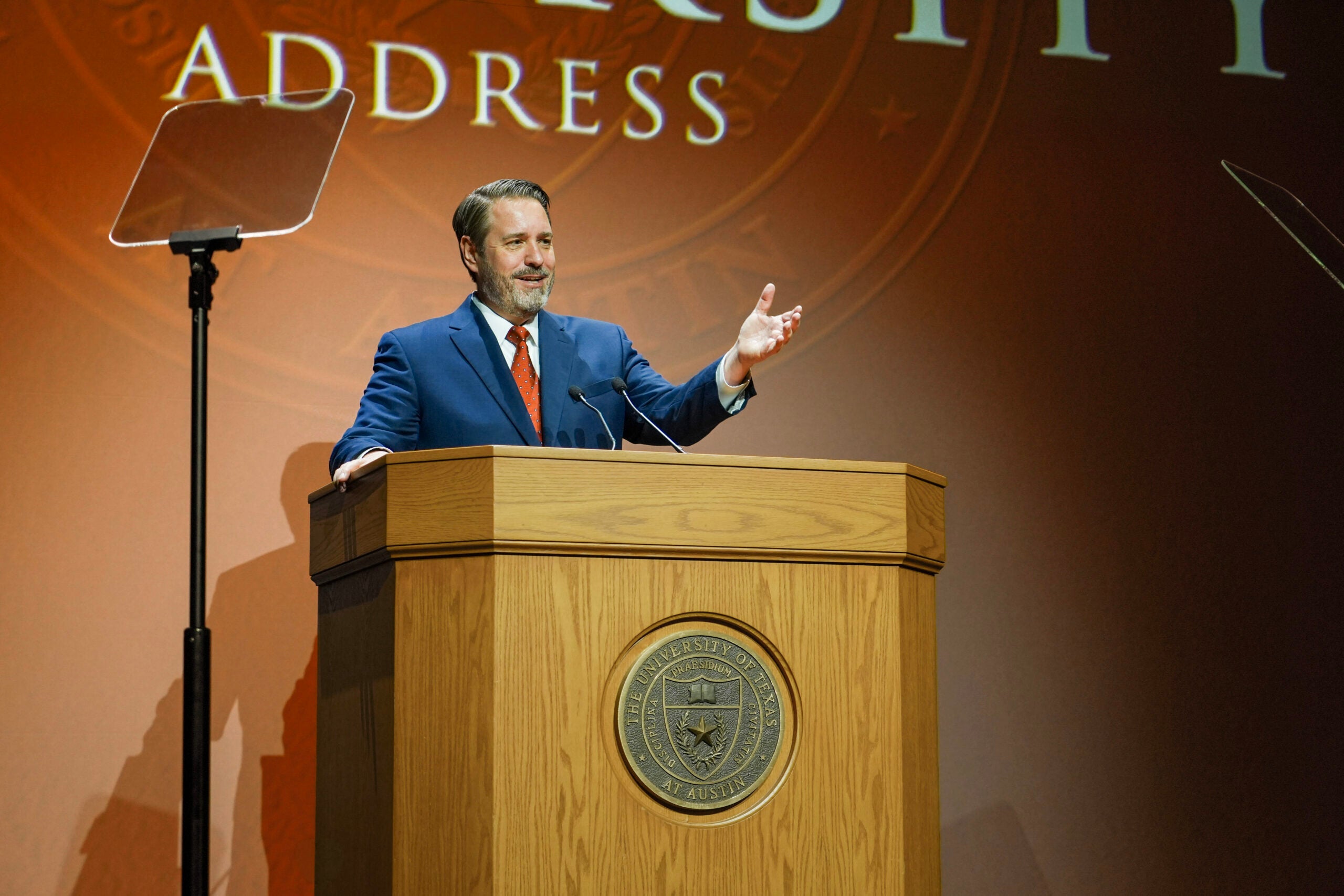
“As the guardian of the new Core, University College will work closely with faculty across our colleges and schools to ensure that the Core provides a common learning experience for our students,” said President Jim Davis during his State of the University address to campus on Wednesday. “The college will have the governance, authority and funding to deliver and sustain an outstanding Core, and I invite members of our faculty to participate.”
Under Stauffer’s leadership, University College will also convene faculty advisory committees in the core’s three key academic pillars.
As a meeting place for faculty members across disciplines, University College will build a community of scholars who, together, will help shape and sustain the quality of the new Core. The college will recruit and house faculty members through primary, joint and courtesy appointments and affiliations, and it will provide a mechanism for strategic or cluster hiring across the Core’s areas of study.
Each area of the new Core — arts and humanities, social sciences and STEM — will require the participation of many exceptional faculty members already teaching at UT colleges and schools, as well as the recruitment of new people to teach in the Core. Faculty from across the University will continue to teach in the Core and be invited to propose new or adapted Core courses. Humanities hiring initiated through the Center for Humanities — which will now be housed within University College — will continue under the new college.
University College will also house postdoctoral fellows and dedicated Core faculty members, supporting their teaching and professional development while giving the University the flexibility to meet instructional demand.
To foster intellectual community across disciplines, the college will host lectures, symposia and other programming connected to the Core.
“Every Longhorn should graduate not only with deep knowledge of a chosen field, but also with a broad understanding of our nation and world, and commitment to the virtues of citizenship,” said UT Executive Vice President and Provost William Inboden. “University College will be instrumental in delivering on that promise. Under inaugural Dean Devin Stauffer, the college will help bring faculty together in this mission while creating a shared intellectual experience that prepares our students to lead lives of purpose.”
The University announced the redesigned Core Curriculum in August, following an extensive, nearly yearlong review of UT’s undergraduate Core Curriculum, the first review in over 20 years.
Beginning last fall, the 22-member Core Curriculum Task Force, composed of faculty members from across the University, conducted the review with input from students, deans, other faculty members and respected academic leaders from other universities.
The task force found that the existing Core had ballooned to more than 1,000 courses, many with little alignment to Core requirements. It proposed a new Core built on three pillars: arts and humanities, social sciences, and STEM.
Under this new framework, all students will explore fundamental questions of human meaning and purpose, citizenship and self-governance, scientific discovery, and the opportunities and challenges of technological innovation.
“I’m proud to lead University College as we build a strong, lasting foundation for the Core Curriculum,” Stauffer said. “The college will bring faculty from across UT together to shape and steward a Core that is rigorous, broad and fundamental to the education of every undergraduate. I look forward to working with colleagues from across the University to support the Core’s continued growth and to think together about how we can best serve our students.”
UT began phasing in the new Core with the introduction of new courses this fall. The phased approach allows the University to expand teaching capacity, maintain instructional quality, and support students’ progress toward graduation.
Throughout the 2026-27 academic year, UT is engaging existing faculty members to teach classes in the new Core, hiring new people to fill gaps in teaching and assessing classes in the existing Core to determine whether they meet the new standards. The entering freshman class of Fall 2028 will be the first cohort required to complete the new Core requirements. Students who entered or will enter UT before Fall 2028 will continue to fulfill their original Core requirements.
Students will take courses in areas such as “Great Questions of Human Life,” “Masterworks of Literature,” “Western Civilization,” “World Politics and Culture,” “Principles of American Politics,” “Great Ideas in Science” and “Computer Science and AI.” Specialized electives will continue to be available, but they will no longer be eligible for the Core.
The redesigned Core also satisfies the requirements of Senate Bill 37, passed by the Texas Legislature and signed by Gov. Greg Abbott last year. UT will continue to work closely with the Texas Higher Education Coordinating Board as it considers revisions to statewide standards.
About Devin Stauffer
Devin Stauffer is a professor of government at The University of Texas at Austin whose scholarship and teaching explore classical and early modern political philosophy. His work examines enduring questions about justice, the relationship between philosophy and politics, and the foundations of modern political thought, with particular attention to Plato, Hobbes and Machiavelli. He has authored several books, and his articles have appeared in journals such as American Political Science Review and the Journal of Politics. In addition to receiving several teaching awards, Stauffer was recently recognized for his leadership with the University’s 2026 Civitatis Award for outstanding faculty citizenship.